
Ultra-Fast AI Inference at 10 GSPS Detects Particle Pile-Up in Real Time
An FPGA-based CNN localizes every particle in the spill at GSI/FAIR with 300 ns latency while processing 120 Gbit/s, even when detector pulses overlap.
www.spdevices.com
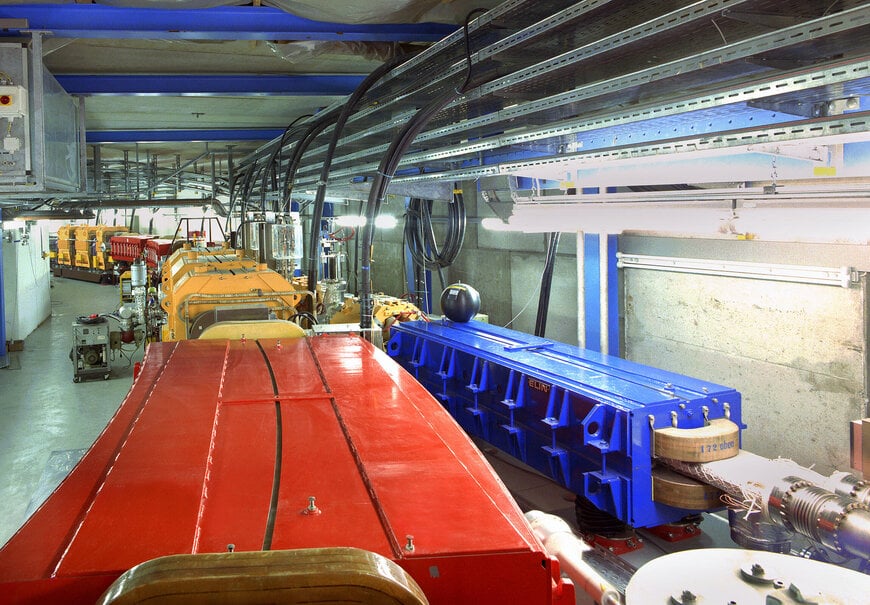
FPGA-based AI inference at 10 giga samples per second (GSPS) on the Teledyne ADQ35 enables reliable and accurate particle localization at GSI Helmholtzzentrum für Schwerionenforschung in Darmstadt, Germany, in real time, with sub-microsecond latency and sub-nanosecond time resolution, even at high particle rates with significant signal overlap. The work was conducted as doctoral research at the Fulda University of Applied Sciences together with GSI. A convolutional neural network (CNN) implemented directly on FPGA hardware processes 120 gigabits of data per second with a latency of just 300 nanoseconds.
Counting Every Particle in the Spill
Particle accelerators deliver precisely controlled particle beams for scientific experiments, materials research, and medical applications. At GSI, the SIS18 synchrotron accelerates the particles in the ring accelerator and then delivers its beam to the experiments by extracting particles from the beam, the so-called spill. For spill control, it is essential to know how many particles are in the spill and how they are distributed in time. To ensure this, each particle in the spill has to be localized in real time while the accelerator is operating, which is a major task in beam instrumentation for particle accelerators.
A detector is placed into the beam, which emits a pulse for each particle passing through it. This is illustrated in Figure 1. If multiple particles pass through the detector within a short time interval, the pulses overlap, and the detector response can become nonlinear. This event of overlapping pulses is called pile-up, and its likelihood increases with higher beam intensity. If pile-up events cannot be resolved properly, they must be avoided, limiting beam intensity.
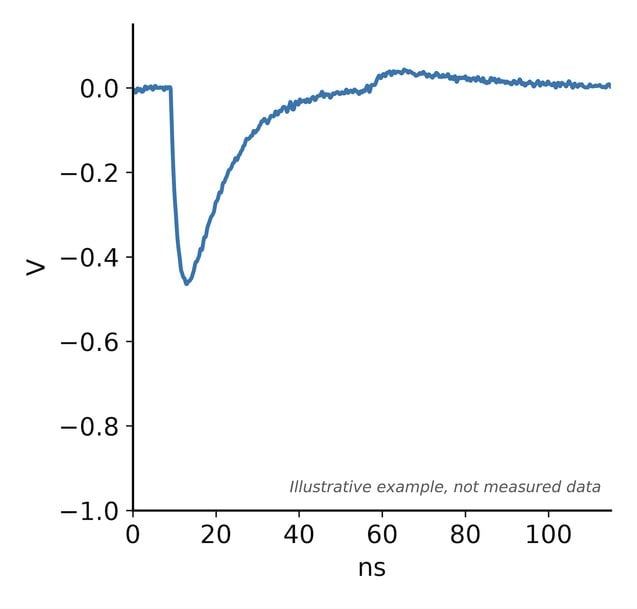
Figure 1. The pulse generated when a particle hits the detector.
Figure 2 shows four examples of this pile-up event. Each example shows the signal response when three particles arrive within a short time interval. The time of arrival for each particle is shown with a green dotted line.
Traditional methods such as multi-threshold detection or local maxima search struggle and often fail to detect particles when pile-up occurs. This leads to undercounting, which can be detrimental to spill control and downstream experiments.
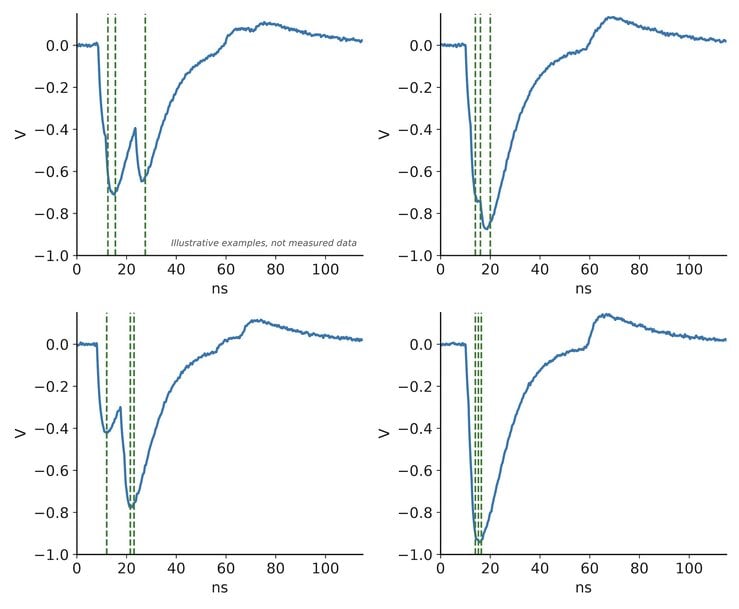
Figure 2. The detector response when multiple particles arrive within a short time interval. Three particles arrive and their pulses overlap.
AI-Based Signal Processing on FPGA
To address this challenge, a CNN was developed and trained on labeled data. It was then implemented directly on FPGA hardware using a toolchain developed by UFAIRA.
The AI model localizes each individual pulse, even when pile-up occurs, extracting both particle count and time-of-arrival information in real time. This enables accurate reconstruction of the spill even at very high rates. The CNN FPGA implementation processes the data inline and ensures deterministic latency, which is very important for real-time applications such as spill control.
Implementation on the Digitizer
The solution is realized using the Teledyne SP Devices ADQ35 high-speed digitizer, with sampling rates up to 10 GSPS and an onboard AMD Kintex UltraScale KU115 FPGA. This provides plenty of computational resources for real-time AI inference directly on the digitizer. By processing the data directly on the digitizer, the system avoids data transfer bottlenecks and enables sub-microsecond latency operation.
Using a toolchain for FPGA-optimized, hardware-aware training and implementation of the CNN in FPGA fabric, the implemented CNN can process 32 samples in parallel at 312.5 MHz, leading to 10 GSPS, with a low and deterministic latency and high accuracy.
300 ns Latency at 120 Gbit/s
The implemented CNN achieves a latency of just 300 nanoseconds, processing 120 gigabits per second (10 GSPS, with 12 bits per sample). It takes less than 15% of the available DSP and less than 6% of the available LUT resources on the FPGA, thereby leaving plenty of space for even bigger models or to target a higher throughput.
The AI-based approach significantly improves performance under pile-up conditions and outperforms traditional methods such as multi-threshold detection and local maxima search. The CNN localizes individual pulses in pile-up events with such reliability that pile-up no longer has to be avoided by reducing the particle rate. This allows the system to run at much higher particle rates without requiring changes to the detector hardware itself.
When Does AI Help in High-Speed Real-Time Data Processing?
Based on this example, AI becomes particularly relevant when multiple events occur within the same time span and produce a superimposed signal. But AI can also help when the signal processing is too complex for traditional methods, or when signal shapes vary due to real-world effects such as drift, noise, and nonlinearity. AI models can learn complex signal behavior and extract information that is difficult or impossible to recover using traditional methods in real time.
The approach demonstrated here is broadly applicable to high-speed data domains that require inline, low-latency processing, including real-time spectrum monitoring and signal classification, channel estimation in RF systems, high-frequency trading, network intrusion detection, image processing for autonomous systems, and much more.
About UFAIRA
The methods and toolchain used in this research are now the basis for UFAIRA, a company building customized FPGA-based AI accelerators for real-time inference, founded in 2026 as a spinout from the doctoral research at Fulda University of Applied Sciences.
Learn more at: https://ufaira.eu/?utm_source=mepax
About Teledyne SP Devices
Teledyne SP Devices is a pioneer in high-speed data acquisition, delivering advanced digitizers and signal processing solutions for demanding applications worldwide. With a long history of innovation, including early leadership in 10 GSPS digitizer technology, we help customers capture and process data faster, more accurately, and more efficiently.
Learn more at: https://www.spdevices.com/en-us?utm_source=mepax
