
Overview of the latest developments in the power MOSFET market
Analysis of the ten latest component announcements featured on electronique-news.com highlights significant advances in power MOSFET technology.
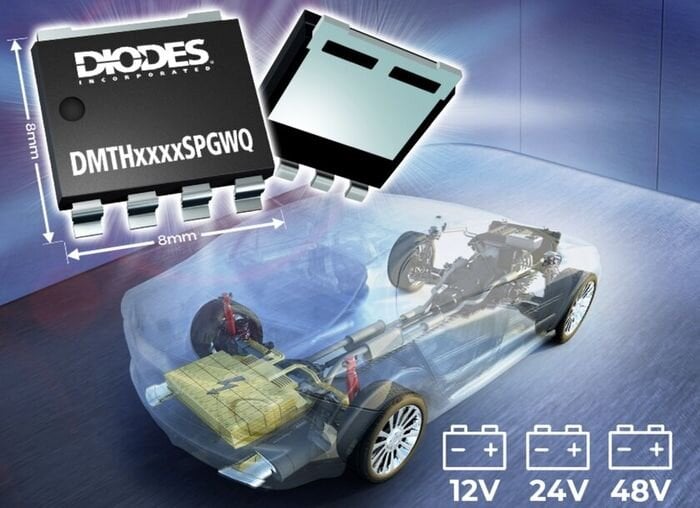
Whether based on conventional silicon or silicon carbide (SiC), manufacturers — including Toshiba, Rohm, Diodes and STMicroelectronics — are focusing their innovations on the shift towards higher-voltage automotive electrical systems, advanced packaging with very low thermal resistance, and integration into high-power-density environments.
Developments in MOSFET technology reflect the ongoing pursuit of the best possible balance between on-resistance, switching speed and compactness. While increasing power densities in space-constrained environments, such as AI data centres and automotive electrification, are driving demand for higher-performance semiconductors, innovations in packaging — including top-side cooling, copper clips and AOI-compatible designs — are playing a key role in unlocking the full potential of silicon and silicon carbide on automated manufacturing lines.
1. Transition in electrical architectures: the rise of 48 V and AI
One of the major developments is the adaptation of components to two rapidly changing markets: automotive applications and computing infrastructure.
• Automotive electrification (12 V, 24 V and 48 V): Increasing electrical requirements in vehicles, including inverters, power steering, braking systems and water pumps, are driving the adoption of 48 V electrical networks. To withstand transient voltage peaks without compromising efficiency, Rohm, Toshiba and Diodes have introduced 80 V and 100 V MOSFET ranges. Rohm's AG16xFNxx series and Diodes' DMTH10H1M7SPGWQ, for example, are designed to provide an attractive alternative to conventional 100 V devices, with particularly low RDS(on) values of down to 1.5 mΩ.
• Data centres and AI servers: The expansion of high-density computing requires high-current power distribution with low thermal dissipation. Toshiba addresses this requirement with its 80 V TPM1R408RH series, featuring a maximum RDS(on) of 1.4 mΩ. Based on the U-MOS11-H process, it delivers a 45% reduction in the figure of merit (RDS(on)×Qg), helping to minimise switching losses. Rohm, meanwhile, has made its 600 V superjunction series (R60xxXNx and R60xxWNx) available in compact surface-mount packages (DFN8080-5L and TOLL).
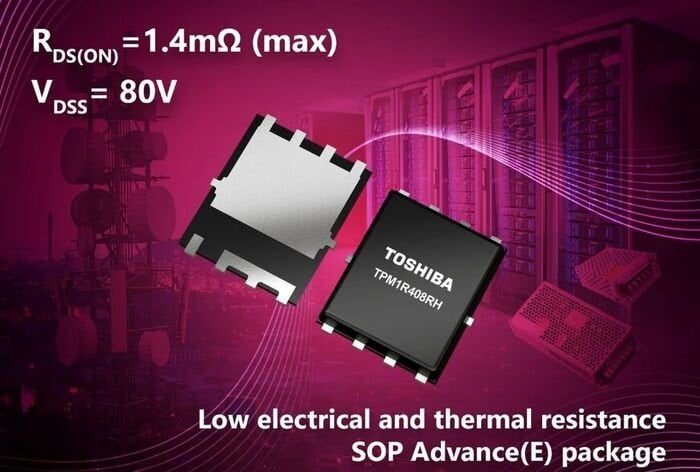
Toshiba offers the 80 V N-channel power MOSFET from the TPM1R408RH series, designed to improve the efficiency of industrial switching power supplies.
Advances in silicon die technology are being accompanied by significant progress in package geometry and architecture.
• Top-Side Cooling: For high-voltage applications of up to 1,200 V, such as 800 V traction systems in electric vehicles or photovoltaic inverters, Rohm has introduced a surface-mount SiC package with top-side cooling. This approach dissipates heat directly to an external heatsink mounted above the device, rather than through the PCB, eliminating the need for thermal vias while retaining compatibility with automated assembly lines. The package's proprietary structure provides a creepage distance of 6.66 mm.
• Copper-clip interconnect technology and leadless packages: To reduce parasitic resistance and thermal impedance, manufacturers are moving away from internal wire bonding. Toshiba, for example, has implemented packages without internal leads, such as SOP Advance EWF, connecting the die using a solid copper clip. As a result, the XPMR5904PB achieves a maximum drain current of 180 A, a 20% increase over previous generations. Diodes also uses copper-clip technology in its PowerDI8080-5 package, supporting currents of up to 847 A while reducing footprint by 40% compared with the D2PAK format.
• Automated optical inspection (AOI) and thermal-cycle resistance: The addition of gull-wing leads and wettable flanks to surface-mount devices, including series from Toshiba, Rohm and Diodes, helps absorb mechanical stresses caused by temperature fluctuations while allowing solder joints to be inspected by automated optical systems on automotive production lines.
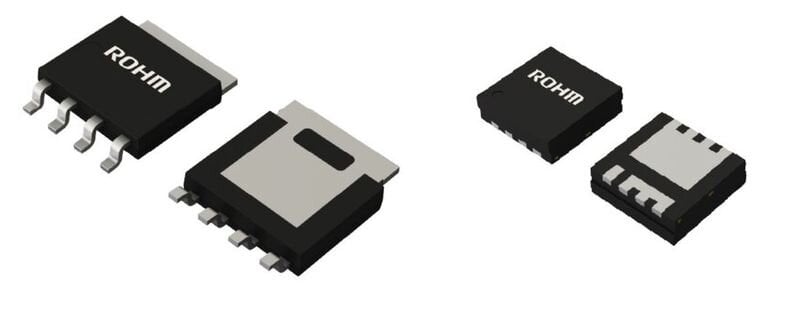
Rohm has launched the 80 V power MOSFETs in its AG16xFNxx series, specifically designed for new 48 V automotive power systems.
The drive to optimise PCB space is also encouraging greater component integration.
• Integrated complementary pairs: Toshiba has introduced a compact TSOP6F package (2.9 × 2.8 mm) incorporating both an N-channel MOSFET (46 mΩ) and a P-channel MOSFET (45 mΩ). The closely matched on-resistance values help balance thermal distribution in bridge circuits for BLDC motor control or load-switching applications.
• Ultra-low on-resistance: In power distribution units and battery management systems (BMS), STMicroelectronics highlights its STL059N4S8AG device from the Smart STripFET F8 family, which offers a typical RDS(on) of 0.59 mΩ at 40 V and supports a continuous current of 420 A in a PowerFLAT 5x6 package.
Summary of the specifications of the 10 new MOSFETs
| Manufacturer | Part number / Series | Max. voltage / current | Package / Packaging | Key feature / Main application |
|---|---|---|---|---|
| Toshiba | XPJ1R504PB | 40 V / 120 A | Dedicated package with gull-wing leads | Thermal impedance of 0.76 °C/W and RDS(on) of 1.54 mΩ for 12 V automotive applications. |
| Rohm | R60xxXNx / R60xxWNx | 600 V | DFN8080-5L & TOLL | Fast-switching superjunction technology for AI servers and industrial power supplies. |
| Toshiba | TPM1R408RH | 80 V / 288 A | SOP Advance(E) (4.9 × 6.1 mm) | U-MOS11-H process, delivering a 45% reduction in the figure of merit (RDS(on) × Qg). |
| Toshiba | SSM3/6K range | 60 V and 100 V | SOT-23F, TSOP6F, UDFN6B | Voltage headroom suited to the transition of industrial electrical networks from 24 V to 48 V. |
| Rohm | AG16xFNxx | 80 V | HPLF5060 & DFN3333 | Alternative to 100 V devices for 48 V automotive electrical systems. |
| Toshiba | XPMR5904PB | 40 V / 180 A | SOP Advance (EWF) with wettable flanks | Leadless design with direct copper-clip interconnect and AOI compatibility. |
| Rohm | TW007D120E | 1,200 V (AC max.) | Surface-mount package with Top-Side Cooling | Top-side cooling and insulation with a 6.66 mm creepage distance for 800 V systems. |
| Toshiba | SSM6L826R | N-channel (46 mΩ) / P-channel (45 mΩ) | TSOP6F (2.9 × 2.8 x 0.8 mm) | Integrated complementary pair with balanced thermal characteristics. |
| Diodes | DMTH10H1M7SPGWQ (et al.) | 40 V to 100 V / up to 847 A | PowerDI8080-5 | Copper clip and a 40% smaller footprint than D2PAK for power steering and 48 V BMS applications. |
| STMicroelectronics | STL059N4S8AG | 40 V / 420 A | PowerFLAT 5x6 | Smart STripFET F8 technology with a typical RDS(on) of 0.59 mΩ for automotive applications. |
Published by Youssef Belgnaoui, editor at Induportals.
