
electronics-journal.com
04
'26
Written on Modified on
Redefining Electrical Protection for Data Centers and Critical Infrastructure
Developments in telecommunications and artificial intelligence drive specialized power protection requirements for cloud and edge computing architectures.
www.salicru.com
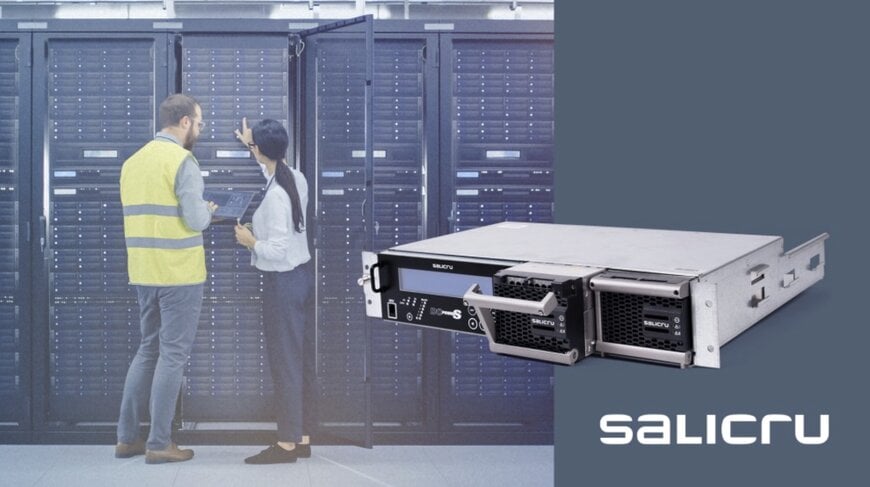
The protection of critical infrastructure is essential to maintain economic and social stability. While safety remains the primary objective, the unprecedented expansion of communication networks and data centers—accelerated by the widespread use of artificial intelligence (AI)—has necessitated advanced protection for a vast number of electronic devices.
Cloud and Edge Architectures
Data processing architectures are categorized as centralized (cloud) or distributed (edge), with selection based on data origin, required response speed, scalability, resilience, and security. While both systems rely on the alternating current (AC) electrical grid, the underlying telecommunications and data equipment operate on direct current (DC), requiring specialized AC-to-DC conversion and protection.
Power Conversion and Protection Strategies
Operators utilize two primary methods to ensure stable, continuous power and infrastructure resilience:
- Uninterruptible Power Supplies (UPS): These systems store energy in batteries and perform AC-to-DC conversion to provide clean power during grid disturbances, including outages, overvoltages, and harmonics.
- DC Power Systems: Common in telecommunications and edge environments, these systems utilize a pure DC architecture. They feature redundant, modular designs that allow for expansion based on specific operational requirements.
Critical Applications and Infrastructure Requirements
DC power systems are utilized across fixed and mobile networks, railway infrastructures, and substations. In the railway sector, these systems must offer extreme reliability and high immunity to disturbances to support signaling and control equipment. For edge data centers and substations, additional priorities include low energy consumption, modularity, and a compact physical footprint. While cloud and edge models coexist, each requires specific power supply and protection configurations tailored to their unique scale.
Additional Context
The choice between UPS and pure DC architecture is fundamentally a technical decision based on energy efficiency and system complexity. In a traditional UPS setup, power often undergoes multiple conversions (AC to DC for battery storage, then back to AC for distribution, and finally DC again at the device level), with each step incurring energy losses. Pure DC architectures minimize these "conversion penalties," making them highly efficient for edge locations where power availability and heat dissipation are critical constraints.
Technically, the "modular" nature of modern DC systems refers to hot-swappable power modules that allow for N+1 or N+N redundancy. This ensures that the failure of a single rectifier does not interrupt the DC bus supplying critical loads. Furthermore, as AI-driven data centers increase the density of electronic components, the integration of advanced monitoring modules is vital for predictive maintenance. These modules track parameters such as ripple voltage and battery impedance, allowing operators to identify potential failures before they result in a total system outage.
Edited by Romila DSilva, Induportals Editor, with AI assistance.
DC power systems are utilized across fixed and mobile networks, railway infrastructures, and substations. In the railway sector, these systems must offer extreme reliability and high immunity to disturbances to support signaling and control equipment. For edge data centers and substations, additional priorities include low energy consumption, modularity, and a compact physical footprint. While cloud and edge models coexist, each requires specific power supply and protection configurations tailored to their unique scale.
Additional Context
The choice between UPS and pure DC architecture is fundamentally a technical decision based on energy efficiency and system complexity. In a traditional UPS setup, power often undergoes multiple conversions (AC to DC for battery storage, then back to AC for distribution, and finally DC again at the device level), with each step incurring energy losses. Pure DC architectures minimize these "conversion penalties," making them highly efficient for edge locations where power availability and heat dissipation are critical constraints.
Technically, the "modular" nature of modern DC systems refers to hot-swappable power modules that allow for N+1 or N+N redundancy. This ensures that the failure of a single rectifier does not interrupt the DC bus supplying critical loads. Furthermore, as AI-driven data centers increase the density of electronic components, the integration of advanced monitoring modules is vital for predictive maintenance. These modules track parameters such as ripple voltage and battery impedance, allowing operators to identify potential failures before they result in a total system outage.
Edited by Romila DSilva, Induportals Editor, with AI assistance.
