
electronics-journal.com
25
'26
Written on Modified on
Hardware Platforms for Low-Latency Edge AI Inference
Supermicro introduces Intel-powered hardware platforms optimized for edge computing and industrial AI inference applications.
www.supermicro.com
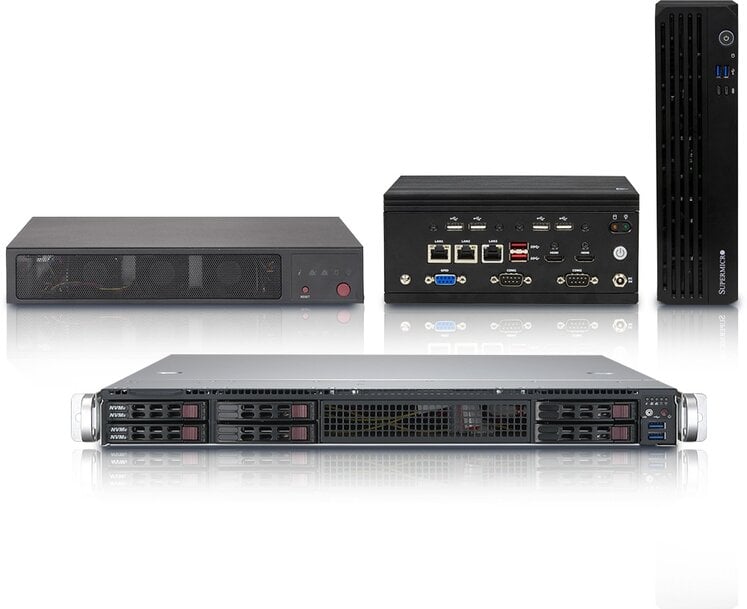
Supermicro has expanded its portfolio of edge computing systems utilizing Intel Core Ultra Series 3 and Core Series 2 processors, alongside Intel Arc Pro B-series GPUs. The hardware platforms are engineered to execute low-latency artificial intelligence (AI) inferencing and computer vision workloads across industrial, retail, and manufacturing environments by processing data close to the source of generation.
Industrial Edge and DIN-Rail Platforms
For industrial automation and physical security applications, the fanless SYS-E103-14P utilizes Intel Core Ultra Series 3 processors within a compact, DIN-rail mountable chassis. The system integrates a dedicated Neural Processing Unit (NPU) and graphics processing unit (GPU) to deliver up to 180 Tera Operations Per Second (TOPS) of AI compute performance without requiring discrete graphics cards. The hardware supports up to 128GB of DDR5 memory and is designed to operate within a thermal envelope of 0°C to 45°C. Additionally, the short-depth 1U SYS-111AD-WN2R and compact SYS-E300-13AD5 systems have been upgraded to support Intel Core Series 2 processors and expanded DDR5 memory bandwidth while maintaining existing deployment footprints.
Workstation Towers and Discrete GPU Acceleration
For localized model development and office-based edge environments, the SYS-521AD-LN2 mini tower integrates Intel Core Series 2 processors featuring up to 12 performance cores (P-cores) and up to 64GB of DDR5 memory. This system supports discrete GPU accelerators, including the newly supported Intel Arc Pro B-series. The Arc Pro B70 provides up to 367 TOPS and 32GB of VRAM for high-throughput AI pipelines, while the B60 offers 197 TOPS with multi-GPU scalability. For space-constrained deployments, the low-power B50 variant delivers up to 170 TOPS. These hardware configurations enable the real-time execution of agentic AI workloads and intensive data routing at the network edge.
Additional Context: This section details technical specifications not included in the original announcement
In edge computing architectures, processing artificial intelligence workloads locally rather than relying on centralized cloud data centers drastically reduces network latency and bandwidth costs. A critical metric for evaluating this edge inference hardware is Tera Operations Per Second (TOPS), which quantifies the maximum number of mathematical operations a chip can execute per second. To achieve high TOPS within the strict power and thermal budgets of fanless industrial computers, semiconductor manufacturers now integrate Neural Processing Units (NPUs) directly onto the CPU die. NPUs are specialized silicon accelerators highly optimized for the parallel matrix multiplication tasks inherent in neural networks. This silicon architecture allows edge systems to process computer vision and machine learning algorithms efficiently without the massive power draw and cooling requirements of a discrete, high-wattage GPU.
Edited by Lekshman Ramdas, Induportals editor – adapted by AI.
www.supermicro.com
