
How does solar radiation disrupt electronic systems and what solutions can protect them?
Here are some key points to understand this phenomenon and the solutions to implement.
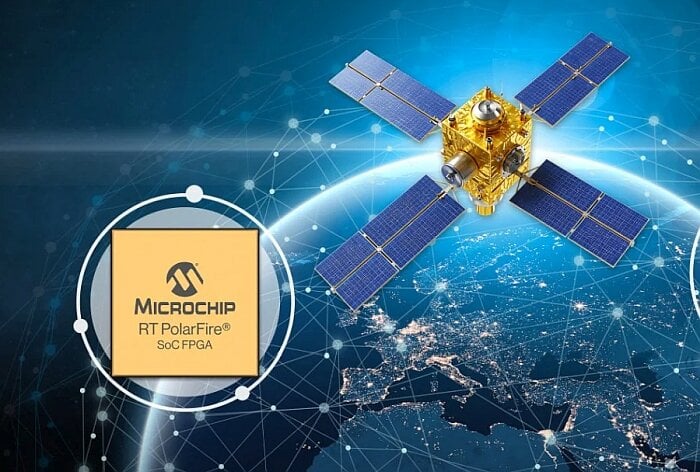
Microchip Technology notably offers the PolarFire® range of FPGAs, which stand out for their radiation tolerance.
According to Airbus, an in-depth analysis of a technical incident that occurred in late October in the United States revealed that intense solar radiation could corrupt critical flight-control data. It is a rare phenomenon, but one with potentially serious consequences.
Article written by Youssef Belgnaoui, éditor at Electronic Journal.
- What is solar radiation?
Solar radiation refers to energetic particles (protons, electrons, heavy ions) and electromagnetic waves (X-rays, ultraviolet, radio waves) emitted by the Sun, especially during solar flares or coronal mass ejections (CME). These events, linked to the magnetic activity of our star, can send streams of particles toward Earth within hours or days. Although Earth’s magnetic field and atmosphere largely protect us, electronic systems at high altitude — such as those on aircraft or satellites — are far more exposed. When solar particles interact with electronic circuits, they can cause temporary or permanent malfunctions, or even critical failures.
- What impact can solar radiation have on electronic systems?
Solar radiation affects electronic components in several ways:
- Transient effects: an energetic particle can flip a memory bit — notably in RAM or a register — leading to a software error or data corruption. This appears to be what happened in the A320 flight-control system.
- Permanent effects: a short circuit may occur within a component, making it unusable until it is rebooted or replaced.
- Progressive degradation: prolonged exposure to radiation can alter semiconductor performance, reducing their service life.
Such disturbances are particularly concerning in the aeronautics sector, where system reliability is an absolute priority.
- Which electronic components are most vulnerable to solar radiation?
Not all electronic circuits react in the same way to radiation. The most sensitive include:
- Volatile memory (RAM, registers): stored data can be instantly altered by an energetic particle.
- Microprocessors and FPGAs: their complexity makes them vulnerable to software errors or system freezes.
- Analogue-to-digital converters and sensors: solar radiation can distort digital outputs and measurements.
- CMOS-based components: the smaller the transistor geometry, the more sensitive it is to radiation.
- How can electronic systems be protected from radiation?
Several strategies exist to mitigate risks, combining hardware and software approaches:
Hardware solutions
Shielding: using absorbing materials (such as tungsten or composites) to protect critical components.
Redundancy: duplicating or triplicating essential systems — such as flight computers — to enable automatic recovery in case of failure.
Radiation-hardened (rad-hard) components: employing devices specifically designed to withstand radiation, often used in aerospace or nuclear environments.
Electrical filters and protection circuits to limit radiation-induced currents.
Software solutions
Error detection and correction: algorithms continuously verify data integrity and correct faulty bits in real time.
Software redundancy: running multiple parallel instances of the same programme to compare results.
Dynamic reconfiguration: some electronic systems (for example using FPGAs) can reconfigure their circuits if an anomaly is detected.
- Why was a simple software update sufficient in the case of the Airbus A320?
In the case of the A320, Airbus opted for a software update rather than a hardware modification for several reasons:
- Speed of deployment: a software update can be rolled out across the fleet within hours, whereas a hardware modification would require months of certification and retrofitting.
- Nature of the issue: the incident was linked to memory data corruption — a problem solvable through protection algorithms (such as cyclic redundancy checks, CRC) or revalidation protocols.
- Cost and complexity: replacing components on 6,000 aircraft would have been logistically and financially prohibitive. Software offers a way to address the vulnerability without altering hardware.
- Flexibility: a software patch can be refined or improved more easily than a hard-hardened circuit, especially if new threats (such as increased solar activity) emerge.
- The update likely introduced reinforced integrity checks for critical data, automatic recovery mechanisms if corruption is detected, and an optimisation of memory management to limit the impact of transient effects.
