
electronics-journal.com
07
'26
Written on Modified on
Micron Launches World's First Gen5 G9 QLC SSD for Client Computing
The new client SSD combines Gen5 bandwidth, high-density QLC NAND and low-power design to enable compact, AI-capable laptops with higher storage capacity and efficiency.
www.micron.com
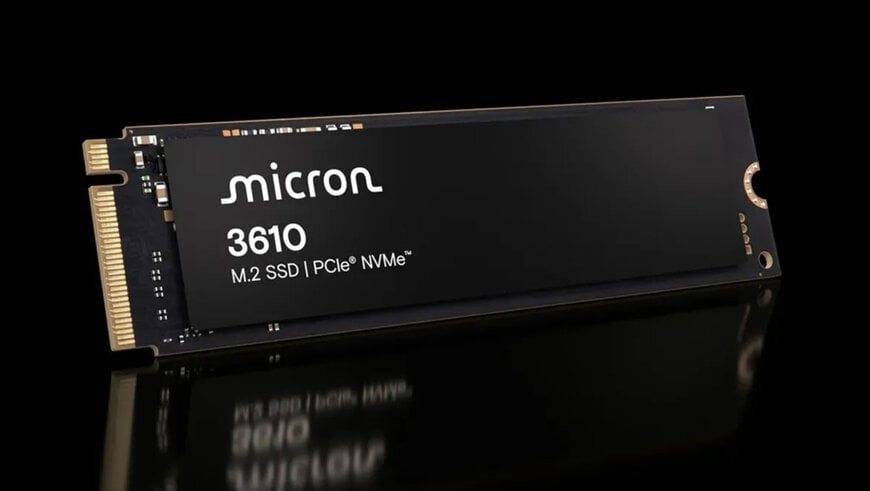
As client computing platforms evolve to support on-device AI, high-resolution media and increasingly parallel workloads, storage performance and efficiency are becoming critical system constraints. Client SSDs must now deliver higher throughput while fitting within strict power, thermal and space limits, particularly in ultra-thin designs. Micron’s latest NVMe SSD addresses these requirements by introducing PCIe Gen5 capabilities into a QLC-based client storage platform.
Gen5 performance in a compact client form factor
The Micron 3610 NVMe SSD is built on the company’s G9 QLC NAND and is the first client SSD to combine QLC flash with PCIe Gen5 bandwidth. It delivers sequential read speeds of up to 11,000 MB/s and sequential write speeds of up to 9,300 MB/s, positioning it well above typical Gen4 client drives.
Despite this performance level, the device is offered in a single-sided M.2 2230 form factor, enabling capacities of up to 4 TB within space-constrained systems such as ultra-thin laptops, handheld PCs and compact AI-capable devices. This capacity density allows system designers to increase local storage without expanding board area or relying on double-sided modules.
Power efficiency and thermal control for mobile systems
To balance Gen5 performance with mobile power constraints, the SSD uses a DRAM-less architecture supported by host memory buffer (HMB) technology. Combined with DEVSLP low-power states, this approach improves performance per watt by up to 43% compared with Gen4 TLC SSDs helping extend battery life in mobile systems.
Thermal management is handled through host-controlled mechanisms, allowing OEMs to define thermal thresholds and performance behavior based on system design. This is particularly relevant for fanless or passively cooled devices, where sustained performance must be managed without exceeding thermal envelopes.
Supporting AI and data-intensive workloads
The SSD’s throughput and latency characteristics are designed to support emerging client workloads, including on-device AI inference. According to Micron, the drive can load AI models with up to 20 billion parameters in under three seconds, reducing startup latency for local AI applications.
In addition to sequential performance, the device achieves up to 1.5 million IOPS random read and 1.6 million IOPS random write, supporting responsive multitasking, fast application launches and media-rich workflows. Benchmark testing shows up to 30% higher scores and 28% higher bandwidth compared with Gen4 QLC SSDs in PCMark® 10 workloads.
Security and platform integration considerations
The SSD integrates advanced security features, including data object exchange (DOE) and device identifier composition engine (DICE), supporting secure device identity and data protection in client platforms. These features are increasingly relevant as laptops and edge devices handle sensitive workloads and AI-generated data locally.
Positioned between Micron’s premium Gen5 4600 series and its Gen4 client offerings, the 3610 SSD expands the range of Gen5 options available to OEMs, enabling broader adoption of high-speed storage without the cost and power trade-offs typically associated with flagship solutions.
By bringing PCIe Gen5 performance, QLC economics and compact design together in a single client-focused product, the Micron 3610 SSD reflects a broader shift in client storage toward supporting AI-driven computing while maintaining efficiency, thermal stability and form-factor flexibility.
www.sg.micron.com
