
electronics-journal.com
16
'26
Written on Modified on
28V Dual-Role USB-C Power Controllers for Portable Devices
Diodes Incorporated expands USB PD 3.1 controller portfolio for managing bidirectional power in battery-powered portable equipment.
www.diodes.com
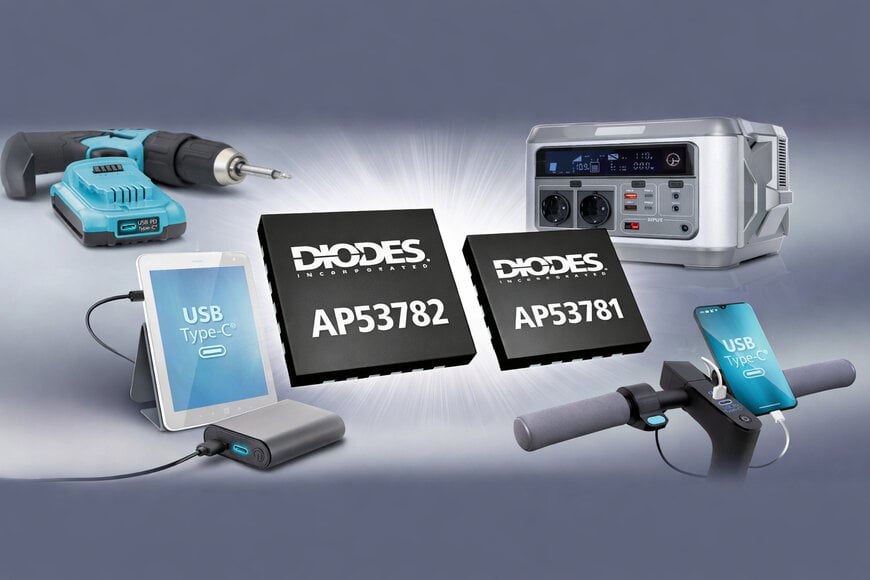
Diodes Incorporated has released two dual-role USB-C power delivery controllers designed to manage both charging and power output in portable, battery-powered systems requiring up to 140 W.
Bidirectional power management under USB PD 3.1
The newly introduced controllers address the growing need for compact devices that can both accept power from an external charger and supply power to other equipment through a single USB-C port. By supporting USB Power Delivery 3.1 with Extended Power Range (EPR), the devices operate up to 28 V on VBUS, enabling power transfer levels as high as 140 W. This capability is relevant for applications such as power banks, power tools, e-bikes, and portable displays, where higher voltage reduces current and associated conduction losses.
Both controllers function as dual-role power (DRP) devices, automatically negotiating whether the port behaves as a sink or a source. Role negotiation is handled internally through firmware compliant with the PD 3.1 specification, allowing the system to adapt to either a compliant charger or another USB-C device without manual intervention.
System protection and dead-battery operation
To maintain operability in low-energy conditions, the controllers support dead-battery mode. When the system battery is fully depleted, the device defaults to sink operation until external power is detected, allowing the system to recover without auxiliary circuitry. In addition, the configuration channel (CC) pins are tolerant up to 34 V, providing protection against accidental shorts between the CC lines and the high-voltage VBUS rail—an important safeguard in rugged or user-handled equipment.
Fixed-profile versus MCU-controlled designs
The two devices target different system architectures. One variant relies on preloaded Power Data Object (PDO) and Request Data Object (RDO) tables to select operating modes through external resistors. This approach supports eight source profiles and, in sink mode, eight fixed voltage levels combined with eight current selections. Eliminating the need for a host microcontroller reduces bill-of-materials cost and simplifies certification for designs with static power requirements.
The second variant integrates an I²C interface, enabling communication with a host MCU. This configuration allows dynamic selection of power profiles, adaptive source and sink behavior, and tighter integration with system-level power management firmware. Such flexibility is relevant for products that adjust operating modes based on load conditions, battery state, or thermal constraints.
Packaging, operating range, and availability
The controllers are offered in compact QFN packages measuring 3 mm × 3 mm and 4 mm × 4 mm, supporting space-constrained layouts common in portable electronics. Both devices are specified for junction temperatures from −40 °C to +125 °C, aligning with industrial and outdoor operating environments. Unit pricing at 1,000-piece volumes is below one US dollar, positioning the devices for cost-sensitive, high-volume designs.
Application context
By combining bidirectional power control, high-voltage tolerance, and PD 3.1 EPR compliance, the controllers support a broader transition toward standardized USB-C power interfaces in portable equipment. This consolidation reduces the need for proprietary chargers and multiple adapters while enabling higher-power operation through a single connector, a key requirement in modern portable power delivery architectures.
www.diodes.com
