
electronics-journal.com
19
'26
Written on Modified on
Automotive ESD Protection Enables High-Density PCB Design
Tier-1 automotive suppliers adopt compact chip varistors to protect communication lines while reducing PCB space and cost.
www.tdk.com
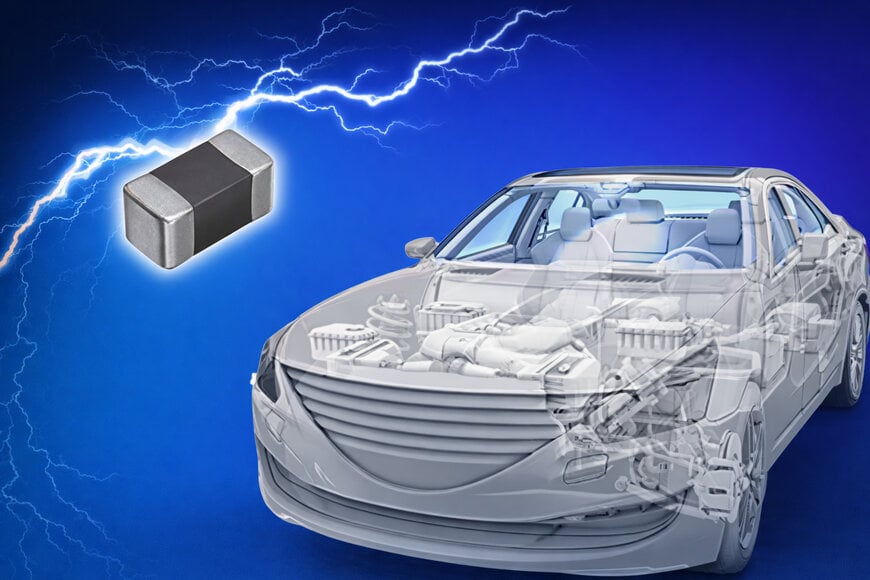
Automotive electronics manufacturers are facing rising integration levels driven by Advanced Driver Assistance Systems (ADAS), autonomous driving functions, and connected vehicle features. Modern vehicles incorporate growing numbers of cameras, radars, microphones, and communication modules, all of which increase PCB density and sensitivity to electrical disturbances.
Tier-1 suppliers must ensure long-term reliability under harsh automotive conditions while simultaneously reducing PCB footprint and overall system cost. One critical challenge is protecting high-speed communication lines from electrostatic discharge (ESD), which can compromise signal integrity and system stability.
To address these constraints, several automotive electronics manufacturers evaluated alternatives to conventional transient voltage suppression (TVS) diodes and selected chip varistors from TDK as a replacement solution.
Technical Challenge: ESD Protection Without Increasing PCB Size
Traditional TVS diodes offer fast response times and proven ESD protection but require relatively large mounting areas, limiting PCB miniaturization. As ECU designs become more compact, protection components increasingly compete with functional circuitry for space.
Manufacturers needed an ESD protection device that could:
- Withstand automotive ESD stress levels,
- Maintain signal quality on high-speed communication lines,
- Operate reliably at elevated temperatures,
- Reduce PCB area and assembly costs.
Selected Solution: Automotive-Qualified Chip Varistors
The selected solution was an automotive-qualified chip varistor series designed for ESD protection in vehicle communication applications. Unlike silicon-based TVS diodes, these chip varistors use a multilayer ceramic structure based on zinc oxide, providing high surge resistance in a significantly smaller footprint.
The solution complies with AEC-Q200 automotive qualification requirements and supports operating temperatures up to 125 °C, meeting in-vehicle reliability expectations.
Deployment and Technical Rationale
The chip varistor series was introduced to automotive communication designs in 2019, initially replacing larger 1608-size components with 1005-size versions. This transition enabled PCB miniaturization without compromising ESD robustness.
More recently, a 0603-size variant was introduced to further reduce mounting area while maintaining equivalent ESD performance. Compared with conventional TVS diodes, the 0603 chip varistor enables up to an 80 % reduction in PCB area for ESD protection components. Low capacitance characteristics also support use on high-speed signal lines.
Results: Space Savings and Cost Efficiency
By replacing TVS diodes with compact chip varistors, automotive electronics manufacturers achieved:
The selected solution was an automotive-qualified chip varistor series designed for ESD protection in vehicle communication applications. Unlike silicon-based TVS diodes, these chip varistors use a multilayer ceramic structure based on zinc oxide, providing high surge resistance in a significantly smaller footprint.
The solution complies with AEC-Q200 automotive qualification requirements and supports operating temperatures up to 125 °C, meeting in-vehicle reliability expectations.
Deployment and Technical Rationale
The chip varistor series was introduced to automotive communication designs in 2019, initially replacing larger 1608-size components with 1005-size versions. This transition enabled PCB miniaturization without compromising ESD robustness.
More recently, a 0603-size variant was introduced to further reduce mounting area while maintaining equivalent ESD performance. Compared with conventional TVS diodes, the 0603 chip varistor enables up to an 80 % reduction in PCB area for ESD protection components. Low capacitance characteristics also support use on high-speed signal lines.
Results: Space Savings and Cost Efficiency
By replacing TVS diodes with compact chip varistors, automotive electronics manufacturers achieved:
- Significant PCB area reduction, improving layout flexibility,
- Stable ESD protection up to ±25 kV (IEC 61000-4-2),
- Lower component and assembly costs due to reduced package size,
- Improved suitability for dense, multifunctional ECU designs.
The increased adoption of these components has resulted in high production volumes, with shipments projected to exceed 300 million units per month by 2025.
Applications in Series Production
The compact chip varistors are already deployed in series production for:
Applications in Series Production
The compact chip varistors are already deployed in series production for:
- Automotive microphones, where ESD protection and noise suppression support voice recognition and hands-free communication,
- Telematics ECUs, ensuring reliable data transmission in connected vehicle modules.
Adoption is expanding to space-constrained applications such as ADAS modules, infotainment systems, in-vehicle sensor networks, and control electronics for electric vehicles.
Conclusion
As automotive electronics continue to evolve toward higher integration and miniaturization, replacing TVS diodes with automotive-qualified chip varistors offers a technically viable approach to ESD protection. The solution enables reduced PCB footprint, maintains communication reliability, and supports cost-efficient, high-density electronic design in next-generation vehicles.
www.tdk.com
Conclusion
As automotive electronics continue to evolve toward higher integration and miniaturization, replacing TVS diodes with automotive-qualified chip varistors offers a technically viable approach to ESD protection. The solution enables reduced PCB footprint, maintains communication reliability, and supports cost-efficient, high-density electronic design in next-generation vehicles.
www.tdk.com
