
electronics-journal.com
28
'26
Written on Modified on
Automated Wireless Coexistence Testing for Crowded RF Environments
Keysight Technologies introduces a standards-aligned test solution to validate wireless device reliability under interference conditions.
www.keysight.com
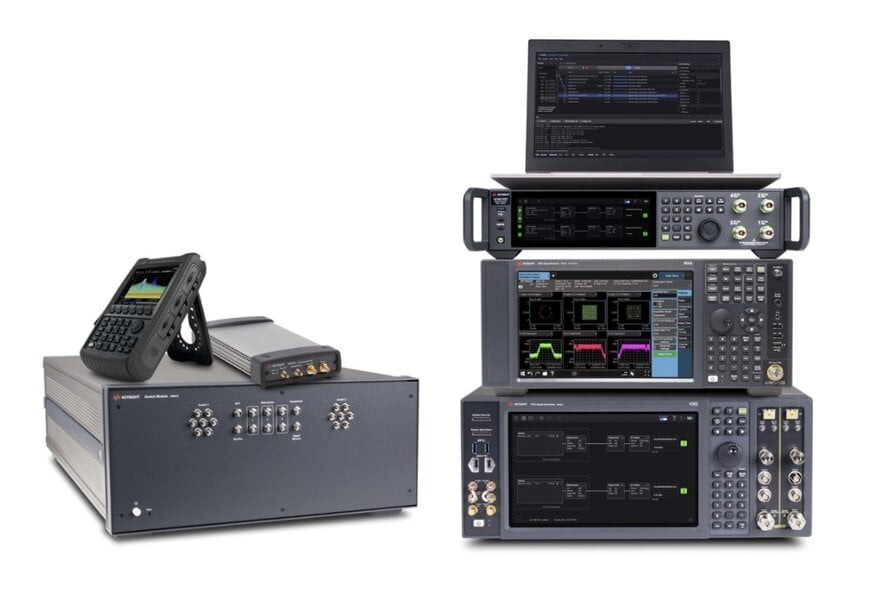
Keysight Technologies has released a new Wireless Coexistence Test Solution designed to automate and standardize validation of wireless device performance in interference-prone RF environments, supporting earlier risk detection and improved regulatory readiness.
Addressing interference in modern wireless systems
Wireless devices are increasingly deployed in dense RF environments across healthcare, consumer electronics, and industrial applications. As spectrum usage grows, devices must demonstrate reliable operation in the presence of both intentional and unintentional interference to ensure functional safety and consistent performance.
Manual wireless coexistence testing is often complex and difficult to reproduce, requiring extensive setup and expertise. These limitations can delay development and obscure interference risks until late in the design cycle. Keysight’s new solution targets this gap by automating coexistence testing workflows and aligning them with recognized industry standards.
Alignment with regulatory frameworks
In regulated sectors such as medical devices, wireless reliability is directly linked to safety and market approval. The U.S. Food and Drug Administration recommends that manufacturers assess wireless coexistence risks as part of device validation, with ANSI C63.27 cited as a recognized evaluation framework.
Keysight’s Wireless Coexistence Test Solution automates pre-compliance testing aligned with ANSI C63.27, supporting all three defined test tiers—from baseline interference assessments to complex multi-signal scenarios. This alignment enables engineering teams to identify coexistence risks earlier, reduce redesign cycles, and prepare more effectively for regulatory submissions.
Predefined scenarios and RF realism
The platform includes a built-in library of nearly 100 predefined test scenarios mapped to ANSI C63.27 requirements. These scenarios allow engineers to execute standardized tests without developing custom setups, improving repeatability and reducing configuration time.
To emulate real-world RF conditions, the solution integrates a wideband vector signal generator covering frequencies from 9 kHz to 8.5 GHz, with scalability up to 110 GHz. It supports modulation bandwidths up to 250 MHz, expandable to 2.5 GHz, and enables up to eight virtual signals on a single RF port. This configuration allows simulation of dense, multi-signal interference environments representative of operational conditions.
Open architecture and automated workflows
The solution is built on OpenTAP, an open-source, cross-platform test sequencer. This architecture provides a configurable framework accessible through a graphical user interface while allowing advanced users to upload custom waveforms and adapt test sequences as requirements evolve.
Engineers can validate test plans offline using simulation mode before executing physical tests, supporting more efficient test planning. Sequenced automation across the test flow reduces manual intervention and shortens test cycles by more than 50 percent, shifting engineering effort from setup tasks to analysis of device-under-test behavior.
Measurement focus and performance metrics
Beyond pass/fail validation, the platform supports detailed performance analysis under interference. Keysight complements the solution with consulting services to help teams define and track key performance indicators such as latency, throughput, jitter, and packet error rate (PER), tailored to specific devices and use cases.
This data-driven approach supports design decisions based on measurable coexistence performance rather than qualitative assessment alone.
Application context
The Wireless Coexistence Test Solution addresses a growing need for structured, repeatable validation as wireless devices move into safety-critical and high-density environments. By combining automated testing, standards alignment, and realistic RF emulation, the platform supports faster development cycles, improved compliance readiness, and more reliable wireless operation across diverse application domains.
www.keysight.com
