
electronics-journal.com
05
'26
Written on Modified on
embedded world 2026: hema Embedded Vision Platform Unites FPGA Real-Time Processing with GPU-Based AI
Hybrid FPGA–GPU architecture enables ultra-low-latency, AI-accelerated Embedded Vision for industrial, medical, and defence applications.
www.hema-electronic.com
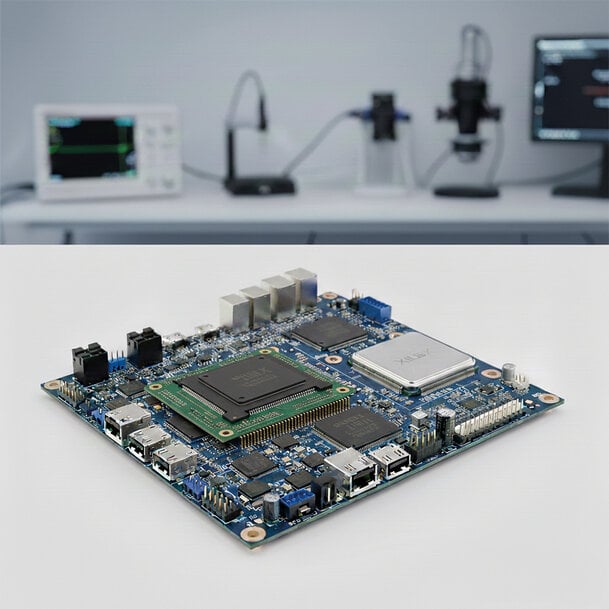
The hema Embedded Vision Platform now supports System on Modules with GPUs, TPUs, and other AI computing units, in addition to FPGA-based modules.
Image: hema electronic / AI generated
At embedded world 2026, hema electronic will showcase the latest evolution of its Embedded Vision Platform, now supporting GPU-based and AI-accelerated System-on-Modules (SoMs) alongside proven FPGA-based modules. The hybrid architecture combines deterministic real-time processing with high-performance AI computing, enabling customised electronics for signal processing, sensor fusion, and video data management in safety-critical environments.
Visitors to Hall 2, Booth 2-641 will see a live demonstrator illustrating how workloads are efficiently partitioned between FPGA and GPU resources within the modular platform. The approach allows designers to leverage FPGA strengths such as ultra-low latency and deterministic behaviour, while accelerating AI inference and complex analytics on GPUs or other AI accelerators—delivering powerful, energy-efficient systems with fast development cycles.
Modular platform, faster paths from prototype to production
The hema Embedded Vision Platform is built around a configurable toolkit of layout blocks and circuits. Engineers can select, place, and extend modules—adding proprietary or new circuitry—to create tailored systems quickly. This modularity reduces design risk, shortens time-to-market, and supports both rapid prototyping and scalable volume production.
Services for security and long-term availability
Complementing the hardware platform, hema electronic offers comprehensive lifecycle services. These include early-stage longevity and component-availability testing, proactive obsolescence management, and modular software and test environments—ensuring maximum security, scalability, and long-term supply for mission-critical electronics.
Supporting innovation and young talent
With more than 45 years of electronics manufacturing and 30+ years of Embedded Vision expertise, hema electronic will also present the 3rd hema visioneers award during embedded world. The award ceremony takes place on 12 March 2026 at 9:45 a.m., Student Day Stage, NCC Mitte (Brussels Room), recognising outstanding academic theses in Embedded Vision. Guests are warmly invited.
www.hema.com
Image: hema electronic / AI generated
At embedded world 2026, hema electronic will showcase the latest evolution of its Embedded Vision Platform, now supporting GPU-based and AI-accelerated System-on-Modules (SoMs) alongside proven FPGA-based modules. The hybrid architecture combines deterministic real-time processing with high-performance AI computing, enabling customised electronics for signal processing, sensor fusion, and video data management in safety-critical environments.
Visitors to Hall 2, Booth 2-641 will see a live demonstrator illustrating how workloads are efficiently partitioned between FPGA and GPU resources within the modular platform. The approach allows designers to leverage FPGA strengths such as ultra-low latency and deterministic behaviour, while accelerating AI inference and complex analytics on GPUs or other AI accelerators—delivering powerful, energy-efficient systems with fast development cycles.
Modular platform, faster paths from prototype to production
The hema Embedded Vision Platform is built around a configurable toolkit of layout blocks and circuits. Engineers can select, place, and extend modules—adding proprietary or new circuitry—to create tailored systems quickly. This modularity reduces design risk, shortens time-to-market, and supports both rapid prototyping and scalable volume production.
Services for security and long-term availability
Complementing the hardware platform, hema electronic offers comprehensive lifecycle services. These include early-stage longevity and component-availability testing, proactive obsolescence management, and modular software and test environments—ensuring maximum security, scalability, and long-term supply for mission-critical electronics.
Supporting innovation and young talent
With more than 45 years of electronics manufacturing and 30+ years of Embedded Vision expertise, hema electronic will also present the 3rd hema visioneers award during embedded world. The award ceremony takes place on 12 March 2026 at 9:45 a.m., Student Day Stage, NCC Mitte (Brussels Room), recognising outstanding academic theses in Embedded Vision. Guests are warmly invited.
www.hema.com
