
electronics-journal.com
05
'26
Written on Modified on
Compact Fanless Edge System for Vision Automation
Impulse Embedded introduces a compact, fanless embedded computing platform for machine vision, industrial automation, and edge AI deployments.
www.impulse-embedded.co.uk
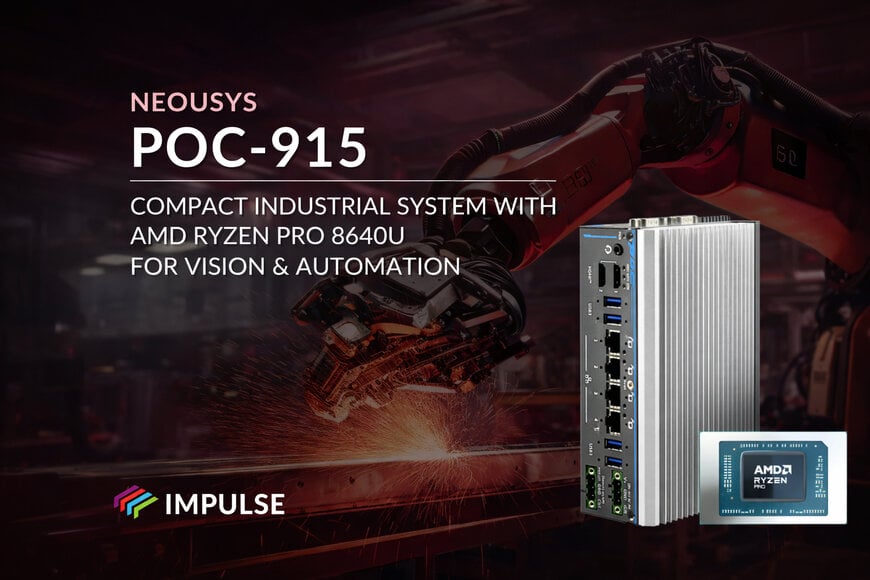
Impulse Embedded has announced the availability of the Neousys POC-915, an ultra-compact embedded system designed for continuous industrial operation in vision-centric and automation-focused environments.
Edge computing requirements in industrial environments
Industrial automation, machine vision inspection, and smart infrastructure increasingly rely on edge computing platforms that combine processing density, low maintenance requirements, and robust mechanical design. In distributed installations such as control cabinets, roadside equipment, trackside systems, and mobile infrastructure, fanless operation and compact form factors are often necessary to ensure long-term reliability and predictable thermal behavior.
The POC-915 addresses these constraints by integrating modern x86 processing with AI acceleration in a fanless enclosure intended for DIN-rail mounting. By removing active cooling components, the system reduces failure points associated with dust ingress and mechanical wear, which is critical for always-on industrial workloads.
Processing and acceleration architecture
The system is based on an AMD Ryzen PRO 8640U processor, which integrates CPU, GPU, and on-chip AI acceleration. This architecture enables local execution of vision inference, data pre-processing, and automation logic without reliance on cloud resources. AI acceleration is particularly relevant for edge use cases such as object detection, quality inspection, and event-based monitoring, where latency and bandwidth constraints limit centralized processing.
Local NVMe storage support allows high-speed data buffering and logging, which is commonly required in vision systems handling high frame-rate camera streams or in automation scenarios where traceability data must be retained locally before upstream transfer.
Connectivity and industrial integration
For deployment in camera- and sensor-heavy systems, the platform provides multi-port networking with PoE+ capability, depending on configuration. This allows direct powering and data connection of vision cameras or distributed sensors, reducing the need for external power injectors and simplifying system architecture.
Industrial I/O options, including serial interfaces and isolated digital inputs and outputs, enable direct integration with programmable logic controllers, encoders, and field devices. Expansion via mini-PCIe and modular interfaces supports additional connectivity options such as wireless communication, making the system adaptable to varied edge deployment scenarios within a digital supply chain or automotive data ecosystem.
Mechanical design and deployment scenarios
The compact enclosure is designed for DIN-rail mounting as standard, with wall-mount options available. This supports installation in confined industrial spaces where panel real estate is limited. The mechanical and thermal design is intended for continuous operation, supporting stable performance in environments where systems are expected to run unattended over extended periods.
Typical application areas include machine vision inspection stations, industrial automation control nodes, transport infrastructure systems, and smart roadside or trackside installations, where dependable operation and consistent connectivity are required.
System configuration and deployment support
Impulse Embedded provides system-level support for selecting and configuring the platform according to application-specific requirements, including processor performance, I/O configuration, storage capacity, power input, and mounting constraints. This approach is intended to reduce integration risk and ensure that deployed systems align with environmental and operational demands.
According to Stuart Martin, Business Development Manager at Impulse Embedded, the platform is positioned to support vision and automation workloads while maintaining the mechanical robustness required for industrial field deployment, particularly where compact form factors and reliable connectivity are critical.
Position within the industrial edge landscape
Within the broader industrial embedded computing market, the POC-915 aligns with a class of fanless edge systems that prioritize compact design, PoE-enabled networking, and integrated AI acceleration. Its differentiation lies in the combination of AMD-based AI processing, DIN-rail-focused mechanics, and configurable industrial I/O, which are commonly evaluated criteria when selecting platforms for vision and automation deployments.
By addressing processing, connectivity, and mechanical integration in a single platform, the system targets integrators and operators seeking to deploy scalable edge nodes without adding external compute or interface modules.
www.impulse-embedded.com
