
electronics-journal.com
25
'26
Written on Modified on
NXP Introduces 10BASE-T1S PMD Transceiver for Edge Ethernet
New automotive and industrial transceivers enable low-cost multi-drop Single Pair Ethernet for software-defined vehicle and industrial architectures.
www.nxp.com
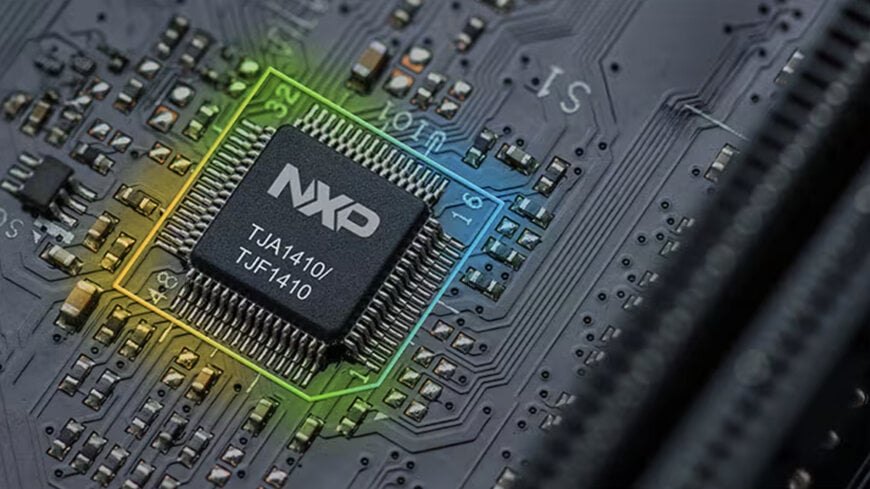
Automotive electronics, industrial automation, and building systems are transitioning toward software-defined architectures that require scalable, secure, and unified networking. With the production release of the TJA1410 (automotive) and TJF1410 (industrial), NXP Semiconductors introduces the first 10BASE-T1S Physical Medium Dependent (PMD) transceivers designed to extend Ethernet connectivity efficiently to the intelligent edge.
The new devices enable 10 Mb/s multi-drop Single Pair Ethernet (SPE), allowing OEMs to replace legacy field buses and proprietary communication protocols with a standardized Ethernet backbone while maintaining low system complexity and cost.
Extending Ethernet to the network edge
Traditional Ethernet PHYs integrate both digital and analog functions into a single device. NXP’s PMD approach separates the PHY into two parts:
- The digital portion can be integrated into the host microcontroller (MCU) or Ethernet switch.
- The PMD handles the analog transmit and receive functions on the physical medium.
This partitioning reduces pin count and silicon complexity, enabling CAN-like simplicity for 10BASE-T1S deployments. It also lowers bill of material (BOM) cost and facilitates integration in edge nodes such as sensors, actuators, and distributed controllers.
The multi-drop capability of 10BASE-T1S allows several nodes to share the same physical cable segment. Compared to point-to-point Ethernet topologies, this reduces cabling, simplifies harness design in vehicles, and eliminates the need for dedicated gateways between field buses and Ethernet networks.
Automotive: functional safety and zonal architectures
The TJA1410 targets automotive applications, particularly body, comfort, and zonal architectures in software-defined vehicles (SDV). The device complies with ISO 26262 ASIL B for functional safety relevant applications and supports Open Alliance TC10 and TC14 specifications.
Key characteristics include:
The multi-drop capability of 10BASE-T1S allows several nodes to share the same physical cable segment. Compared to point-to-point Ethernet topologies, this reduces cabling, simplifies harness design in vehicles, and eliminates the need for dedicated gateways between field buses and Ethernet networks.
Automotive: functional safety and zonal architectures
The TJA1410 targets automotive applications, particularly body, comfort, and zonal architectures in software-defined vehicles (SDV). The device complies with ISO 26262 ASIL B for functional safety relevant applications and supports Open Alliance TC10 and TC14 specifications.
Key characteristics include:
- Robust electromagnetic compatibility (EMC) performance
- Low quiescent current for improved energy efficiency
- Remote wake capability
- Compatibility with lower-cost CAN FD common mode chokes
By enabling Ethernet at the edge, the TJA1410 supports advanced functions such as AI-enabled sensor fusion and over-the-air updates, while maintaining safety requirements. When combined with NXP’s S32K5, S32N7, and S32J100 families integrating MACsec-secured 10BASE-T1S ports, the solution enables end-to-end secured Ethernet communication across zonal and central compute architectures.
Industrial and building automation: migration from legacy field buses
For industrial and building automation, the TJF1410 enables migration from legacy field buses such as Modbus or RS-485 to scalable Ethernet networks. The device supports multi-drop 10BASE-T1S networking, allowing distributed nodes to connect directly to an Ethernet backbone without protocol conversion.
The TJF1410 also supports demanding industrial environments, including applications such as building circuit breakers, and exceeds the node-count and cable-length guidelines defined in the automotive Open Alliance TC14 standard.
Combined with NXP’s MCX A microcontroller series, the TJF1410 forms a complete 10BASE-T1S system solution optimized for system cost. Future members of the MCX A family will integrate native 10BASE-T1S ports, further reducing system complexity and component count.
Cost-efficient Ethernet foundation for software-defined systems
The production availability of the TJA1410 and TJF1410 marks a significant step in deploying Ethernet connectivity beyond backbone and domain controllers down to end nodes. By delivering multi-drop Single Pair Ethernet with low footprint and simplified integration, NXP provides OEMs with a scalable path toward unified networking in automotive, industrial automation, and building systems.
The result is a networking foundation capable of supporting secure communication, software updates, distributed intelligence, and AI-enabled functions across next-generation software-defined architectures.
www.nxp.com
Industrial and building automation: migration from legacy field buses
For industrial and building automation, the TJF1410 enables migration from legacy field buses such as Modbus or RS-485 to scalable Ethernet networks. The device supports multi-drop 10BASE-T1S networking, allowing distributed nodes to connect directly to an Ethernet backbone without protocol conversion.
The TJF1410 also supports demanding industrial environments, including applications such as building circuit breakers, and exceeds the node-count and cable-length guidelines defined in the automotive Open Alliance TC14 standard.
Combined with NXP’s MCX A microcontroller series, the TJF1410 forms a complete 10BASE-T1S system solution optimized for system cost. Future members of the MCX A family will integrate native 10BASE-T1S ports, further reducing system complexity and component count.
Cost-efficient Ethernet foundation for software-defined systems
The production availability of the TJA1410 and TJF1410 marks a significant step in deploying Ethernet connectivity beyond backbone and domain controllers down to end nodes. By delivering multi-drop Single Pair Ethernet with low footprint and simplified integration, NXP provides OEMs with a scalable path toward unified networking in automotive, industrial automation, and building systems.
The result is a networking foundation capable of supporting secure communication, software updates, distributed intelligence, and AI-enabled functions across next-generation software-defined architectures.
www.nxp.com
