
electronics-journal.com
11
'26
Written on Modified on
New RF Modules Proteus-IV and Ophelia-IV for Flexible IoT Connectivity
Würth Elektronik introduces compact wireless modules based on Nordic’s nRF54L15 SoC for Bluetooth LE 6.0 and multiprotocol applications.
www.we-online.com
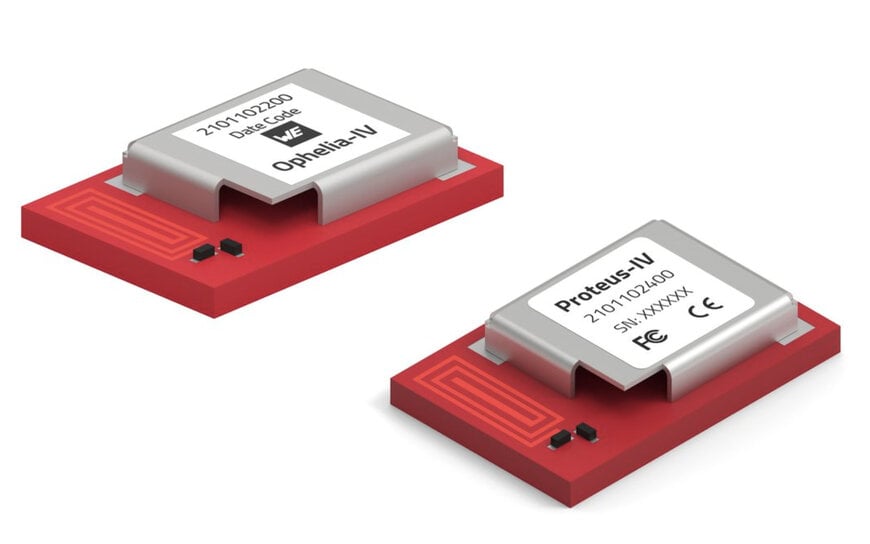
Würth Elektronik has expanded its wireless connectivity portfolio with the new Proteus-IV and Ophelia-IV RF modules, built on the latest nRF54L15 system-on-chip from Nordic Semiconductor. Both modules are designed for modern IoT and industrial connectivity applications and differ mainly in their firmware configuration.
While Proteus-IV is designed as a ready-to-use Bluetooth Low Energy 6.0 module with preinstalled firmware, Ophelia-IV provides maximum flexibility for developers. The module is delivered without firmware and enables the development of custom applications and proprietary wireless protocols using the nRF Connect SDK and the Zephyr RTOS.
Compact design with a powerful wireless platform
The modules measure only 8 × 12 × 2.3 mm and feature 1.5 MB of flash memory and 256 KB of RAM. They are based on the new nRF54L15 SoC, which integrates a 128-MHz Arm Cortex-M33 processor, a RISC-V coprocessor, and an energy-efficient 2.4-GHz multiprotocol radio.
This architecture supports a wide range of wireless standards, including Bluetooth LE 6.0, Matter, Thread, Zigbee, NFC, and IEEE 802.15.4, as well as proprietary 2.4-GHz protocols. As a result, the modules are well suited for IoT systems, smart home devices, industrial automation, and connected sensor applications.
Proteus-IV: Bluetooth module for rapid product integration
The Proteus-IV module is designed for fast integration into market-ready products. Its preinstalled firmware supports all four Bluetooth LE roles:
- Central
- Peripheral
- Broadcaster
- Observer
Bluetooth LE functionality can be controlled via a UART interface from an external host controller. Integrators can configure a range of parameters, including multiconnect capabilities, central and peripheral roles, Bluetooth security modes, UART settings, and connection parameters.
With existing radio and Bluetooth certifications, Proteus-IV helps significantly reduce development effort and shorten time-to-market.
Ophelia-IV: Development platform for custom firmware
In contrast, Ophelia-IV is designed as a flexible development platform. Developers can use Zephyr RTOS to create custom firmware and develop highly specialized connected components for IoT infrastructures.
A key advantage of both modules is their extremely low power consumption:
With existing radio and Bluetooth certifications, Proteus-IV helps significantly reduce development effort and shorten time-to-market.
Ophelia-IV: Development platform for custom firmware
In contrast, Ophelia-IV is designed as a flexible development platform. Developers can use Zephyr RTOS to create custom firmware and develop highly specialized connected components for IoT infrastructures.
A key advantage of both modules is their extremely low power consumption:
- 10.0 mA during transmission at 1 Mbps with +8 dBm output power
- 3.2 mA during reception at the same data rate
- only 0.8 µA in standby mode
This makes the modules particularly suitable for battery-powered devices and energy-efficient IoT applications.
Robust and versatile for industrial environments
The new generation of RF modules is designed for industrial use and operates reliably within a temperature range of −40 to +105 °C. Power supply is flexible, supporting voltages between 1.7 V and 3.6 V.
“Ophelia-IV is ideal for applications where standalone operation is essential, since the on-chip microcontroller can also host the end application,” explains Ravindra Singh, Product Manager Wireless Connectivity & Sensors at Würth Elektronik eiSos. “As a certified module, Proteus-IV significantly reduces development time, time-to-market, and overall device costs.”
Both modules use the WLCSP version of the Nordic chipset, enabling the extremely compact module size. This makes them particularly suitable for applications with limited installation space, such as portable devices, sensors, and compact industrial electronics.
Prepared with AI assistance and edited by an industrial journalist, Maria Brueva.
www.we-online.com
Robust and versatile for industrial environments
The new generation of RF modules is designed for industrial use and operates reliably within a temperature range of −40 to +105 °C. Power supply is flexible, supporting voltages between 1.7 V and 3.6 V.
“Ophelia-IV is ideal for applications where standalone operation is essential, since the on-chip microcontroller can also host the end application,” explains Ravindra Singh, Product Manager Wireless Connectivity & Sensors at Würth Elektronik eiSos. “As a certified module, Proteus-IV significantly reduces development time, time-to-market, and overall device costs.”
Both modules use the WLCSP version of the Nordic chipset, enabling the extremely compact module size. This makes them particularly suitable for applications with limited installation space, such as portable devices, sensors, and compact industrial electronics.
Prepared with AI assistance and edited by an industrial journalist, Maria Brueva.
www.we-online.com
