
electronics-journal.com
18
'26
Written on Modified on
Keysight Validates 800GE Ultra Ethernet for AI Clusters
Interoperability testing of LLR and CBFC link layer mechanisms ensures predictable latency and congestion control in hyperscale AI networks.
www.keysight.com
Data centers, hyperscale computing, and AI networking infrastructure are facing increasing pressure from east-west traffic and latency-sensitive workloads, prompting the need for enhanced Ethernet validation tools. Keysight Technologies, Inc. has demonstrated interoperability of Ultra Ethernet link layer technologies—Link Layer Retry (LLR) and Credit-Based Flow Control (CBFC)—at full 800 Gigabit Ethernet (800GE) line rate, in collaboration with Broadcom at OFC 2026 (Los Angeles Convention Center, Los Angeles, California, 15-19 March).
This demonstration addresses a key question for engineers designing AI clusters: how to validate next-generation Ethernet performance under real-world conditions. Traditional Ethernet architectures can struggle with congestion and tail latency in large-scale AI environments, where predictable throughput and low latency are essential for distributed training and inference workloads.
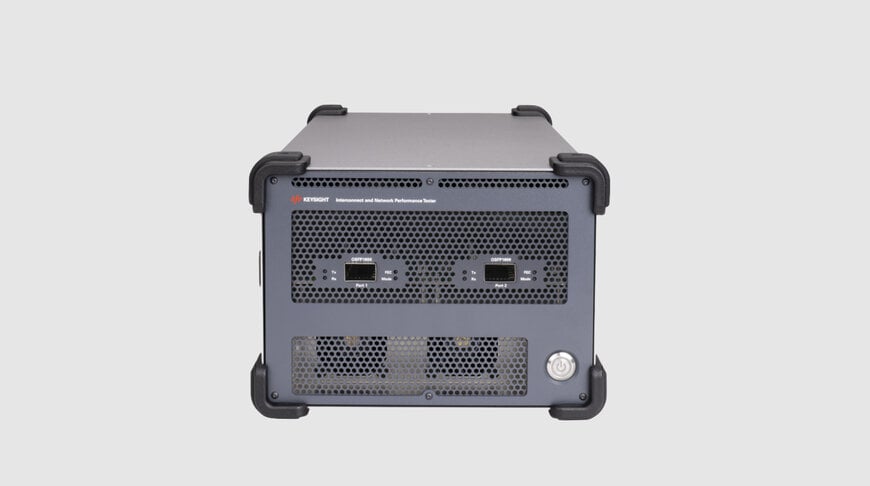
The interoperability test combined Keysight’s Interconnect and Network Performance Tester with Broadcom’s Tomahawk Ultra Ethernet switch, operating at 800GE line rate (800 Gbit/s). This setup enabled validation of two critical link layer mechanisms defined by the Ultra Ethernet Consortium (UEC) specification.
LLR introduces local retransmission of corrupted packets at the link layer, reducing the need for higher-layer recovery and limiting latency spikes. CBFC provides a credit-based mechanism to regulate data flow between devices, helping prevent buffer overflows and congestion-related packet loss. Together, these technologies contribute to more stable and predictable network behavior in AI-scale environments.
Validation of Ultra Ethernet for AI Scale-Up Networks
The demonstration reflects ongoing efforts to validate Ethernet for scale-up networking (ESUN), a framework supporting high-bandwidth, low-latency communication within AI clusters. As AI infrastructure grows, validation tools must replicate real traffic patterns and verify interoperability between components from different vendors.
Keysight’s role within the Ultra Ethernet Consortium includes contributing to validation methodologies for link layer enhancements introduced in the UEC 1.0 specification. Demonstrations such as this one provide early verification that these features can operate at full line rate without compromising performance.
Supporting Hyperscale AI Workloads
For engineers deploying AI clusters, the integration of LLR and CBFC addresses specific operational challenges. Local error recovery reduces retransmission overhead across the network, while flow control mechanisms help maintain throughput under heavy load conditions. These capabilities are particularly relevant in environments where thousands of GPUs or accelerators exchange data continuously.
The use of 800GE links reflects current trends in hyperscale data centers, where higher bandwidth is required to support model training and real-time inference. Ensuring interoperability at this speed is a prerequisite for production deployment.
Toward Production-Ready Ultra Ethernet Infrastructure
The interoperability between Keysight’s test platform and Broadcom’s switching hardware represents a step toward standardized, multi-vendor Ultra Ethernet ecosystems. Verifying compliance with UEC specifications is essential for ensuring compatibility and reducing integration risks in large-scale deployments.
While similar validation platforms exist—such as high-speed Ethernet test systems from vendors like Spirent Communications or VIAVI Solutions—this demonstration focuses specifically on Ultra Ethernet features operating at full 800GE line rate, aligning with emerging AI networking requirements.
By enabling early-stage validation of advanced Ethernet capabilities, the demonstration supports the transition from specification to deployable infrastructure for AI-optimized networks.
Edited by Industrial Journalist, Natania Lyngdoh — Adapted by AI.
www.keysight.com
