
electronics-journal.com
18
'26
Written on Modified on
The differential pressure sensor relies on high resolution
Würth has released a differential pressure sensor designed to provide calibrated measurement data for HVAC, industrial automation, and medical instruments.
www.we-online.com
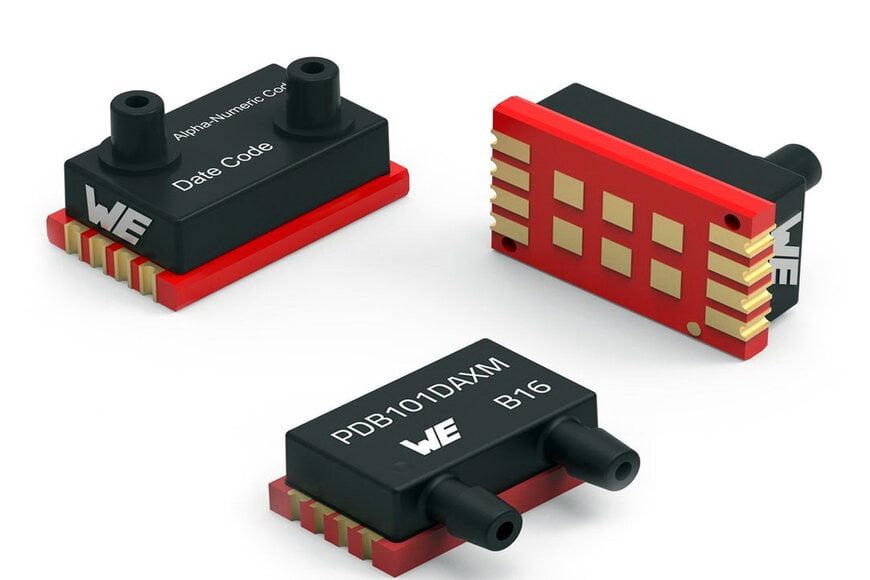
The WSEN-PDMS facilitates precise monitoring within the digital supply chain by offering an accuracy of ±1 mbar and a 16-bit resolution. To ensure compatibility with various embedded architectures, the sensor supports a supply voltage range from 3.0 V to 5.5 V. Communication is handled through digital I²C and SPI interfaces, or alternatively via an analog output.
For data integrity in electrically noisy environments, the sensor includes optional Cyclic Redundancy Check (CRC) bits. This mechanism allows the receiving microcontroller to verify the transmitted differential pressure and temperature data, ensuring robust communication for mission-critical applications.
Design Variations and Application Scope
The hardware is available in two distinct casing configurations to meet specific mechanical requirements. One variant features vertical straight nozzles for use with pressure adapters, while the other utilizes horizontal barbed nozzles for direct tube connection. These options are intended to simplify system integration and rapid prototyping in the automotive data ecosystem and general industrial sectors.
The sensor operates within a temperature range of -25°C to +85°C. Primary application areas include:
- Filter-status monitoring and gas-leak detection in industrial plants.
- Heating, ventilation, and air-conditioning (HVAC) systems.
- Medical respiratory equipment, such as inhalation devices.
Development Support and Technical Evolution
This series is an advancement of the existing WSEN-PDUS architecture, maintaining a robust design while expanding interface options. To accelerate the design-in process, Würth Elektronik provides evaluation boards and a Software Development Kit (SDK) via GitHub. These resources allow engineers to validate sensor performance and integrate the component into firmware environments without extensive manual driver development. While standard versions are available ex stock, the manufacturer also supports specification-based adjustments for specialized application requirements.
Edited by an industrial journalist, Evgeny Churilov.
www.we-online.com
This series is an advancement of the existing WSEN-PDUS architecture, maintaining a robust design while expanding interface options. To accelerate the design-in process, Würth Elektronik provides evaluation boards and a Software Development Kit (SDK) via GitHub. These resources allow engineers to validate sensor performance and integrate the component into firmware environments without extensive manual driver development. While standard versions are available ex stock, the manufacturer also supports specification-based adjustments for specialized application requirements.
Edited by an industrial journalist, Evgeny Churilov.
www.we-online.com
