
electronics-journal.com
06
'26
Written on Modified on
Automotive Flat-Wire Inductors for High-Current Power Conversion
Würth Elektronik has introduced the WE-SFIA inductor series for automotive DC/DC converters, battery systems, and high-current power electronics requiring compact thermal-efficient designs.
www.we-online.com
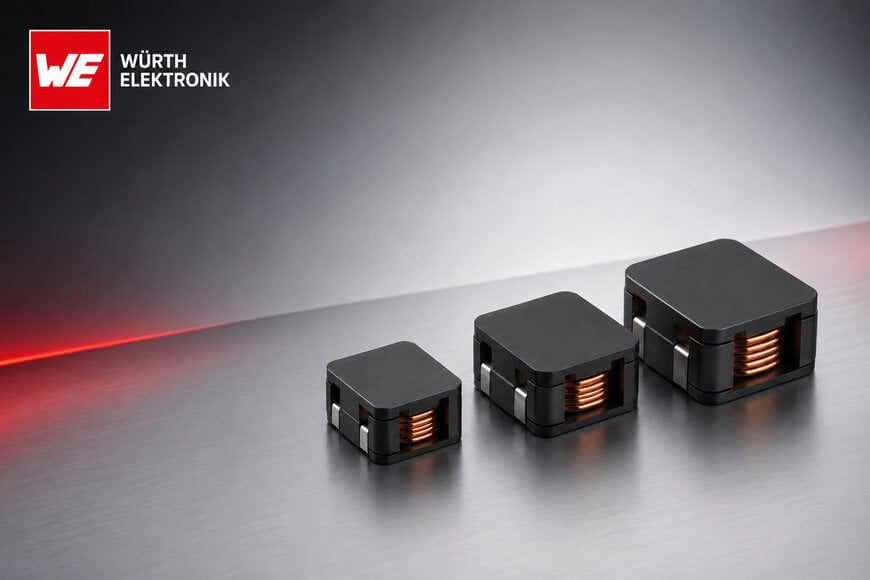
Würth Elektronik has expanded its automotive passive component portfolio with the WE-SFIA series of SMT flat-wire inductors designed for high-efficiency power conversion applications. Available in 2010, 2013, and 2016 package sizes, the inductors target automotive electronics requiring low DC resistance, high saturation current capability, and stable operation across extended temperature ranges.
The new series supports operating temperatures from -40°C to +180°C and is intended for use in high-current DC/DC converter topologies, including single-phase and multiphase buck and boost converters. According to Würth Elektronik, the inductors support saturation currents of up to 150 A, making them suitable for applications in battery management systems, motor control units, infotainment platforms, and automotive audio systems.
Flat-Wire Construction for Reduced Losses
The WE-SFIA series uses flat-wire winding technology instead of conventional round-wire construction. In power electronics, flat-wire inductors are used to improve current density and thermal performance while reducing electrical losses in compact assemblies.
Compared with round-wire designs, flat-wire windings provide a larger conductor cross-sectional area, which lowers DC resistance and improves current-carrying capability. The geometry also enables tighter and more uniform winding structures, contributing to improved thermal dissipation and mechanical robustness under automotive operating conditions.
Würth Elektronik states that the flat-wire architecture also reduces AC losses associated with high-frequency switching operation, including skin-effect-related losses. These characteristics are relevant in modern automotive power electronics, where higher switching frequencies are increasingly used to improve converter efficiency and reduce passive component size within the broader automotive data ecosystem.
Designed for High-Efficiency Automotive Power Systems
The WE-SFIA inductors are intended for high-efficiency DC/DC converters used in electric and hybrid vehicle subsystems as well as distributed vehicle electronics. High-current inductors are critical components in digital supply chain infrastructure for automotive manufacturing because they support efficient voltage regulation in advanced electronic control units and power distribution architectures.
The series covers inductance values from 0.33 µH to 4.7 µH, with additional values available through custom configurations. Würth Elektronik also indicated that the devices can be adapted to customer-specific electrical and mechanical requirements beyond the standard catalogue versions.
According to the company, optimized magnetic core materials improve saturation performance compared with conventional commercial inductor designs. Higher magnetic saturation tolerance is particularly important in transient load conditions where current spikes can degrade converter stability or efficiency.
Compact Package Options for Thermal-Constrained Designs
The inductors are offered in compact SMT package formats intended for space-constrained automotive electronics. Combining high saturation current capability with compact dimensions allows engineers to reduce board area while maintaining thermal margins and converter efficiency.
Applications include:
- High-current buck and boost converters
- Multiphase voltage regulation modules
- Battery management systems
- Motor drive electronics
- Automotive infotainment and audio systems
- Power filtering and choke applications
Würth Elektronik announced the WE-SFIA series on May 5, 2026, from Waldenburg, Germany.
Edited by an industrial journalist Sucithra Mani with AI assistance.
www.we-online.com
Edited by an industrial journalist Sucithra Mani with AI assistance.
www.we-online.com
