
electronics-journal.com
12
'26
Written on Modified on
Compact GNSS Module Targets Industrial Automation
Septentrio introduces a multi-frequency GNSS receiver designed for UAVs, robotics, and precision industrial control systems requiring low SWaP and resilient positioning.
www.septentrio.com
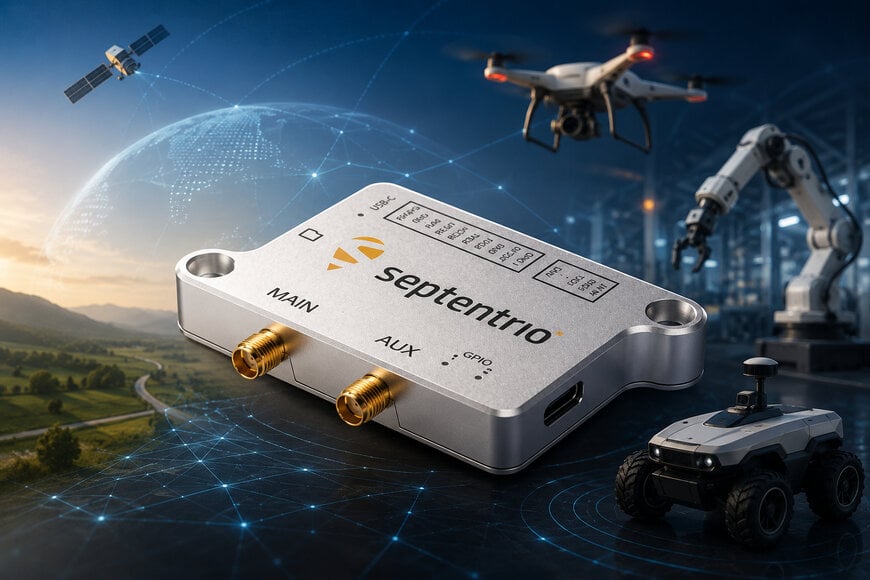
Septentrio, part of Hexagon, has released the mosaic-G5 P6, a compact multi-frequency GNSS receiver module intended for industrial automation, robotics, unmanned aerial vehicles (UAVs), and other space- and power-constrained systems. The module combines high-accuracy positioning, interference mitigation, and dual-antenna heading capabilities in a 23 mm × 16 mm package weighing 2.2 g.
The release expands Septentrio’s mosaic family of GNSS modules and addresses increasing demand for resilient positioning in autonomous and connected systems operating in complex radio-frequency environments. Applications include autonomous machinery, robotic navigation, precision guidance systems, and UAV flight control within the broader digital supply chain and industrial automation sectors.
Multi-constellation positioning and interference mitigation
The mosaic-G5 P6 supports multiple satellite constellations, including GPS, Galileo, GLONASS, BeiDou, QZSS, and NavIC. Multi-frequency reception improves positioning reliability and signal availability in environments affected by signal blockage, multipath interference, or degraded satellite visibility. The receiver is also compatible with Galileo High Accuracy Service (HAS), enabling decimetre-level positioning without requiring additional correction infrastructure.
According to Septentrio, the module integrates AIM+ interference mitigation technology designed to protect against GNSS jamming and spoofing. Jamming occurs when radio-frequency interference overwhelms GNSS signals, reducing positioning accuracy or causing signal loss. Spoofing involves transmission of counterfeit satellite signals intended to manipulate receiver coordinates. The integrated mitigation system is intended to maintain positioning continuity in industrial and autonomous applications where navigation reliability is safety-critical.
Sensor fusion and motion-control integration
The receiver provides high update rates and low-latency positioning output intended for real-time motion control and navigation. Septentrio also states that raw GNSS measurements are accessible for sensor-fusion workflows, enabling integration with inertial measurement units (IMUs), LiDAR, cameras, or other sensors used in robotic and autonomous systems. This capability supports advanced localisation and navigation algorithms commonly used in automotive data ecosystem development and industrial robotics.
The module supports both single- and dual-antenna configurations. Dual-antenna operation enables direct GNSS-based heading calculation without relying solely on vehicle motion, which is particularly relevant for low-speed autonomous machinery, robotic platforms, and precision alignment systems.
Open-source compatibility and evaluation platform
Septentrio states that the mosaic-G5 P6 is compatible with widely used open-source software frameworks and autopilot systems, including PX4, ArduPilot, and ROS. Compatibility with these platforms simplifies integration into existing robotic and drone architectures and reduces development effort for embedded navigation systems.
To support prototyping and system validation, Septentrio also introduced the mosaic-go G5 P6 evaluation kit. The kit includes direct autopilot connectivity and support through the company’s RxTools configuration and evaluation software.
Septentrio presented the module during the Xponential trade show held in Detroit, United States, from May 11 to 14, 2026.
Edited by an industrial journalist Sucithra Mani with AI assistance.
www.septentrio.com
