
electronics-journal.com
19
'26
Written on Modified on
Ethernet Interface Board With Dual-Core Processing and Hardware Networking
MIKROE integrates the W55RP20 system-in-package to provide embedded networking and processing capabilities for industrial automation and internet of things gateways.
www.mikroe.com
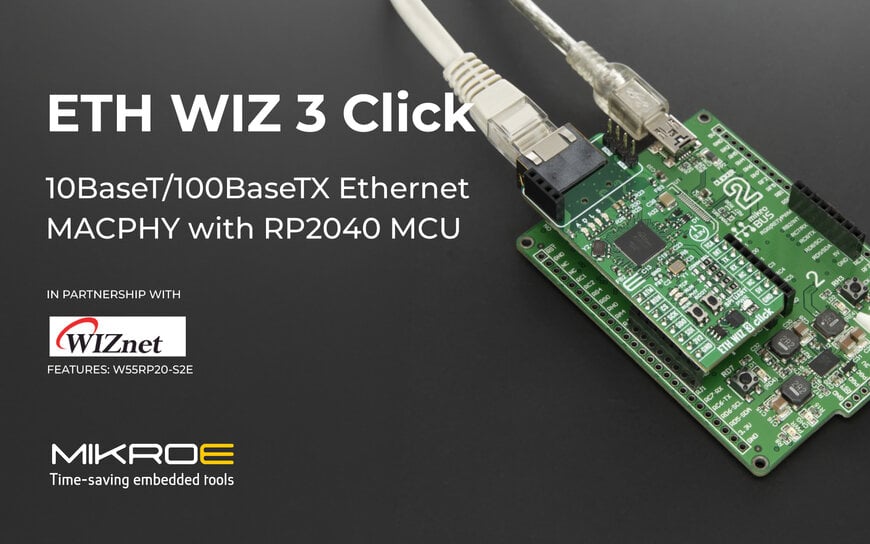
The integration of networking capacity with onboard data processing allows engineers to implement Ethernet connectivity directly into embedded systems. The interface board provides deterministic hardware-based networking for Internet of Things (IoT) gateways, industrial automation environments, network-enabled controllers, and smart devices requiring continuous data transmission and edge processing.
System Architecture and Microcontroller Integration
At the core of the module is the W55RP20 System-in-Package (SiP) developed by WIZnet. This component merges the W5500 Ethernet controller with the RP2040 dual-core microcontroller architecture. The processing element features a dual Arm Cortex-M0+ processor operating at frequencies up to 133 MHz, supported by on-chip static random-access memory (SRAM) and Flash memory. This dual-core architecture permits the concurrent execution of primary application code and auxiliary network management tasks.
Hardware TCP/IP Stack Offloading
The integrated Ethernet controller operates using a hardwired TCP/IP stack. By processing network protocols at the hardware level, the system offloads transmission overhead from the main processor. This method reduces latency and reserves computational resources for primary application logic. The module includes an integrated Ethernet Physical Layer (PHY). For physical deployment diagnostics, status light-emitting diodes (LEDs) relay link state information and indicate Transmission Control Protocol (TCP) activity.
Interface Options and Hardware Expansion
Connectivity between the module and the host system relies on selectable Serial Peripheral Interface (SPI) or Universal Asynchronous Receiver-Transmitter (UART) communication paths, configured through a designated hardware jumper. The board features a Universal Serial Bus (USB) Type-C interface driven by the internal USB 2.0 controller of the RP2040 processor. The physical layout incorporates exposed Ethernet magnetics center taps, allowing engineers to implement optional Power over Ethernet (PoE) functionality. Accessible debugging test points are integrated directly into the printed circuit board to support signal verification.
Ecosystem Compatibility and System Diagnostics
The interface module operates within the mikroBUS socket standard. It features an automatic identification mechanism that allows compatible host systems to read the hardware configuration upon connection. MIKROE chief executive officer Nebojsa Matic indicated that the module serves IoT gateways, industrial automation systems, and embedded hardware requiring direct Ethernet integration. The hardware utilizes open-source software libraries that supply the necessary operational drivers for system programming and network configuration.
Additional Context: This section details technical specifications and competitive benchmarking not included in the original product announcement.
The implementation of the WIZnet W55RP20 System-in-Package significantly reduces printed circuit board footprint compared to utilizing a discrete RP2040 microcontroller alongside a separate W5500 Ethernet controller. The hardware TCP/IP mechanism supports up to eight independent network sockets simultaneously and relies on 32 kilobytes of internal memory dedicated strictly to transmission and reception buffers. Compared to software-based TCP/IP stacks, such as lwIP running on standard microcontrollers, a hardwired stack isolates network handling from the central processing unit. This structural isolation prevents network congestion or denial-of-service vectors from depleting operational memory and stalling the main application loops. Competing discrete solutions often function strictly as media access controllers and physical layer transceivers (MAC/PHY), forcing the host microcontroller to process all network protocols via software. By coupling the network controller with dual Cortex-M0+ cores, the SiP allows developers to allocate one core to continuous industrial sensor polling while the second core handles data packetization and cloud server interfacing.
Edited by an industrial journalist, Lekshman Ramdas, with AI assistance.
www.mikroe.com
