
electronics-journal.com
30
'26
Written on Modified on
Integrated Optical Wireless Quantum Key Distribution Security Stack
Fraunhofer IPMS and partners have developed a wireless quantum-secure communication system combining light fidelity and quantum key distribution for critical infrastructure.
www.fraunhofer.de

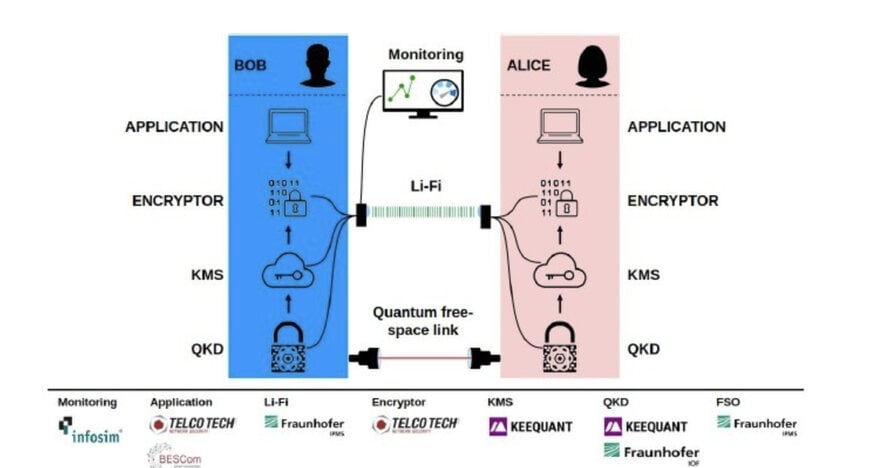
A research consortium has demonstrated an integrated optical-wireless quantum security stack that combines free-space continuous-variable and discrete-variable quantum key distribution with light fidelity technology. This system enables wireless, quantum-secure key distribution over line-of-sight links for critical civil infrastructure, including maritime connectivity, aviation, and the automotive data ecosystem.
Hybrid Optical Quantum Integration and Spectral Separation
The technical architecture integrates multiple optical wireless technologies into a shared free-space environment to eliminate the dependency on dedicated fiber networks. The system operates simultaneously by utilizing precise wavelength separation and optical filtering. Continuous-variable quantum key distribution is executed at fifteen hundred and fifty nanometers, while discrete-variable quantum key distribution operates at eight hundred and ten nanometers. Concurrently, the light fidelity system functions within the eight hundred and fifty to nine hundred and forty nanometer range. This spectral isolation allows the classical data communication channel and both quantum channels to coexist without mutual signal degradation, ensuring secure data transport across the digital supply chain.
Alignment Control and Operational Workflow Integration
A significant simplification in the communication architecture is achieved by routing the quantum key distribution post-processing data directly over the light fidelity link. This eliminates the necessity for a secondary, dedicated classical communication channel, relying instead on the light fidelity connection as the sole medium for classical data exchange. To maintain optical alignment over free-space distances, the system incorporates a specialized pointing, acquisition, and tracking subsystem. This tracking unit leverages the endpoint identification and localization capabilities of the light fidelity system, which provides a continuous feedback loop to establish and preserve the optical alignment required for the quantum channels.
Distribution of Responsibilities Within the Consortium
The development was executed by a collaborative consortium consisting of six specialized partners. KEEQuant managed the overall project coordination, continuous-variable quantum key distribution, and key management integration. The Fraunhofer Institute for Photonic Microsystems IPMS designed the optical transmitter and receiver hardware, the pointing mechanics, and the light fidelity integration, drawing on fifteen years of optoelectronic engineering experience. The Fraunhofer Institute for Applied Optics and Precision Engineering IOF provided the discrete-variable quantum key distribution components. Network management and monitoring systems integration were developed by Infosim, while TELCO TECH handled encryption integration, and BESCom managed the transition of use cases and technical dissemination.
Additional Context: This section details technical specifications and competitive benchmarking not included in the original product announcement
The transition from fiber-based quantum key distribution to free-space optical links represents a critical evolution in mobile security applications and flexible network topographies. Traditional quantum networks depend on dedicated dark fiber infrastructure, which incurs high deployment costs and limits secure transmission to fixed, physical endpoints. By combining continuous-variable and discrete-variable methods with light fidelity, this hybrid wireless approach addresses the critical bottleneck of endpoint mobility and rapid deployment in modern communications.
When benchmarked against standard radio-frequency-based wireless security, optical wireless communication via light fidelity offers inherent physical security advantages. Radio signals are subject to interception, eavesdropping, and electronic jamming outside the secure perimeter. In contrast, line-of-sight optical signals are confined to a narrow physical beam, meaning any attempt to intercept or block the transmission physically interrupts the link and immediately alerts the network monitoring systems. Furthermore, light fidelity avoids the regulatory frequency allocations and radio interference challenges typical of crowded industrial or corporate environments.
In the competitive landscape of free-space quantum communications, most existing systems operate exclusively using either discrete-variable or continuous-variable protocols. Discrete-variable systems excel over longer distances but typically require complex single-photon detectors that are sensitive to ambient light noise. Continuous-variable systems utilize standard telecommunications components at fifteen hundred and fifty nanometers and offer higher tolerance to daylight interference, though they require sophisticated digital signal processing. The integration of both modalities into a singular optical assembly, guided by a shared pointing and tracking framework, positions this technology as a highly versatile solution capable of adapting to diverse atmospheric and operational requirements.
Edited by Maria Brueva, Induportals editor – adapted by AI.
www.ipms.fraunhofer.com
