
electronics-journal.com
02
'26
Written on Modified on
Autonomous robotic reference design combines compute and perception interfaces
The Dragonwing IQ10 Robotics Reference Design by Qualcomm provides an integrated platform for artificial intelligence performance and deterministic control in industrial automation.
www.qualcomm.com
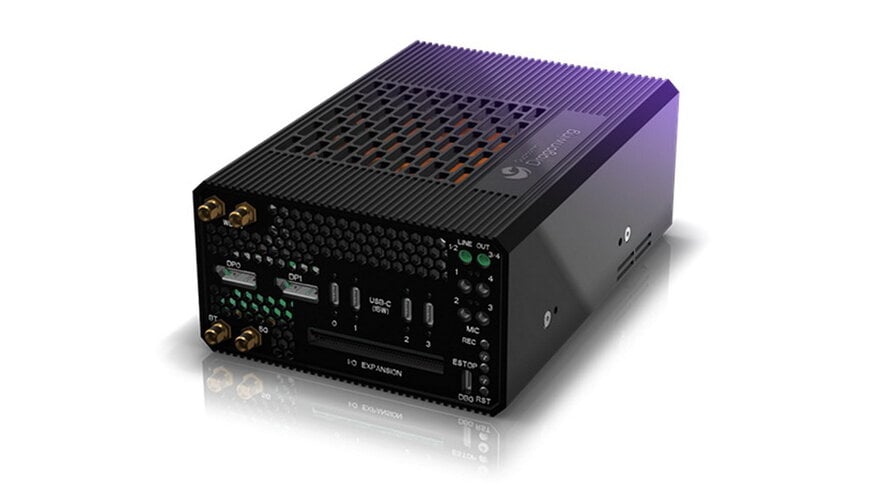
The Dragonwing IQ10 Robotics Reference Design (RRD) integrates compute, sensing, networking, and software into a single hardware platform to streamline the transition from prototype to production. The system targets applications in industrial automation, autonomous mobile robots (AMRs), and humanoid robotics by consolidating heterogeneous processing and sensor interfaces.
Integrated Architecture for Accelerated Edge Computing
The reference design is built around the Dragonwing IQ10 processor, which features 18 Qualcomm Oryon central processing unit (CPU) cores, multicore neural processing units (NPUs), and a graphics processing unit (GPU) architecture. This hardware configuration delivers up to 700 tera operations per second (TOPS) of artificial intelligence (AI) performance, eliminating the need for external hardware accelerators during on-device perception, planning, and reasoning workloads.
The platform addresses integration complexity by natively absorbing sensor ingestion rather than relying on external bridging components. It supports up to 12 Gigabit Multimedia Serial Link 2 (GMSL2) cameras alongside Light Detection and Ranging (LiDAR), Time-of-Flight (ToF), and Inertial Measurement Unit (IMU) sensors. This native integration reduces data latency between sensing and processing layers while maintaining synchronization across multi-modal data streams.
Deterministic Control and Environmental Specifications
For precise motion execution, the platform incorporates high-speed deterministic interfaces and industrial communication protocols, including Peripheral Component Interconnect Express (PCIE), Time-Sensitive Networking (TSN), USB, Control Area Network (CAN), Ethernet, EtherCAT, and CAN Flexible Data-Rate (CAN-FD).
The hardware is housed in an enclosed system featuring forced-air cooling. It is rated for operation across a temperature range of -40 to 70 °C and accepts 12V/24V power inputs, matching the environmental and electrical constraints common in industrial deployment scenarios.
The accompanying software infrastructure utilizes a layered architecture. It includes on-device AI runtimes for low-latency decision-making, native Robot Operating System 2 (ROS2) support to decouple hardware from application logic, and core platform services for sensing, planning, and actuation. Cloud-connected lifecycle management is handled via the Qualcomm AI Hub for fleet monitoring and model deployment. The integrated stack provides out-of-the-box functional blocks for localization, navigation, manipulation, and natural language interaction.
The system was unveiled at the Computex 2026 trade show in Taipei, Taiwan, held from June 2 to June 5, 2026. Early evaluation and ecosystem deployment are supported by partners including NEURA Robotics, Advantech, APLUX, Booster, Innodisk, MeiG, NEXCOM, Radxa, Thundercomm, and VinMotion.
Additional Context
This section details technical specifications and competitive benchmarking not included in the original product announcement.
The Dragonwing IQ10 RRD enters a competitive landscape centered on high-TOPS edge AI computing for robotics, where the primary benchmark standard is established by the Nvidia Jetson AGX Orin Industrial module. The Jetson AGX Orin Industrial delivers up to 275 TOPS of AI performance, operates within a temperature range of -40 to 85 °C, and features an 12-core Arm Cortex-A78AE CPU alongside a 2048-core Ampere architecture GPU.
By comparison, the Dragonwing IQ10 reference design provides a higher compute ceiling of 700 TOPS and utilizes an 18-core architecture, though its maximum specified operating temperature of 70 °C is narrower than the 85 °C industrial limit of the Jetson module. Additionally, while competitive platforms often require external carrier boards to break out high-density GMSL2 and EtherCAT interfaces, the Dragonwing design natively integrates 12 GMSL2 channels directly into the deployment-ready enclosure to minimize propagation delay in multi-modal sensor fusion.
Edited by Evgeny Churilov, Induportals Media - Adapted by AI.
www.qualcomm.com
