
electronics-journal.com
04
'26
Written on Modified on
STMicroelectronics Introduces Intelligent Vibration Sensor for Industrial Monitoring
IIS3DWB10IS provides the first compelling alternative to piezosensor for condition monitoring, combining performances, lightweight design, ease of integration, ultra-accuracy, and energy efficiency.
www.st.com
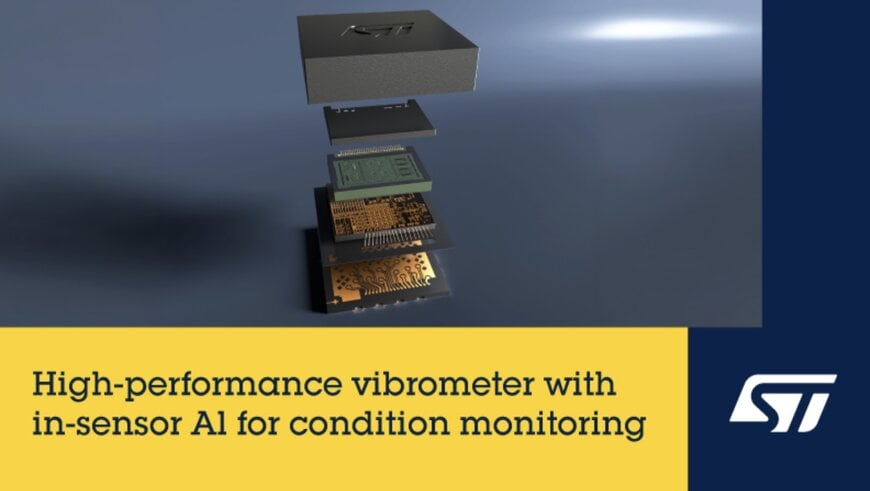
STMicroelectronics has introduced the IIS3DWB10IS digital vibration sensor featuring an integrated intelligent sensor processing unit (ISPU 2.0) to bring advanced digital signal processing and edge AI inference directly to the sensing element for industrial predictive maintenance. The device is designed to measure vibrations and shocks up to 200g at operational frequencies of 10 kHz and above.
High-Frequency Sensing and Rugged Design
Built using ST Micro Electromechanical Systems (MEMS) technology, the component functions within a wide temperature range up to 125°C to withstand harsh industrial environments. The hardware targets remote condition monitoring and predictive maintenance strategies across sectors such as automotive and general manufacturing, where rotating and oscillating machinery is utilized for cutting, shaping, moving, and cooling.
The device features a selectable full-scale dynamic range up to 200g, combined with an acceleration noise floor down to 35 µg/sqrt(Hz). The architecture also integrates a 2048×80-bit FIFO register alongside an embedded temperature sensor. The hardware is backed by the company's 10-year industrial longevity commitment.
Edge Computation and ISPU 2.0 Architecture
The embedded ISPU 2.0 introduces dedicated hardware accelerators to process real-time signal processing and AI workloads natively at the edge. The programmable core is C-compliant and incorporates on-chip program and data RAM.
Operating at 40 MIPS and 40 MFLOPS, the internal digital signal processor delivers up to four times the processing performance of its prior generation. Furthermore, the updated sensor interface supports a data transfer rate with the internal MEMS circuitry that is six times faster than earlier iterations.
Software Ecosystem and Integration
The sensor is supported by a dedicated ecosystem providing software libraries to facilitate mathematical computations directly on the internal processing unit. Supported on-device algorithms include:
- Fast Fourier Transforms (FFT)
- Signal filtering
- Envelope detection
- Velocity severity monitoring
- Automated anomaly detection
Additional Context
This section details technical specifications and competitive benchmarking not included in the original news release.
Industrial predictive maintenance has historically relied on analog piezoelectric accelerometers for high-frequency monitoring because traditional digital MEMS sensors typically lacked the necessary bandwidth (often restricted below 5 kHz) and exhibited high noise densities. High-end piezoelectric alternatives achieve extremely low noise floors and bandwidths extending past 10 kHz, but they demand dedicated external analog front-ends (AFEs), analog-to-digital converters (ADCs), and shielded cabling, which increases total system bill of materials (BOM), power consumption, and mechanical footprint.
The 10 kHz flat frequency response and low noise density of this MEMS architecture establish a direct benchmark against standard industrial piezoelectric sensors. It optimizes system design by integrating the sensing element, a 3-axis digitizer, and a 32-bit RISC processing core into a single 4.5 mm × 4.5 mm surface-mount package.
Compared to standard digital MEMS sensors and legacy piezoelectric setups, this device achieves superior system-level efficiency by executing mathematical algorithms—such as FFT and velocity severity—natively within its internal ISPU. By utilizing dedicated hardware accelerators to handle these repetitive processing tasks at 40 MFLOPS, it eliminates the continuous data transmission overhead over SPI or I3C buses. This significantly reduces the computational load and power draw of the host microcontroller, allowing for smaller, battery-operated wireless monitoring nodes that were previously unfeasible with discrete analog piezoelectric architectures.
Edited by Romila DSilva, Induportals Editor, with AI assistance.
www.st.com
