
electronics-journal.com
10
'26
Written on Modified on
Mitsubishi Electric & Semikron Danfoss Develop New Power Module
Jointly developed 3-level standard package enhances inverter efficiency, design flexibility and standardization for industrial and renewable applications.
www.mitsubishielectric.com
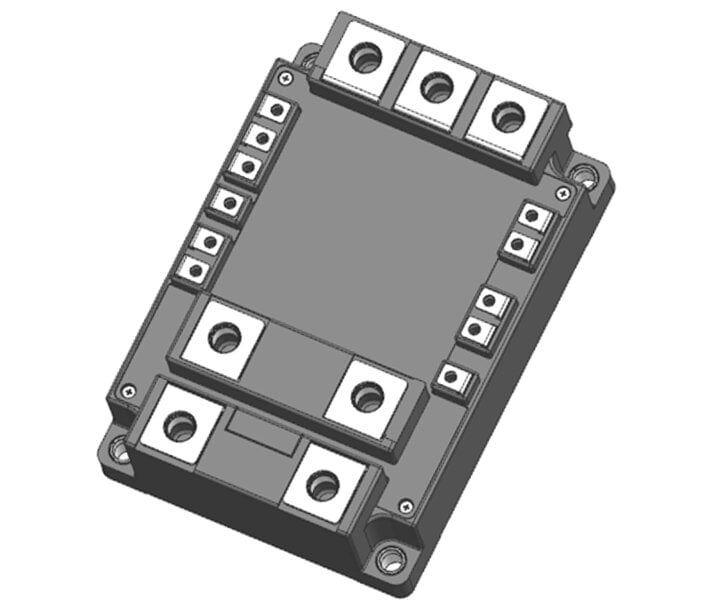
Mitsubishi Electric Corporation and Semikron Danfoss Elektronik GmbH & Co. KG have entered into an industrial partnership to jointly develop a new standard package for power semiconductor modules featuring integrated 3-level circuits. By combining their respective engineering expertise in power electronics manufacturing, the two companies aim to streamline manufacturing value chains and accelerate the adoption of energy-efficient conversion technologies. The primary goal of this strategic collaboration is to establish a standardized physical layout that allows original equipment manufacturers to unify their inverter designs across industrial drive equipment and renewable energy systems.
System Architecture and Terminal Layout Optimization
The standardized package merges design elements from two existing platforms: Mitsubishi Electric’s high-power LV100-type package and Semikron Danfoss’s SEMITRANS20 architecture. The technical solution functions by incorporating a 3-level T-type circuit topology directly into a unified module housing. This topology controls direct current voltage utilizing three distinct potential levels rather than two, which produces an output voltage waveform that closely approximates a true sine wave.
At the system level, responsibilities are divided evenly between the partners; both entities co-developed the physical standardization framework but will independently manufacture and market their own proprietary semiconductor chips within the compatible housing. The design features an optimized arrangement of main electrode terminals and auxiliary control terminals structured explicitly for 3-level operations. By standardizing the physical footprint, pinning configurations, and electrical interfaces, the platform ensures cross-manufacturer compatibility, providing industrial consumers with dual-source supply security.
Efficiency Enhancements and Industrial Use Cases
The deployment of this integrated multi-level package directly targets high-throughput industrial drive systems, grid-scale solar inverters, and wind energy converters. Traditional inverter architectures rely heavily on conventional 2-level circuits, which introduce higher harmonic distortion and elevated switching losses at high operational frequencies.
By utilizing the newly established 3-level standard package, systems achieve significant power conversion efficiency gains. The specialized topology reduces the voltage step-stress ($Delta V$) experienced by internal semiconductor switches during state transitions, which lowers overall switching energy losses. Furthermore, the cleaner output waveform minimizes harmonic distortion, permitting engineering teams to downsize associated peripheral filter components, such as inductors and capacitors. This technical mechanism yields highly compact inverter designs, enhances process stability, and lowers structural manufacturing costs.
The underlying package concept was exhibited at the Power Conversion Intelligent Motion (PCIM) Europe Expo & Conference in Nuremberg, Germany, from June 9 to 11, 2026. This exhibition validated the real-world application of the unified terminal layout and highlighted how standardized dimensions can simplify international engineering support and infrastructure scalability for global automation markets.
Additional Context:
This section details technical specifications and competitive benchmarking not included in the original product announcement.
The standardized 3-level package establishes a distinct operational alternative to standalone 2-level IGBT modules and proprietary, manufacturer-specific multi-level housings. Traditional 2-level modules feature lower initial layout complexity but demand large, heavy harmonic filters to protect downstream industrial motors from insulation degradation caused by high voltage spikes. The integrated T-type multi-level circuit compresses these external filter dependencies by splitting the voltage strain, balancing electrical loads more effectively across the internal silicon substrate.
When evaluated against alternative multi-level topologies, such as Neutral Point Clamped (NPC) circuits, the T-type configuration utilized in this package exhibits specific performance trade-offs. While standard NPC circuits utilize auxiliary clamping diodes that increase total component count and conduction losses at lower switching frequencies, the T-type variant uses a bidirectional switch connected directly to the neutral DC bus. This design choice optimizes conduction efficiency for low-to-medium switching frequencies, which are highly prevalent in industrial motor drives.
Furthermore, compared to proprietary closed-ecosystem power modules, this open, co-developed standard mitigates supply chain single-point failures. By establishing a standard physical outline and terminal footprint, plant engineers can drop either manufacturer's module directly into the same mechanical baseplate and gate-driver interface without redesigning the core inverter power electronics assembly.
Edited by Natania Lyngdoh, Induportals editor, assisted by AI.
www.mitsubishielectric.com
