
electronics-journal.com
25
'26
Written on Modified on
Portable DA110 Indicator for High-Precision Strain Gauge Measurement
HBK introduces the DA110 Handheld Indicator for mobile calibration and high-speed industrial asset monitoring.
www.hbkworld.com
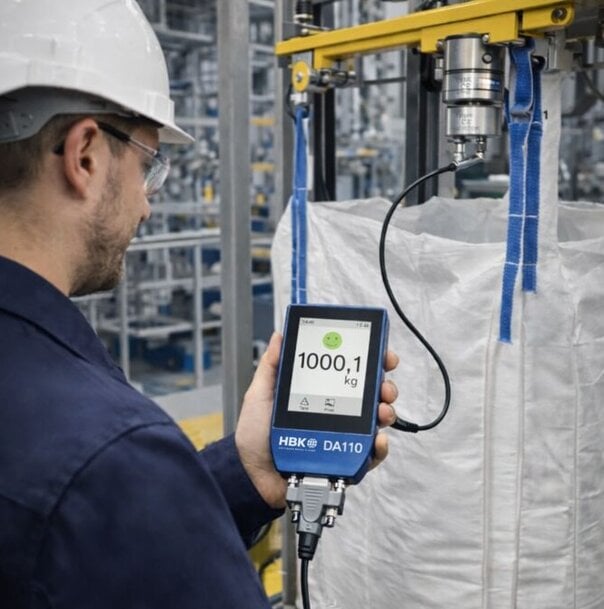
Hottinger Brüel & Kjær (HBK) has launched the DA110 Handheld Indicator, a portable measurement device engineered for demanding industrial and metrological environments. The tool integrates with a wide array of strain gauge sensors to perform mobile calibration, material testing, and asset monitoring directly on the factory floor, eliminating the need for stationary laboratory setups.
Sensor Integration and Sampling Performance
The DA110 is designed to seamlessly interface with full-bridge, 4-wire, and 6-wire strain gauge sensors ranging from 80 to 5000 Ω, alongside high-precision force, torque, and weighing transducers. The hardware incorporates Transducer Electronic Data Sheet (TEDS) technology, enabling immediate sensor recognition and automated configuration when switching between measurement tasks. The signal processing architecture achieves an accuracy class of up to 0.01% of full scale at a 4.8 kHz sampling rate. To capture rapid, dynamic force profiles, the indicator also supports high-speed sampling up to 19.2 kHz with a 0.1% accuracy threshold.
Mobile Calibration and Industrial Applications
To ensure standards-compliant metrological traceability in the field, the DA110 can be calibrated by the German Accreditation Body (DAkkS) to function as a fully traceable reference instrument within an organization's existing calibration chain. This capability allows field technicians to perform precise, repeatable verification directly on heavy industrial machinery, including stamping presses, hydraulic press brakes, and torque verification systems. Furthermore, when paired with industrial load cells, the device acts as a mobile reference system for verifying large-scale weighing installations in silos, tanks, and filling stations, enabling operators to detect mechanical drift and verify summed signals without interrupting standard plant workflows.
Additional Context: This section details technical specifications not included in the original announcement
In industrial metrology, strain gauge sensors utilize a Wheatstone bridge circuit to measure minute changes in electrical resistance caused by mechanical deformation. While a basic 4-wire configuration is common, the 6-wire connection scheme supported by the DA110 is critical for high-precision field work. The two additional "sense" wires allow the measurement instrument to continuously monitor and dynamically compensate for voltage drops across long sensor cables, ensuring the excitation voltage at the bridge remains perfectly stable regardless of cable length or temperature-induced resistance changes. Additionally, the integration of TEDS (defined by the IEEE 1451.4 standard) embeds an EEPROM memory chip directly within the sensor connector. This chip stores the sensor's exact calibration data, sensitivity metrics, and serial number, allowing the handheld indicator to automatically read and scale the measurement channel—effectively eliminating manual parameter entry errors during high-pressure field diagnostics.
Edited by Lekshman Ramdas, Induportals editor – adapted by AI.
www.hbkworld.com
