
electronics-journal.com
03
'26
Written on Modified on
Multilayer Ceramic Capacitor Architectures for High Power Density Systems
The YAGEO Group expands its passive component portfolio to address power stability and electromagnetic interference challenges in modern industrial electrification.
www.rutronik.com
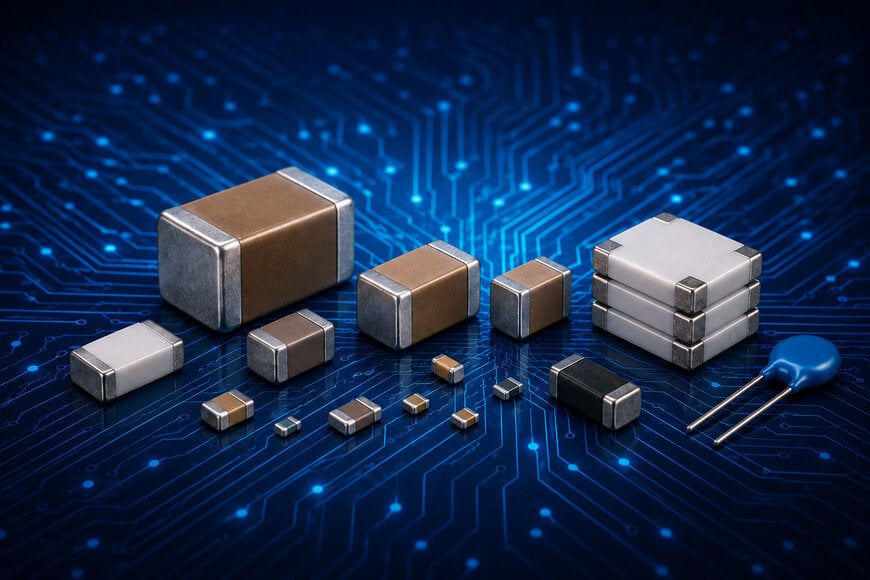
The distribution framework with Rutronik delivers the integrated multilayer ceramic capacitor portfolio of the YAGEO Group to industrial, automotive, and aerospace markets. This technical solution combines advanced dielectric materials and specialized component geometries to optimize power conversion and energy management in high-voltage electronic assemblies.
Dielectric Material Characteristics and Environmental Constraints
Electronic systems require passive components capable of operating reliably under elevated switching frequencies and higher operating voltages, such as modern 800 V automotive data ecosystem architectures. The integration of technology from YAGEO and KEMET into a unified portfolio provides access to multiple dielectric formulations, including C0G, U2J, X5R, X6S, X7R, X7T, X7S, X8G, X8L, and X8R. These materials allow engineers to balance capacitance stability against operational temperature variations up to 260 degrees Celsius. Component dimensions span from standard EIA 01005 form factors up to large 4540 configurations, supporting high-density placement in artificial intelligence server power architectures where physical space is constrained.
Structural Configurations and Power Conversion Performance
Component degradation under mechanical and thermal stress represents a primary failure mechanism in mission-critical applications. The portfolio mitigates these risks through diverse physical packaging geometries, including surface-mount, leaded, disc, and transient liquid phase sintering configurations. This structural variety allows for optimized decoupling, filtering, and power rail stabilization across different circuits. The specialized stacking mechanisms reduce equivalent series resistance and increase ripple current handling capability, directly influencing the operational efficiency of power conversion systems operating at potentials up to 10,000 VDC. Furthermore, the capacity to deploy multiple technologies from a single architecture assists component standardization across platforms, simplifying the digital supply chain by reducing part-number proliferation.
Additional Context:
This section details technical specifications and competitive benchmarking not included in the original product announcement
In high-power and high-frequency electronic designs, standard multilayer ceramic capacitors face operational limitations due to acoustic noise, piezoelectric effects, and mechanical cracking under thermal cycling. Industry alternatives from manufacturers such as Murata and TDK address these limitations using polymer-based flexible terminations or traditional metal lead frames. In comparison, the YAGEO Group utilizes a proprietary transient liquid phase sintering material configuration that bonds multiple ceramic elements together without a conventional lead frame. Benchmark comparisons indicate that this leadless stacking technique achieves a lower equivalent series inductance compared to standard metal-frame stacked capacitors, which extends the usable frequency range and improves efficiency in high-density power modules.
Edited by Sucithra Mani, Induportals editor – adapted by AI.
www.rutronik.com
