
electronics-journal.com
10
'26
Written on Modified on
TDK Launches High-Capacitance Soft-Termination MLCCs for 48V Systems
The 10 μF/100 V X7R components minimize ESR while preventing board-flex cracking in AI servers and EVs.
www.tdk.com
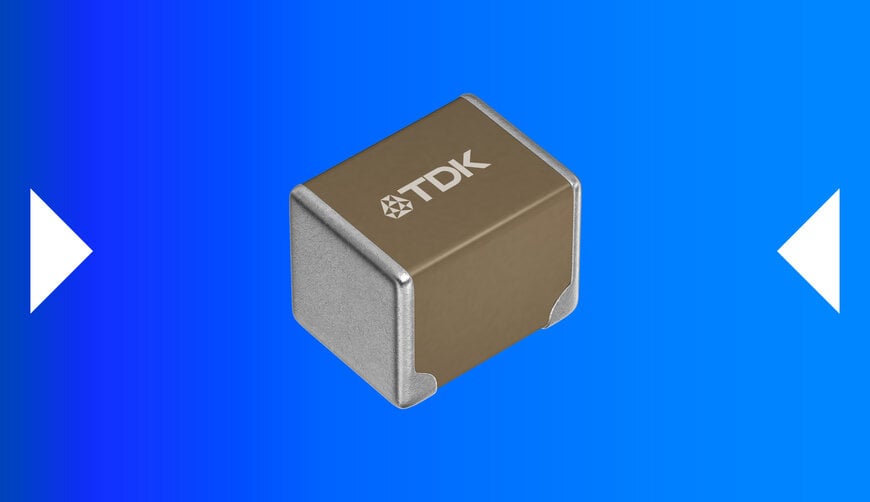
TDK Corporation has expanded its CN series of low-resistance soft-termination Multilayer Ceramic Capacitors (MLCCs) with a new 100 V-rated component that achieves an industry-leading capacitance of 10 μF in the compact 3225 package (3.2 x 2.5 x 2.5 mm). Scheduled for mass production in September 2026, the components are engineered to provide critical smoothing and decoupling for 48 V power architectures, which are increasingly adopted in AI servers, humanoid robots, and electric vehicles (xEVs) to reduce wiring weight and power losses.
Traditionally, soft-termination MLCCs are used to prevent the ceramic dielectric body from cracking under external mechanical stress or thermal cycling. However, the conductive resin layer utilized to absorb these stresses typically increases the capacitor's equivalent series resistance (ESR). TDK has resolved this by designing an optimized resin electrode structure that reduces ESR to levels equivalent to standard terminal MLCCs. Available in both commercial and AEC-Q200 compliant automotive-grade variants, the new CN series capacitors deliver twice the capacitance of conventional components of the same size. This allows hardware engineers to halve the capacitor component count on the power rail, shrinking printed circuit board (PCB) footprints while enhancing overall system reliability.
Additional Context
This section provides technological and market background not explicitly detailed in the original release.
The transition from 12 V to 48 V power distribution networks in hyperscale AI data centers and automotive architectures is driven by the fundamental need to drastically reduce resistive power losses (I2R). Because a 48 V system carries one-quarter of the current of a 12 V system for the exact same power delivery, it permits the use of significantly thinner wire harnesses and smaller copper busbars. However, 48 V rails require robust decoupling capacitors—typically rated with a safety margin at 100 V—to filter out high-frequency switching noise and supply instantaneous burst currents to intermediate voltage regulators. In AI servers, these capacitors are mounted on exceptionally thick PCBs subjected to immense thermal cycling and physical flex caused by the mounting pressure of massive GPU heatsinks. If a standard rigid ceramic capacitor cracks under this physical strain, it often fails as a dead short circuit, which can destroy the entire power rail. TDK's soft-termination design acts as a mechanical shock absorber between the rigid PCB and the brittle ceramic, protecting the component from flexure without sacrificing the ultra-low ESR required for high-efficiency, high-current power conversion.
Edited by Lekshman Ramdas, Induportals editor – adapted by AI.
www.tdk.com
