
electronics-journal.com
16
'26
Written on Modified on
ETRI Selects Anritsu VNA for GaN MMIC High-Frequency Evaluation
The VectorStar ME7838G enables single-sweep broadband measurements up to 220 GHz for advanced 6G device development.
www.anritsu.com
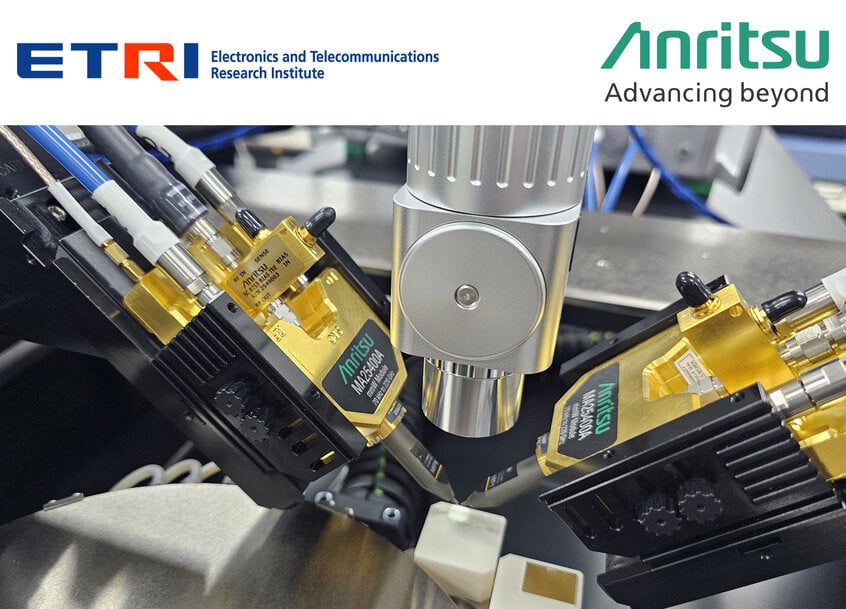
Anritsu has announced that the Electronics and Telecommunications Research Institute (ETRI), a leading Korean research center, has selected the VectorStar™ ME7838G Broadband Vector Network Analyzer (VNA) for the design verification and characterization of high-frequency devices using Gallium Nitride (GaN) Monolithic Microwave Integrated Circuits (MMICs). By deploying the ME7838G, ETRI has established a robust evaluation platform tailored for next-generation millimeter-wave and sub-THz applications, significantly improving measurement reproducibility and reliability.
As telecommunications technologies advance toward 6G and next-generation satellite systems, accurate device evaluation must expand beyond operating frequency bands to include harmonic frequency ranges. ETRI utilizes on-wafer measurements to evaluate device characteristics directly, eliminating the parasitic effects caused by packaging and mounting. However, in the sub-THz range, inconsistencies in probe contact and shifting measurement systems often induce data variations. The ME7838G resolves this by supporting single-sweep measurements up to 220 GHz. This allows ETRI to conduct seamless, broadband on-wafer evaluations on a single platform without the need to switch measurement systems or alter test conditions between frequency bands, resulting in highly accurate comparisons against design models.
Additional Context
This section provides technological and market background not explicitly detailed in the original release.
Gallium Nitride (GaN) is a wide-bandgap semiconductor material that has become essential for high-frequency RF power amplifiers used in modern telecommunications and radar systems due to its superior power density and thermal conductivity compared to traditional silicon or gallium arsenide. As the telecom industry pushes beyond 5G into the sub-Terahertz spectrum (100 GHz to 300 GHz) for 6G research, characterizing these GaN MMICs becomes incredibly complex. Traditional Vector Network Analyzers (VNAs) often require engineers to physically disconnect and reconnect different coaxial or waveguide modules to cover discrete frequency bands (e.g., stopping a test at 110 GHz, changing the hardware, and recalibrating to test up to 170 GHz). This hardware swapping introduces mechanical stress, calibration drift, and probe misalignment on fragile semiconductor wafers. A broadband VNA capable of a continuous "single-sweep" from near-DC up to 220 GHz eliminates these physical interruptions, ensuring that the complex impedance and phase data remain perfectly phase-coherent and stable across the entire spectrum, which is critical for accurate device modeling in foundry environments.
Edited by Lekshman Ramdas, Induportals editor – adapted by AI.
www.anritsu.com
