
electronics-journal.com
22
'26
Written on Modified on
Fraunhofer IPMS Develops 5,040 PPI Full-Color OLED Microdisplay
28 nm CMOS technology combines 2.52 µm subpixels and flexible driving modes for efficient AR, VR devices, showcased at Eurodisplay 2026.
www.fraunhofer.de
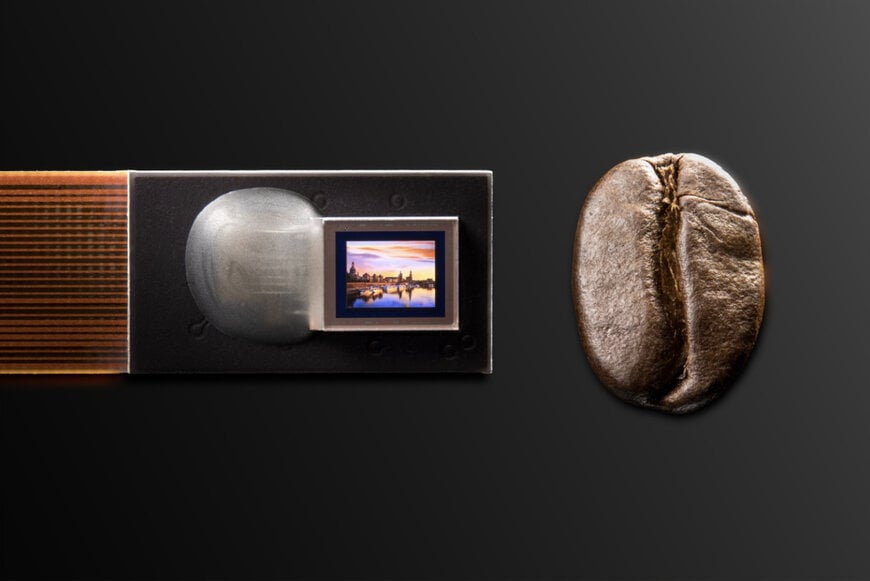
Fraunhofer Institute for Photonic Microsystems IPMS has announced a full-color organic light-emitting diode microdisplay fabricated on a 28 nm complementary metal-oxide-semiconductor backplane for near-to-eye projection systems. The hardware is designed for deployment across augmented reality, virtual reality, mixed reality, and portable optoelectronic devices.
Technical Implementation and Silicon Integration
The architecture utilizes a 28 nm CMOS process node to drive organic light-emitting diode layers, achieving a subpixel pitch of 2.52 × 2.52 micrometers. This layout yields a pixel density of up to 5040 pixels per inch. Full-color rendering relies on an RGBW subpixel arrangement supported by an integrated hardware calculation block within the silicon backplane. This calculation unit algorithmically derives the white subpixel directly from standard RGB signal streams, increasing luminous efficacy and reducing overall power requirements relative to traditional three-channel microdisplays.
The device combines two distinct drive schemes within the backplane circuitry: frame-based operation and memory-based retention. Frame-based driving handles dynamic video sequences with continuous refresh cycles, while memory-based operation holds static graphics directly in pixel-level memory cells to suppress unnecessary refresh cycles and save battery reserves. Philipp Wartenberg, Head of Department IC and System Design at Fraunhofer IPMS, stated that the flexible driving modes allow rapid video playback alongside energy-efficient display of static graphics, which enables extended battery runtime in lightweight wearable devices.
Commercial Applications and Industry Demonstration
Target use cases center on wearable optical engines requiring compact footprints and high spatial resolution, including compact mixed-reality headsets and lightweight smart glasses. Fraunhofer IPMS offers custom parameter configuration, interface matching, evaluation hardware kits, and pilot-line manufacturing. The development is presented at Eurodisplay 2026, scheduled from September 22 to 24, 2026, in Dublin, Ireland.
Additional Context:
This section details technical specifications and competitive benchmarking not included in the original product announcement
Direct-view microdisplays deployed in optical see-through and mixed-reality architectures commonly rely on silicon backplane technologies, where pixel pitch, pixel density, and backplane nodes dictate visual clarity and power efficiency.
Sony Semiconductor Solutions produces 0.44-inch to 1.3-inch OLED-on-silicon microdisplays widely used in visual head-mounted hardware. A representative commercial unit, the Sony ECX339A, achieves a resolution of 5648 × 3842 at approximately 4032 pixels per inch with a 6.3-micrometer pixel pitch. In comparison, the Fraunhofer IPMS 28 nm architecture reaches 5040 pixels per inch with a smaller subpixel footprint of 2.52 × 2.52 micrometers, narrowing pixel grid visibility at equivalent optical magnification.
eMagin, a subsidiary of Samsung Display, manufactures dPd (direct patterned display) RGB OLED microdisplays. Commercial microdisplays utilizing standard legacy CMOS nodes typically range between 55 nm and 180 nm lithography. The implementation of 28 nm CMOS by Fraunhofer IPMS permits higher digital logic integration per unit area, enabling the inclusion of the dedicated RGBW conversion block and dual-mode memory circuits directly beneath the light-emitting layers without expanding die area.
Edited by Natania Lyngdoh, Induportals editor, assisted by AI.
www.ipms.fraunhofer.com
