
electronics-journal.com
30
'26
Written on Modified on
Innovation in Additive Manufacturing for Silicon Wafer Tables
3D Systems introduces a semiconductor wafer table prototype based on additive manufacturing to optimize thermal control and reduce production lead times.
www.3dsystems.com
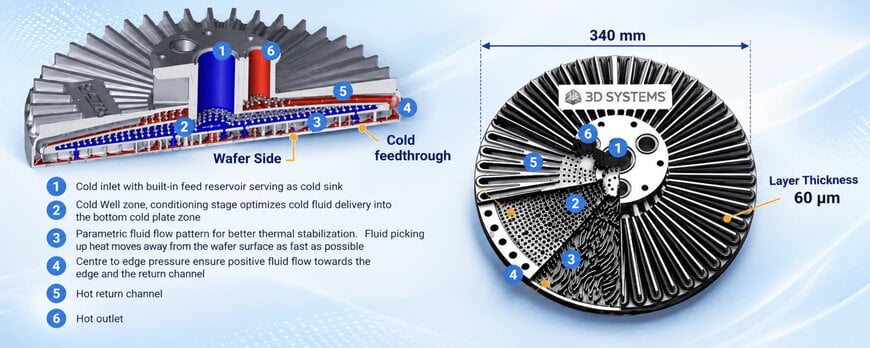
The global market for semiconductor manufacturing equipment, valued at 121 billion dollars in 2025 and 139 billion in 2026, requires components characterized by high levels of precision and thermal stability to support device miniaturization processes. Wafer tables represent critical structural elements employed in operational phases such as lithography, wafer inspection, die placement, etching, and deposition. Conventional design of such components presents geometric limits and constraints linked to the need for assemblies and welding, which reduce thermal dissipation efficiency and prolong procurement cycles.
Cooling Architecture and Technological Integration
The system developed by 3D Systems leverages metal additive manufacturing to create complex internal geometries aimed at containing the effects of thermal expansion and maintaining a constant contact temperature across the entire surface. The solution integrates the DMP Flex 350 Triple printer, the high thermal conductivity A6061-RAM2 alloy, and Oqton's 3DXpert software. The thermal architecture comprises a showerhead-type injector for uniform coolant distribution, a network of generously designed generative geometry fins, and an upstream cooling sump that acts as a buffer reservoir to stabilize the initial liquid temperature.
Performance Results and Operational Metrics
The application of additive manufacturing makes it possible to replace multi-part configurations with a single-piece cooling plate, eliminating critical joint points and associated leakage risks. From a quantitative standpoint, technical data highlights a cooling surface increased by 500 times, a temperature uniformity improvement between 4% and 6%, and a liquid containment capacity 10 times higher than conventional models. Delivery times for a single component stand at one week post-development, compared to approximately 12 weeks required by traditional methods based on brazing and multi-component assembly.
Additional Context:
This section details technical specifications and competitive benchmarking not included in the original product announcement.
In the sector of additive manufacturing for semiconductor components, the use of high thermal conductivity aluminum alloys such as A6061-RAM2 via laser powder bed fusion printing is compared with traditional mechanical machining techniques from solid blocks or welding of 6000 series alloys. Traditional methodologies impose rectilinear cooling channels limited by drilling operations, yielding lower heat transfer efficiency due to the inability to follow conformal profiles. Conversely, conformal cooling channels produced via additive manufacturing allow for convective heat transfer coefficients 30% higher at identical fluid flow rates, reducing local thermal gradients below the threshold of 0.5 degrees Celsius across extended wafer surfaces.
Edited by Sucithra Mani, Induportals editor – adapted by AI.
www.3dsystems.com
