
Why data center security is a substation problem, not a fence problem
Power infrastructure, including early fire detection at the substation, has become the most consequential and most overlooked part of the data center perimeter.
www.flir.com
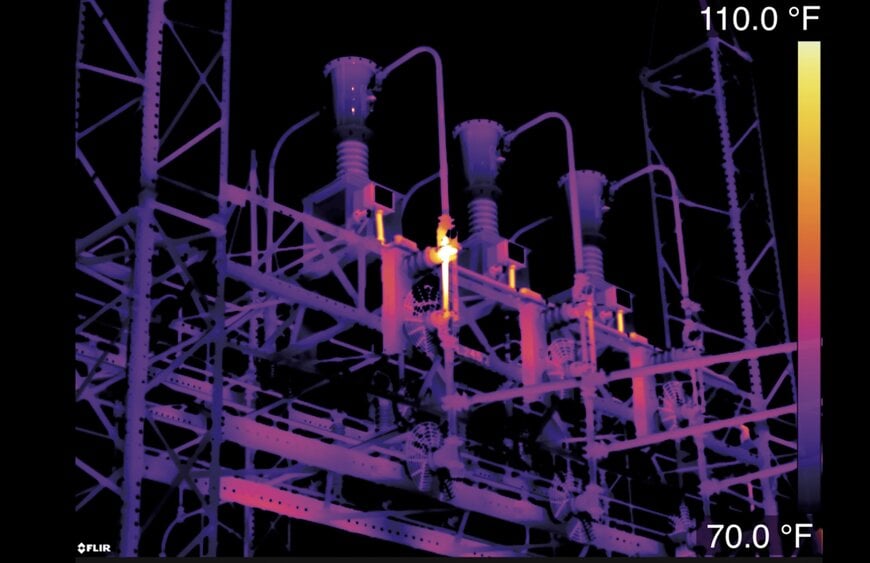
Most data center security discussions focus on the perimeter, with cameras, access controls, and intrusion detection aimed outward, assuming that the internal area requires protection. However, on a modern campus, many of the assets most critical to operational uptime are located outside the building in the utility yard. These assets include transformers, switchgear, and grid interconnections.
That equipment now represents the most critical part of the property. According to Uptime Institute's 2026 Annual Outage Analysis, power remains the primary cause of significant outages at 45%, surpassing cooling, network, and software issues. Furthermore, 57 percent of operators reported that their most recent major outage cost more than $100,000, with 20 percent exceeding $1 million. An event at the substation isn't merely a security concern with operational implications; it is an outage.
A fence marks the boundary but does not indicate the condition inside or whether the movement is a technician, an animal, or an unauthorized individual.
What a perimeter alarm was never meant to detect
On March 20, 2025, a fire at the North Hyde substation in west London cut power to Heathrow Airport, which was closed for about 16 hours and disrupted more than1,000 flights. NESO's final report revealed excess moisture in substation components — an issue identified in 2018 that was never fixed — and a fire suppression system that had been inoperable since at least 2022.
No intruder, no data center, no alarm. The failure arose over years due to the asset's deteriorating condition, a type of risk that perimeter security isn't designed to detect, and that scheduled inspections failed to catch it early. This situation is a clear, recent example of why the substation needs a dedicated security solution rather than just an extension of the fence line.
The security version of this problem is even subtler. Intrusions in utility yards, transformer interference, and tampering often produce no alarms at all because nothing was cut, forced, or crossed in a way that traditional sensors would detect. The event that actually matters can appear identical to an inconsequential one.
Cameras alone cannot protect what they cannot differentiate
A utility yard is constantly in motion: wildlife passes through, vegetation shifts, and technicians work on a schedule — sometimes unexpectedly. Video alone offers an image of this activity but cannot interpret it. The crucial difference is identifying whether a person, animal, or piece of equipment is behaving abnormally, which determines whether dispatch is necessary.
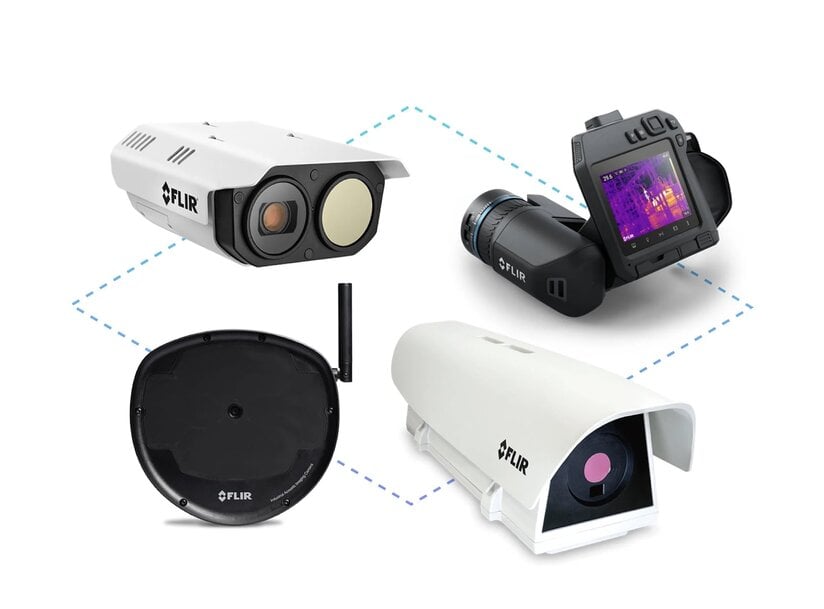
Radar and thermal technologies address different parts of this challenge. The Flir R-190 and R-290 ground radars detect the location, direction, and speed of objects in the yard. Thermal imaging maintains sight of targets in darkness without extra lighting, which is often impractical. Multispectral cameras like the Flir FH-Series and the PT-Series AI SR combine both capabilities, enabling confirmation and identification from a single device.
Radar confirms the presence of an object, thermal imaging clarifies its identity when visual cues are insufficient, and visible imaging provides detailed information for decision-making. In a utility yard, this sequence, detection, identification, and detailed inspection, is what distinguishes a reason to dispatch from a reason to dismiss.
Heat is a security signal and a reliability signal
The same thermal layer that watches the yard for people also monitors equipment temperature. Several conditions may appear as thermal anomalies well before they become visible failures: a transformer running hot, a loose connection, or a degrading bushing.
"Regular inspections and temperature trending are essential because they reveal developing faults early, keeping substations stable, safe, and reliably performing under load," says Darrell Taylor, Director of Business Development for Condition Monitoring, EMEA at Teledyne Flir.
This is where the substation argument stops being a security argument. Continuous thermal monitoring of transformers and switchgear flags developing electrical faults early enough to schedule the intervention rather than absorb the outage. The detection layer is the same. The budget it serves is not.
Two budgets, one asset
That dual role is the practical complication in most buying conversations. Facilities and utility teams own the power equipment, while security teams own the perimeter. The substation sits between them, and neither group may consider its protection entirely its responsibility. This division causes gaps that persist even at sites where every other security layer is well specified.
Naming it early tends to help, because a single deployment can serve both cases, and the operational argument that equipment failures take the site down is one both groups already accept. Flir Nexus® carries target information between connected systems so a yard detection moves into interior validation intact, and Latitude VMS or Cameleon gives both teams the same view of it.
The financial case is arriving independently. Insurers now treat data centers as a specialist, engineering-assessed risk class rather than a standard property occupancy: Swiss Re's sigma insights 07/2026 not, so a yard detection moves into interior validation intact, and Latitude VMS or Cameleon gives both teams the same views that underwriting these sites depends "not only on capacity, but on specialized technical assessment." One colocation provider recorded an 11 percent reduction in premium following deployment.
Compliance is becoming the trigger event
Several requirements call for the documented monitoring of power assets.
NFPA 70B became a standard rather than a recommended practice in its 2023 edition, moving electrical maintenance from advisory to mandatory language and placing explicit weight on thermographic inspection. The 2026 edition is now current.
NERC CIP-014 warrants precise treatment because its scope is frequently overstated. It binds Transmission Owners and Operators, not to electrical loads, so a data center's privately owned substation is generally outside its scope. The requirement instead governs qualifying utility transmission substations at connection points and calls for third-party-verified risk assessments and documented plans to deter, detect, delay, assess, communicate, and respond. That benchmark increasingly shapes what a campus next to it is expected to match.
FERC's July 2026 order in Docket RD26-7 goes further, directing NERC to develop reliability standards for large computational loads and draft registry criteria by the end of 2026 — the first time facilities of this type have been pulled toward the NERC framework directly.
State legislatures are moving faster still. More than 300 data-center-related bills were filed in more than 30 states during the first six weeks of the 2026 session, and 27 states are considering legislation specifically targeting large-load customers (MultiState).
Regional considerations
In the UK, the substation argument is a grid-access argument. Ofgem's demand connections reform responded to a connection queue that grew from 41 GW to 125 GW between November 2024 and June 2025, roughly 50 GW of it from data center projects. A connection that is difficult to obtain is an asset worth protecting on its own terms, and the sector's designation as Critical National Infrastructure pushes toward documented resilience rather than point-in-time checks.
Germany faces the same constraint more acutely: the German Datacenter Association identifies grid access as the industry's key bottleneck, with connection lead times in core locations such as Frankfurt often exceeding five years. In the US, the pressure instead takes the form of state oversight and scrutiny of interconnection.
The common thread is that power connectivity has become the scarcest resource a data center owns. Protecting the building while leaving the yard to a fence and a camera inverts the actual order of risk. The substation is where security and uptime stop being separate conversations.
