
electronics-journal.com
09
'26
Written on Modified on
Keysight introduces Velocity 4900 Layer 1 automation switches
The software-controlled switches automate physical testbed connectivity to modernize network laboratories for AI and 6G development.
www.keysight.com
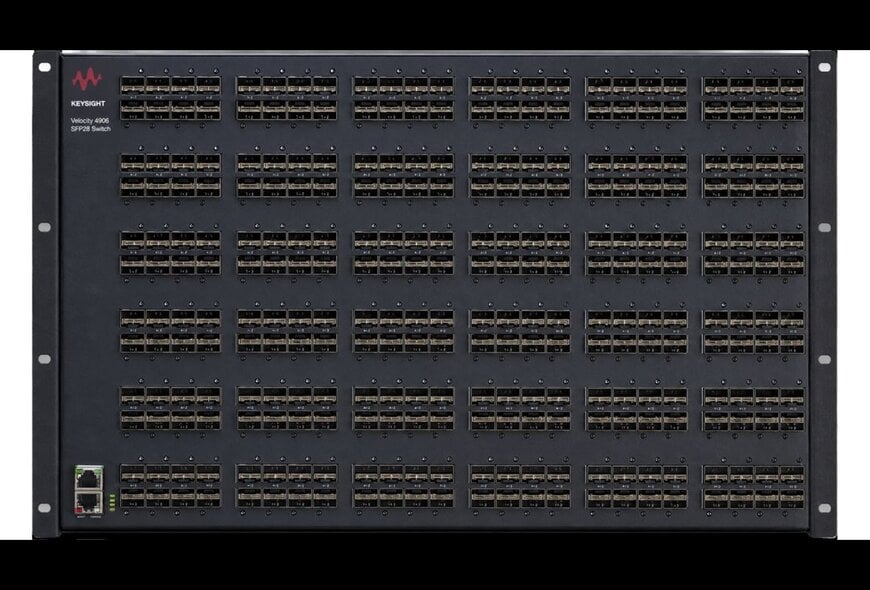
As the scale and complexity of next-generation network technologies increase, test teams face immense pressure to accelerate validation without compromising accuracy. Yet, many test laboratories still rely on manual cabling and physical topology changes, which leads to underutilized equipment and prevents full integration into automated development pipelines. To address these physical-connectivity bottlenecks, Keysight Technologies has launched the Velocity 4900 Series. This new line of cost-effective Layer 1 automation switches replaces manual testbed configurations with software-controlled connectivity, enabling engineering teams to dynamically provision complex testing topologies through an intuitive graphical user interface.
Automating physical testbed connectivity
The Velocity 4900 Series allows testing organizations to securely share expensive or scarce laboratory resources remotely across different teams and geographic locations. By automating physical testbed setup and teardown, engineers can provision or recreate configurations in seconds rather than days. This capability improves equipment utilization, reduces the risk of manual connection errors, and expands overall test coverage. The switches provide true Layer 1 forwarding through an ultra-low-latency, transparent switching matrix, and include port tapping for diagnostics as well as one-to-many traffic replication for broader testing scenarios.
High-density port configurations
The initial release includes two models designed for different infrastructure needs. The Velocity 4902 is a high-speed automation switch featuring 72 QSFP28 ports that support 288 connections with breakouts, facilitating Ethernet speeds from 100 megabits per second (Mbps) to 100 gigabits per second (Gbps). The Velocity 4906 is a high-density platform offering 288 SFP28 ports for speeds from 100 Mbps to 25 Gbps. Both fixed-form-factor platforms support media configurations on a per-port basis, including single-mode fiber, multimode fiber, direct-attach copper, and active optical cables, making them highly adaptable to varied laboratory inventories.
Additional Context: Layer 1 switching in CI/CD workflows
In continuous integration and continuous delivery (CI/CD) software development models, code changes are automatically built, tested, and deployed. While software testing is easily automated, validating physical networking infrastructure—especially for high-bandwidth AI and 6G applications—traditionally requires engineers to physically swap fiber cables between test generators and device prototypes. Layer 1 automation switches eliminate this physical bottleneck. Unlike standard Ethernet switches (Layer 2/3) that process MAC addresses or IP packets and introduce switching latency, a true Layer 1 switch acts as a transparent electrical or optical crosspoint. It forwards raw bitstreams without interpreting the protocol, ensuring deterministic, ultra-low latency. This transparency allows the test instruments to "see" the Device Under Test (DUT) exactly as if they were connected by a direct physical patch cable, enabling automated, zero-touch physical layer validation within a CI/CD pipeline.
Edited by an industrial journalist, Lekshman Ramdas, with AI assistance.
www.keysight.com
