
electronics-journal.com
15
'26
Written on Modified on
Keysight Introduces PCIe 7.0 Protocol Test Solution
Instant link-up and deep protocol visibility reduce risk and shorten next generation system development.
www.keysight.com
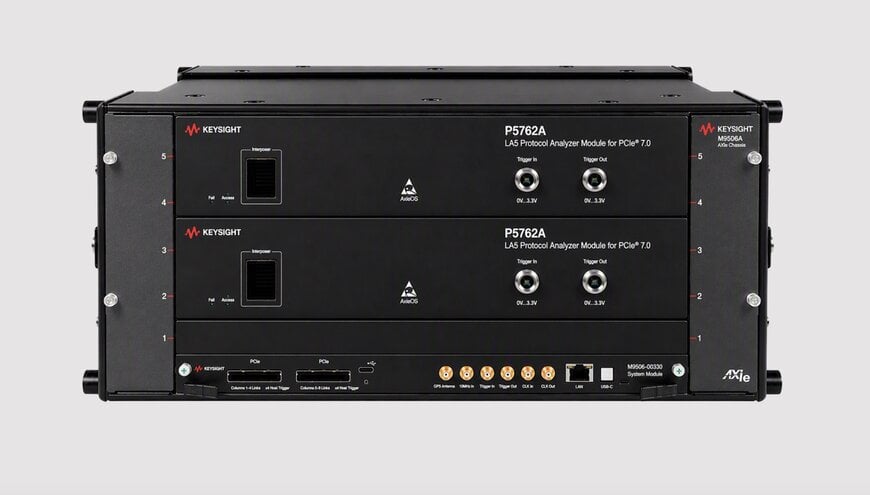
Keysight scalable Protocol Analyzer solution for PCIe® 7.0
Integrated Protocol Validation Architecture
To address these testing challenges, Keysight Technologies introduced its Protocol Test Solution for PCIe 7.0 as a unified verification and debugging platform. The hardware-software environment combines a full-featured protocol analyzer, a hardware exerciser, a dedicated test platform, and specialized protocol analysis software. By acting as an emulation link partner during early silicon turn-on, the exerciser enables hardware teams to drive controlled traffic patterns, test corner cases, and validate device responses before complete system ecosystems are established.
The platform architecture delivers stable trace acquisition without requiring manual signal tuning or repeated calibration loops, expediting the time required to capture actionable first measurements. This integrated workflow guides engineering teams through the entire development lifecycle, spanning initial silicon bring-up, link-level debugging, multi-vendor interoperability verification, and official compliance certification.
Protocol-Layer Observability and Link Training Analysis
Operating at 128 GT/s requires detailed visibility into lower-layer handshake protocols and packet formatting structures. The Keysight analyzer architecture provides granular tracking of the Link Training and Status State Machine (LTSSM), logging state transitions, timeout events, and recovery loops in real time.
The system decodes FLIT-based encoding schemes, transaction layer packets (TLPs), and data link layer packets, isolating transmission errors and protocol anomalies before they propagate through host systems. Engineers can diagnose root causes across complex transaction sequences, verify error-forwarding behaviors, and ensure strict compliance with PCI-SIG specifications. Designed for artificial intelligence scale-up topologies, the solution supports backward compatibility across earlier PCIe generations, preserving test equipment investments while easing the migration path for high-bandwidth accelerators, graphics processing units, optical switches, and CXL memory pools.
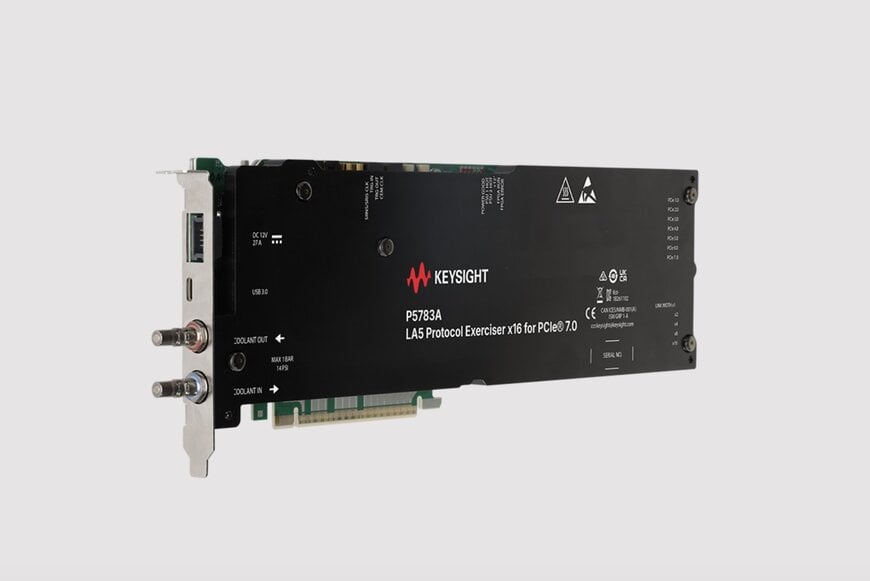
Keysight Protocol Exerciser for PCIe® 7.0 supports speeds from 2.5 GT/s up to 128 GT/s and lane widths up to x16
Additional Context
This section details technical specifications and competitive benchmarking not included in the original product announcement.
The PCI Express 7.0 specification, standardized by the PCI-SIG, utilizes 4-level Pulse Amplitude Modulation (PAM-4) signaling at 64 Gbaud to achieve a raw bidirectional bandwidth of 512 GB/s across a 16-lane (x16) link configuration. Similar to PCIe 6.0, PCIe 7.0 relies on fixed-size 256-byte Flow Control Units (FLITs) paired with low-latency Forward Error Correction (FEC) algorithms to mitigate high bit error rates inherent to PAM-4 signaling over high-loss printed circuit board substrates.
In the high-speed protocol verification sector, Keysight competes with test and measurement providers such as Teledyne LeCroy (with its Summit protocol analyzer series) and Viavi Solutions. Competitive benchmarking across protocol test platforms evaluates receiver jitter tolerance, trace buffer memory depth, physical-layer capture latency, and automated compliance test suite coverage. Providing an integrated platform that combines both traffic generation (exerciser) and high-speed bus capture (analyzer) at 128 GT/s without requiring complex interposer-level signal retuning establishes an essential benchmark for reducing design verification cycles in high-density accelerator architectures.
Edited by Romila DSilva, Induportals Editor, with AI assistance.
www.keysight.com
