
electronics-journal.com
15
'26
Written on Modified on
Radiation-Tolerant GaN Point-of-Load Converters for Space Computing Systems
Microchip Technology has released the POL-05-20S-T point-of-load converter to deliver high-current core power for radiation-exposed processing platforms.
www.microchip.com
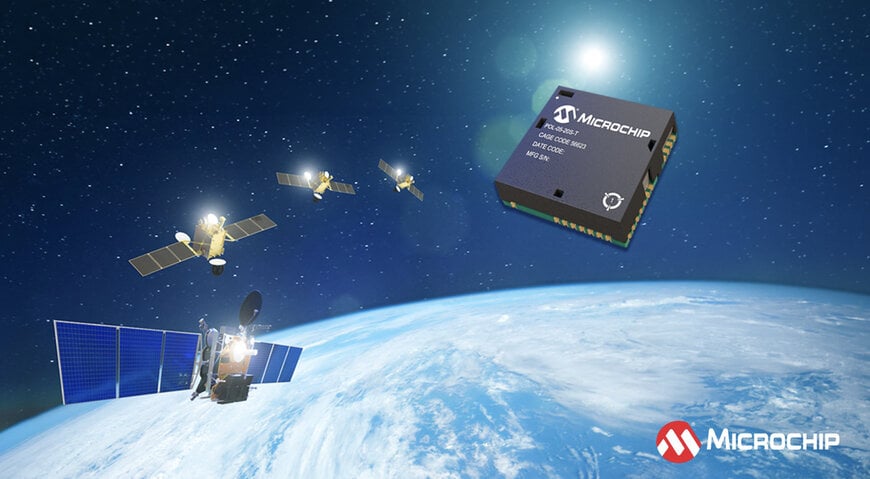
Modern satellite payload architectures increasingly require multi-core processors, field-programmable gate arrays, and application-specific integrated circuits that operate at low supply voltages while drawing high continuous currents. Microchip Technology has expanded its space power management portfolio with the POL-05-20S-T, a radiation-tolerant point-of-load DC-DC converter utilizing gallium nitride semiconductors to supply high-density power in orbital computing architectures.
Semiconductor Switching Mechanics and Power Topologies
Digital processing nodes onboard space platforms exhibit severe dynamic load fluctuations during computing routines, which can cause voltage droop and trigger timing faults if power distribution networks cannot respond rapidly. The POL-05-20S-T employs a synchronous buck regulator topology governed by peak current-mode control to handle dynamic load transients while maintaining stable closed-loop feedback.
By substituting conventional silicon MOSFETs with wide-bandgap gallium nitride (GaN) switching devices, the converter operates at higher switching frequencies with lower parasitic capacitance and minimized switching losses. GaN transistors exhibit lower gate charge (Qg) and zero reverse recovery charge (Qrr), enabling sharp switching transitions and reducing internal thermal dissipation. The converter accepts an input voltage range of 4.75 V to 13.2 V and provides an adjustable output voltage spanning 0.7 V to 5 V, supplying up to 20 A of continuous output current to core rails.
Thermal and Mechanical Architecture in Orbital Form Factors
Satellite thermal dissipation occurs primarily through conduction to structural cold plates, making volumetric efficiency and mechanical packaging critical constraints in flight hardware layout. The POL-05-20S-T is housed in a surface-mount package measuring 1.51 by 1.51 inches with a profile height of 0.45 inches (38.35 by 38.35 by 11.43 millimetres), weighing 25 grams.
The package maintains full 20 A continuous current delivery across a wide operating junction temperature range of minus 55 degrees Celsius to plus 100 degrees Celsius without derating. To ensure voltage regulation accuracy at the low voltage levels required by modern nanometre processing nodes, the converter incorporates remote differential voltage sensing, output droop regulation for load sharing, soft-start circuitry, undervoltage and overvoltage protection networks, and dedicated enable and power-good logic pins. The module interfaces upstream with satellite bus converters, such as 28 V isolated units, and downstream with heavy computing devices, including Microchip's PIC64-HPSC (High-Performance Spaceflight Computing) processors and radiation-tolerant FPGA modules.
Radiation Assurance and Orbital Tolerance Specifications
Semiconductor devices in space environments are vulnerable to long-term cumulative ionizing dose damage as well as catastrophic destructive latch-up events triggered by heavy galactic cosmic rays and solar energetic particles. The POL-05-20S-T is specified to maintain its published electrical operating boundaries up to a total ionizing dose (TID) of 50 krad(Si).
For single-event radiation phenomena, the converter is characterized for single-event effects (SEE) up to a linear energy transfer (LET) threshold of 43 MeV-cm2/mg. This level of radiation hardening prevents destructive single-event burnout and single-event gate rupture within the power stage, qualifying the module for low Earth orbit (LEO) constellations, medium Earth orbit (MEO) platforms, and selected geostationary (GEO) space missions where radiation exposure degrades commercial grade electronics.
Additional Context:
This section details technical specifications and competitive benchmarking not included in the original product announcement.
Point-of-load regulation in space flight systems is governed by strict compliance with radiation hardness assurance guidelines, such as MIL-STD-883 Method 1019 for total ionizing dose and ASTM F1192 for single-event effect testing. Traditional space-grade point-of-load converters have historically relied on radiation-hardened silicon MOSFETs packaged in hermetic hybrid enclosures, which face physical switching frequency limitations that necessitate large discrete inductors and output filtering capacitors.
The 20 A current rating aligns the POL-05-20S-T directly with established space-qualified point-of-load modules, such as the 3D PLUS 3DPM0602 series and isolated or non-isolated regulators from Crane Aerospace & Electronics (Interpoint) and VPT Inc. The 3D PLUS 3DPM0602 module similarly delivers 20 A from a 4.6 V to 13.2 V input range with an output range between 0.8 V and 3.3 V, packaged in a 30 by 30 by 8 millimetre form factor and tested to radiation tolerances of 50 krad TID. However, modules built with wide-bandgap GaN switches offer superior high-frequency slew rates and transient response recovery compared to legacy silicon bipolar or silicon-on-insulator topologies, narrowing the output capacitance required to suppress transient voltage ripple below 50 millivolts during sub-microsecond current steps.
In non-isolated DC-DC architectures targeted at New Space constellations, developers frequently balance high-reliability Class K space standards against commercial-off-the-shelf (COTS) components. With New Space designs requiring qualification for mission durations between three and seven years in LEO polar or equatorial orbits, radiation tolerance ratings between 30 krad and 50 krad have emerged as the industry baseline for micro-satellite and small-satellite payload buses, reducing bill-of-materials overhead compared to deep-space rad-hard modules rated to 100 krad or higher.
Edited by Natania Lyngdoh, Induportals editor, with AI assistance.
www.microchip.com
