
electronics-journal.com
26
'26
Written on Modified on
High Voltage NTC Temperature Sensors for Power Electronics
TDK Corporation expands its NTC temperature sensor portfolio with M704 and M705 probe assemblies, resolving high-voltage insulation and precise thermal monitoring challenges.
www.tdk.com
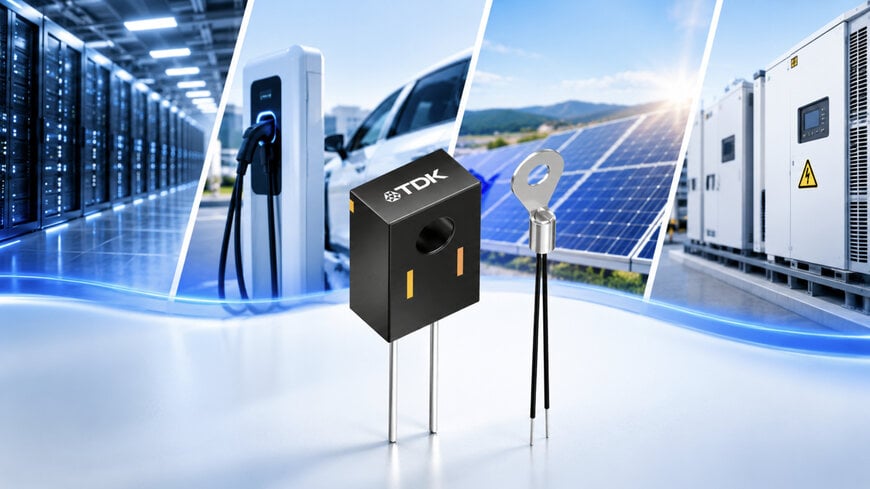
Managing thermal loads in high-voltage industrial power electronics requires sensor assemblies that provide reliable electrical isolation alongside precise thermal feedback. To address this insulation challenge in systems operating up to 4000 V AC, TDK Corporation has introduced the M704 and M705 negative temperature coefficient (NTC) sensor series for demanding environments such as data center power supplies and photovoltaic inverters.
Engineering Challenge and Operating Principles
Industrial power conversion systems including uninterruptible power supplies, power supply units, and solar inverters—operate under severe electrical potentials and thermal stress. Effective thermal management in these environments demands continuous temperature measurement close to active semiconductor components while maintaining strict dielectric strength to protect control circuitry from high-voltage transients. Negative temperature coefficient thermistors exhibit a predictable decrease in electrical resistance as temperature increases, governed by material beta constants. The M704 (ordering code: B57704M0103A001) and M705 (ordering code: B57705M0103A001) assemblies integrate specialized packaging and insulation materials to achieve high dielectric withstand voltages up to 4000 V AC for the M704 and 2500 V AC for the M705, isolating sensing circuits from dangerous high-voltage lines.
Structural Design and Technical Specifications
Both series share core electrical parameters, featuring a nominal resistance R25 of 10 kilohms at 25 degrees Celsius, a B25/100 value of 3988 Kelvin with a 1 percent tolerance, and a resistance tolerance of 2 percent. Despite these shared electrical characteristics, their mechanical designs target distinct integration workflows. The M704 series is housed in a compact plastic case featuring a 3.5 millimeter lead spacing, engineered specifically for automated printed circuit board integration and rapid through-hole assembly in high-volume production lines. It operates across a temperature range from minus 40 degrees Celsius to plus 125 degrees Celsius. Conversely, the M705 series is tailored for high-temperature screw-on mounting, extending its operational ceiling up to plus 180 degrees Celsius. It incorporates a metal-tag ring lug design that establishes direct thermal coupling to metal chassis or heat sinks. This geometry yields a low thermal time constant of approximately 6.2 seconds on a metal plate, ensuring rapid transient response to thermal fluctuations.
Industrial Integration and Application Use Cases
In practical industrial deployments, these NTC sensor assemblies integrate directly into high-density power electronics architectures. Within data center infrastructure, uninterruptible power supplies and power supply units generate intense heat loads while handling high alternating current potentials; the robust insulation of the M704 and M705 prevents dielectric breakdown and signal corruption. In electric vehicle charging stations and photovoltaic inverter systems, where components undergo wide temperature swings and environmental stress, the screw-mounted M705 provides mechanical stability and secure thermal tracking on external heat sinks. Automated printed circuit board mounting of the M704 streamlines manufacturing throughput for internal control boards, minimizing assembly variance and enhancing long-term operational reliability.
Additional Context:
This section details technical specifications and competitive benchmarking not included in the original product announcement.
Industrial temperature sensing in high-voltage power electronics is governed by stringent international safety standards, including insulation coordination guidelines and component safety requirements defined by Underwriters Laboratories and the International Electrotechnical Commission. Achieving dielectric isolation up to 4000 V AC requires careful management of creepage distances and solid insulation thickness within the sensor housing to prevent partial discharges over extended operating lifecycles. Compared to conventional thermocouple assemblies, NTC thermistors offer higher sensitivity and steeper resistance-temperature gradients within moderate temperature ranges, translating to higher measurement resolution for microcontroller-based analog-to-digital converters. The introduction of standardized 10 kilohm thermistors with high-voltage ratings addresses a persistent engineering bottleneck in power conversion equipment, where standard commercial sensors frequently fail to meet reinforced insulation requirements without bulky external housings.
Edited by Sucithra Mani, Induportals editor – adapted by AI.
www.tdk-electronics.tdk.com
