
electronics-journal.com
29
'26
Written on Modified on
TDK Unveils Advanced DC Contactors For Electric Vehicles And Infrastructure
The new series offers reliable bidirectional switching to support demanding automotive power systems rapid charging stations renewable energy storage and artificial intelligence data center architectures.
www.tdk.com
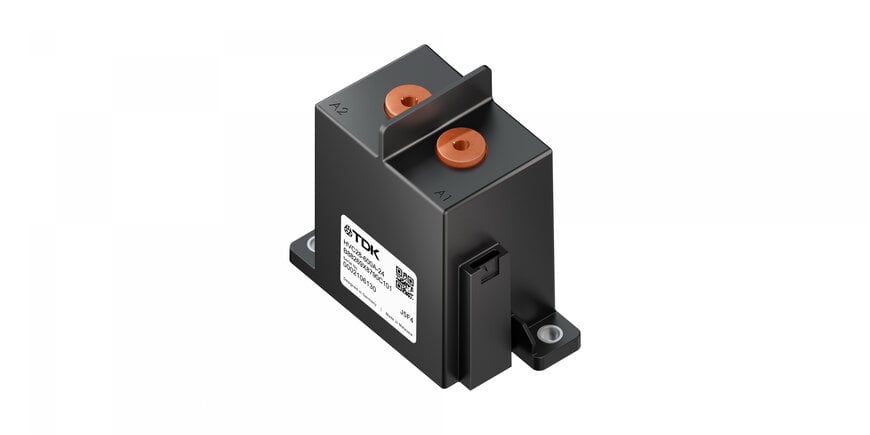
Direct-current power distribution architectures operating at elevated voltages face severe risks during circuit interruption, as direct current lacks the natural zero-crossing point found in alternating current. When opening contacts under full load or fault conditions, an electric arc forms that can sustain itself, degrading contact materials, creating fire hazards, or causing catastrophic switch welding. To maintain electrical safety and prevent system destruction, designers of electrified powertrains, stationary energy storage systems, and fast-charging networks require switching devices that can rapidly quench high-energy arcs while supporting high continuous loads and bidirectional current flow.
Ceramic Arc-Quenching Mechanism and Contact Design
TDK addresses these arc-extinction and power-routing challenges by deploying a hermetically sealed, gas-filled ceramic switching chamber within the HVC28 and HVC29 series. When the contacts separate, the specialized gas atmosphere rapidly cools and destabilizes the plasma channel, suppressing the DC arc in milliseconds and preventing contact erosion.
Both series utilize polarity-free main contact designs. In bidirectional power systems—such as battery systems operating in both charging and regenerative discharge modes, or grid-tied battery energy storage systems—non-polarized terminals eliminate the risk of reverse-polarity failure and remove orientation constraints during harness assembly. An integrated terminal connector provides low-voltage harness mating, reducing installation labor and point-of-failure risks in dense power assemblies.
Performance Ratings for E-Mobility and High-Voltage Infrastructure
Each contactor series serves distinct operating envelopes within modern high-voltage DC networks, with models rated for 300 A, 400 A, 500 A, and 600 A continuous current.
The HVC28 series focuses on automotive traction and vehicle-adjacent charging infrastructure. It supports maximum DC operating potentials of up to 1000 V. Under severe system fault events, the contactor withstands a short-circuit current of 16 kA for 5 ms without contact degradation that would compromise system isolation. In critical fault cut-off scenarios under resistive load conditions, the unit performs a maximum interruption operation at 1600 A and 1000 V. Typical deployment environments include traction battery disconnect units, high-voltage junction boxes, commercial fleet powertrains, and high-power DC fast-charging dispensers.
The HVC29 series accommodates industrial power conversion applications requiring voltage isolation up to 1500 V DC. Built with a short-circuit current withstand capability of 6 kA for 5 ms, the series serves high-capacity battery energy storage systems, solid-state transformers, uninterruptible power supply topologies, and 800 VDC distribution frameworks deployed in high-density computing and artificial intelligence data centers.
Diagnostic Integration and Electrical Specifications
To fulfill functional safety architectures in traction and stationary installations, both series offer an optional, mechanically linked auxiliary mirror contact. Compliant with IEC 60947-4-1, this normally closed contact provides dependable feedback on the operational position of the main contacts, enabling battery management systems and system controllers to verify contact opening before maintenance or following an emergency shutdown.
Actuation relies on a single coil available in 12 V or 24 V configurations, consuming 6 W at nominal voltage. The physical housing measures 95.5 x 96 x 49 mm, with the HVC28 weighing approximately 640 g and the HVC29 weighing approximately 630 g. Operating temperatures span -40 °C to +85 °C. The contactors meet UL 60947-4-1 standards and comply with CE and UKCA directives, while CCC certification remains in progress.
Additional Context
This section details technical specifications and competitive benchmarking not included in the original product announcement.
Industrial migration from 400 V to 800 V traction architectures and 1500 V utility-scale energy storage has made gas-filled DC switching devices an industry benchmark. Gas-filled ceramic contactors, historically pioneered in aerospace and heavy utility applications, have become standard over conventional open-air contactors because the sealed gas mixture — predominantly hydrogen-based — provides superior thermal conductivity and dielectric breakdown strength compared to ambient air.
Benchmark competitors in the 600 A to 1000 V / 1500 V category include sealed contactors from manufacturers such as Sensata GIGAVAC (such as the GX series) and TE Connectivity (KILOVAC series). While legacy industrial contactors often require active magnetic blowout coils that mandate strict current directionality, modern sealed designs achieve bidirectional performance by combining gas quenching with optimized contact geometries. The 16 kA for 5 ms short-circuit rating on the HVC28 aligns with stringent automotive requirements under ISO 6469-3, where contactors must remain closed during upstream fuse clearing or pyrofuse activation to prevent arc flash inside the sealed pack.
Edited by Evgeny Churilov, Induportals Media - Adapted by AI.
www.tdk-electronics.tdk.com
