
electronics-journal.com
03
'26
Written on Modified on
Wireless Mesh Networking for Industrial Sensor Systems
At electronica 2026, NeoCortec demonstrates NeoMesh hardware and gateway architectures addressing battery life and scalability constraints in distributed monitoring environments.
www.neocortec.com
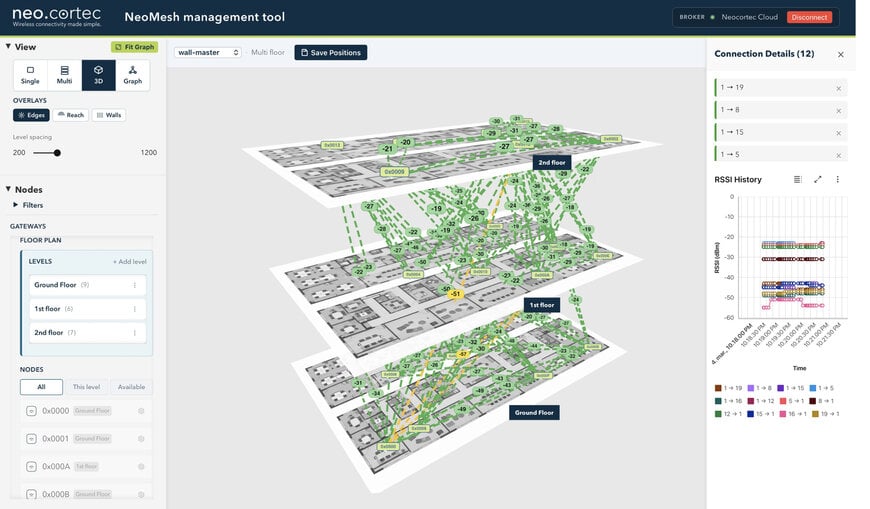
At electronica 2026, taking place from November 10 to 13, 2026, in Munich, Germany, NeoCortec presents its bidirectional wireless mesh networking protocol and integration software designed for low-power industrial automation and building infrastructure. The exhibition demonstrates hardware modules and network management tools developed to eliminate cabling requirements while connecting high-density sensor networks directly to cloud platforms.
Core Technology and System Architecture
The NeoMesh protocol stack operates as an autonomous, bidirectional wireless mesh topology engineered specifically for low-power operation across battery-powered sensor nodes. In contrast to conventional short-range protocols that depend on centralized coordination, the system architecture decentralizes routing tasks across all nodes to support high node counts without elevated standby current. The hardware implementation includes pre-certified surface-mount modules, a dual-band module integrating LoRa modulation developed with Embit, and MikroE Click development boards. The protocol stack is also distributed as a firmware license for direct implementation on selected microcontrollers.
Deployment and Implementation
System integration with local edge infrastructure and external networks is managed through the open-source NeoGW gateway application. This multiplatform gateway translates proprietary mesh payloads into standard MQTT messaging protocols, enabling direct transmission into cloud analytics platforms and supervisory systems. Administrators control, monitor, and diagnose individual mesh networks or multi-site installations through a centralized, web-based Network Management Tool.
Industry Applications
Target sectors include smart building systems, industrial automation, and large-scale facility monitoring where retrofitting physical wiring is cost-prohibitive. Concrete technical use cases encompass ambient environmental monitoring, equipment condition tracking, and distributed submetering across extensive floor plans. The autonomous routing mechanism maintains communication links around physical obstacles and structural changes within industrial environments.
Operational Impact and Performance Metrics
Eliminating designated coordinator nodes reduces single points of failure and prevents the localized battery depletion typical of hierarchical network topologies. Integrating dual-band LoRa modulation delivers expanded signal penetration through dense building materials while preserving deterministic multi-hop packet routing. Standardized MQTT integration at the gateway layer decreases software engineering overhead when connecting field sensors to enterprise management platforms.
Edited by Sucithra Mani, Induportals editor – adapted by AI
www.neocortec.com
