
electronics-journal.com
03
'26
Written on Modified on
Multi-Sensor Fusion Optimizes Visual Mapping for Industrial Robotics
Analog Devices engineers an algorithmic extension for GPU-accelerated processing environments that dynamically combines wheel odometry and inertial data to stabilize autonomous navigation.
www.analog.com
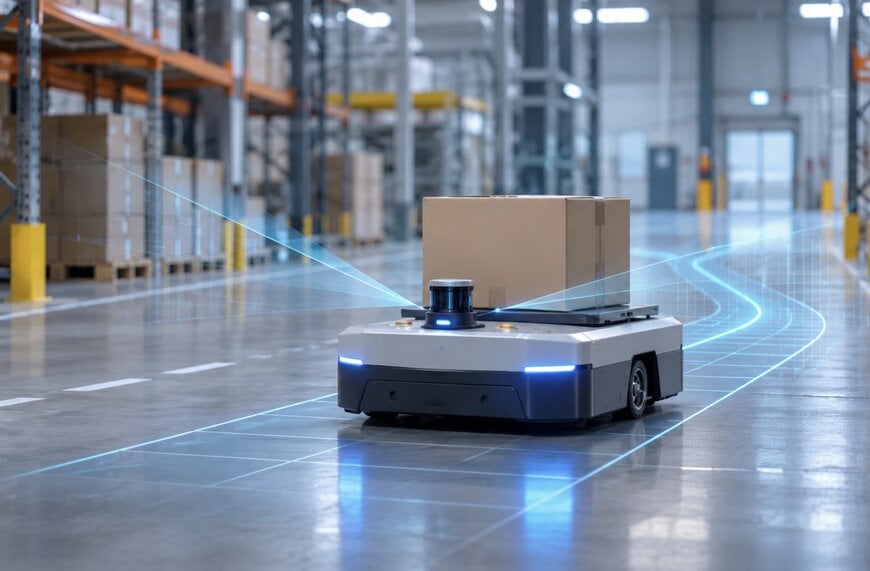
Analog Devices (ADI) and NVIDIA have collaborated to release an extension for the NVIDIA cuVSLAM library that integrates wheel encoders, inertial measurement units (IMUs), and adaptive sensing capabilities. This multi-sensor approach ensures reliable real-time positioning for differential drive and transport robots navigating complex industrial and warehouse environments.
Addressing Positional Drift in Repetitive Environments
Simultaneous Localization and Mapping (SLAM) systems historically struggle in industrial facilities characterized by monotonous walls, repeating storage racks, and variable lighting. While visual SLAM (VSLAM) utilizes camera algorithms to estimate a robot’s orientation and movement path, rapid rotation or line-of-sight obstructions frequently induce positional drift. To address these vulnerabilities in transport robots and Ackermann steering vehicles, engineers shifted from relying on single-measurement sources to a tightly coupled estimation unit capable of processing complementary sensor data on edge computing platforms.
Direct Integration of Kinematic Wheel Odometry
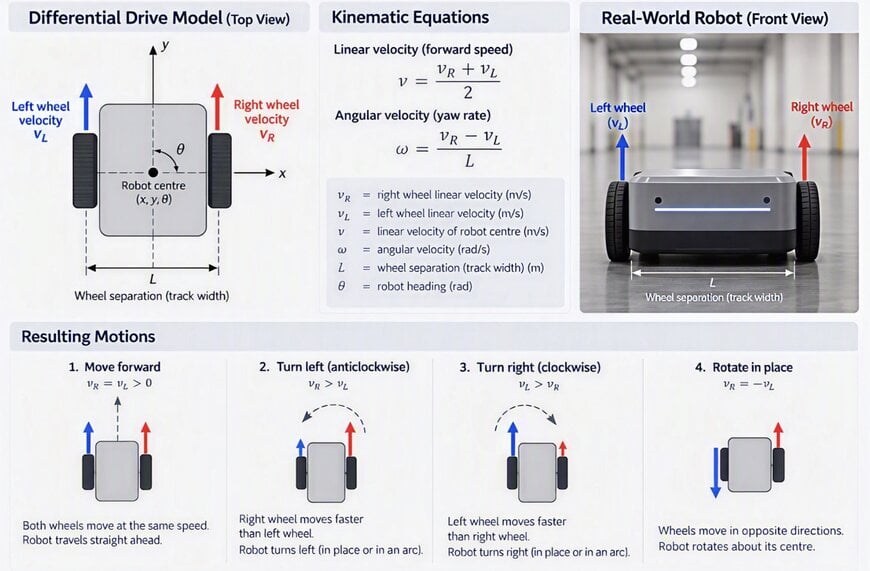
The first architectural enhancement imports measurement data directly from wheel encoders into the positioning process, evaluating both visual and mechanical data simultaneously rather than sequentially. Testing with high-resolution optical encoders demonstrated a 60 percent reduction in average position estimation error. Across complex autonomous mobile robot trajectory segments, integrating mechanical wheel telemetry with spatial visual data reduced the average positional deviation from 24.2 centimeters to 9.7 centimeters. On embedded hardware, the maximum tracking error fell from 1.923 meters to 0.275 meters, with a minimal processing time increase from 1.40 to 1.81 milliseconds per frame. This redundancy maintains tracking during camera obstructions, restricting error to 13.2 centimeters over a five-second visual blackout, while cross-referencing camera data limits deviation to 28.7 centimeters during mechanical wheel slip.
Geometric Tracking for Low-Texture Navigation
Visual algorithms fundamentally rely on distinct textures and corners, which are scarce on flat factory floors. To counter this, the expanded library enables continuous tracking of linear geometric elements such as door frames, structural edges, and continuous shelving. By identifying these lines from multiple viewpoints and dynamically balancing them with traditional point tracking, the system maintains trajectory lock when standard textures are absent. Evaluating this dual point-and-line tracking method across 30 distinct indoor testing profiles yielded measurable positional accuracy improvements in 26 scenarios.
Adaptive Sensor Balancing via Smart Fusion
Rather than utilizing a static calibration factor between optical sensors and IMUs, the system introduces an adaptive balancing architecture called Smart Fusion. A lightweight machine learning model, requiring only 914 tunable parameters, evaluates 10 real-time metrics—including feature visibility duration and camera tracking error—to toggle between vision-trusted and IMU-trusted operational states. When visual features degrade, the system autonomously weights the IMU data more heavily. Standardized benchmarking confirmed the efficacy of this dynamic approach, reducing mean positional error on the EuRoC micro aerial vehicle dataset by 27.7 percent (from 20.2 to 14.6 centimeters) and improving accuracy on the TUM-VI indoor sequences by 14.9 percent (from 27.0 to 23.0 centimeters).
Additional Context
This section details technical specifications and competitive benchmarking not included in the original news release.
In the competitive landscape of visual-inertial odometry, standard open-source frameworks such as ORB-SLAM3 rely primarily on point-based feature extraction and vision-IMU fusion, typically achieving high accuracy in well-textured environments. However, conventional VSLAM systems often experience severe degradation or tracking failure in visually ambiguous industrial settings because they lack native, tightly coupled integration of wheel kinematics and linear geometric features. ADI’s extension differentiates itself by synchronizing continuous wheel odometry, linear structural tracking, and adaptive IMU weighting within a unified GPU-accelerated pipeline, thereby mitigating the accumulative drift and wheel-slip vulnerabilities that compromise standard loose-coupled navigation stacks.
Edited by Aishwarya Mambet, Induportals Editor, with AI assistance.
www.analog.com
