
electronics-journal.com
05
'26
Written on Modified on
STMicroelectronics launches STM32H7P MCUs with embedded edge-AI and DSP acceleration
The Cortex-M7 based microcontrollers integrate dedicated NPU and HSP hardware to optimize digital power and industrial control systems.
www.st.com
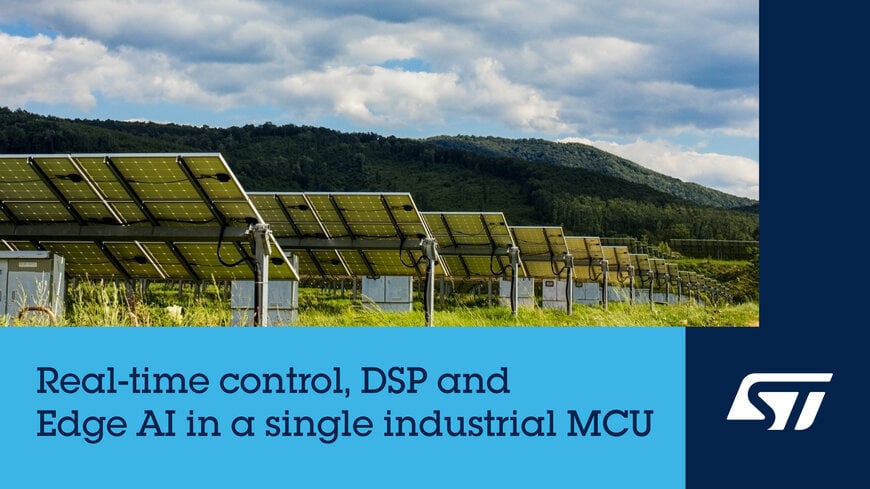
STMicroelectronics has expanded its high-performance microcontroller portfolio with the introduction of the STM32H7P series, engineered specifically for mission-critical industrial applications such as digital power, motor control, and condition monitoring. Built around a 520MHz Arm® Cortex®-M7 core that achieves a 2773-CoreMark® score, the new MCUs are designed to handle demanding real-time control workloads. To maximize performance without migrating to a higher-cost platform, the architecture integrates up to 2MB of Flash memory alongside expanded Tightly Coupled Memories (TCM) for ultra-fast instruction and data access.
Hardware accelerators for DSP and AI workloads
The defining feature of the STM32H7P series is the integration of two dedicated hardware accelerators that offload heavy computational tasks from the main CPU. The Hardware Signal Processor (HSP) acts as a highly efficient DSP engine for matrix, vector, and digital signal operations, executing Fast Fourier Transforms (FFTs) up to five times faster than traditional software implementations on the Cortex-M7.
Parallel to this, the Neural-ART™ Neural Processing Unit (NPU) delivers up to 85 GOPS (Giga Operations Per Second) to accelerate edge-AI workloads. This hardware allows complex machine-learning models to run directly on the edge device without software constraints; for instance, ST reports that AI models for battery-management systems (BMS) run 15 times faster, while Arc Fault Circuit Interrupter (AFCI) safety models for solar inverters achieve up to 40 times faster inference. To further support power electronics, the series inherits advanced analog peripherals—including high-resolution ADCs, DACs, and comparators—from the STM32G5 mixed-signal family. Rated for ambient temperatures up to 125°C, the MCUs feature an exposed-pad LQFP package option to ensure robust thermal dissipation in harsh manufacturing environments.
Additional Context: Field-Oriented Control (FOC) and AI-driven Arc Fault Detection
This section details motor control mathematics and renewable energy safety principles not included in the original press release.
In advanced industrial motor control, such as sensorless Field-Oriented Control (FOC) for permanent magnet synchronous motors (PMSM), the microcontroller must continuously execute complex trigonometric calculations—specifically Clarke and Park transformations. These algorithms translate three-phase alternating stator currents into a two-coordinate, time-invariant system to independently control the magnetic flux and torque. Because these calculations must be computed at control loop frequencies often exceeding 20 kHz, they consume massive amounts of CPU bandwidth. A dedicated Hardware Signal Processor (HSP) handles these heavy matrix and vector math operations natively, preventing the main CPU from bottlenecking and allowing it to simultaneously manage industrial Ethernet communications (like PROFINET or EtherCAT) or functional safety protocols.
Furthermore, the integration of a Neural Processing Unit (NPU) is transformative for renewable energy infrastructure. In solar photovoltaic (PV) systems, high-voltage DC series arcs are a major fire hazard. However, they are notoriously difficult to detect because the high-frequency electrical noise generated by a dangerous arc closely mimics the normal, benign switching noise of the inverter's insulated-gate bipolar transistors (IGBTs). Traditional algorithmic filters struggle to differentiate the two, often triggering frustrating false alarms (nuisance tripping). Edge-AI models running on an NPU can continuously ingest real-time current waveforms and use trained neural networks to instantly recognize the unique spectral signature of a genuine arc fault (AFCI), safely tripping the circuit microseconds before a fire can ignite.
Edited by an industrial journalist, Lekshman Ramdas, with AI assistance.
www.st.com
