
electronics-journal.com
11
'25
Written on Modified on
Infineon Expands CoolSiC Portfolio for Efficient Power Conversion
New 750 V G2 devices in Q-DPAK and D2PAK packages improve thermal behavior, switching efficiency, and gate-drive flexibility for automotive chargers and industrial power systems.
www.infineon.com
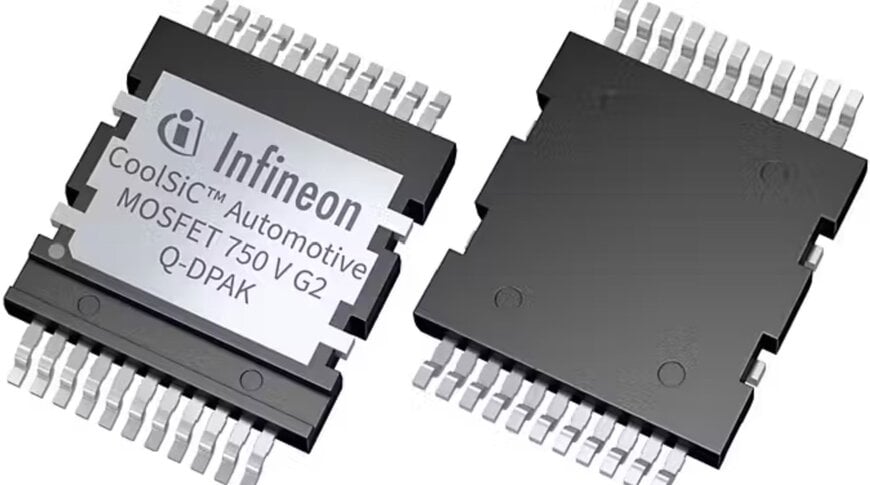
Silicon carbide (SiC) devices are increasingly used in electric mobility, EV charging, and industrial power-conversion systems where efficiency and thermal performance are critical. To support these applications, Infineon Technologies has expanded its CoolSiC MOSFET 750 V G2 portfolio with new packaging options designed for high power density and robust switching behaviour.
Expanded CoolSiC Options for Automotive and Industrial Designs
The portfolio now includes Q-DPAK and D2PAK packages with typical RDS(on) values up to 60 mΩ at 25 °C. These devices target a wide range of power-conversion tasks: onboard chargers and HV–LV DC-DC converters in electric vehicles, as well as server and telecom switch-mode power supplies and EV-charging infrastructure in industrial environments.
For applications requiring very low conduction losses, the series also offers an ultra-low RDS(on) option of 4 mΩ at 25 °C. This level of resistance is suitable for static switching functions such as solid-state circuit breakers, eFuses, high-voltage battery disconnect units, and solid-state relays, where minimized on-state losses directly improve system efficiency.
Top-Side Cooling for Higher Thermal Performance
A key addition to the range is the top-side-cooled Q-DPAK package. By transferring heat through the top surface rather than the PCB, this package enables more efficient thermal paths and simplifies cooling design in high-power applications. This architecture is intended for systems where thermal headroom limits power density.
The devices also exhibit improved figures of merit, including RDS(on) × QOSS and RDS(on) × Qfr. These characteristics reduce switching losses in both hard-switching and soft-switching topologies, improving efficiency particularly in hard-switching conditions where switching energy typically dominates.
Robust Gate Behavior and Design Margin
The CoolSiC MOSFET 750 V G2 technology combines a typical threshold voltage VGS(th) of 4.5 V at 25 °C with a low QGD/QGS ratio. This combination helps limit parasitic turn-on events during fast switching transitions—important for reliability in high-frequency designs or in systems with high dv/dt.
The components support static gate voltages down to −7 V and transient voltages down to −11 V, offering broad compatibility with existing gate-driver platforms. These extended ratings provide designers with additional safety margins when dealing with noise, switching transients, or mixed-technology designs.
www.infineon.com
