
Configurable Single-Coil Fan Control for Low-Power Systems
Melexis introduces a highly configurable cooling fan driver for low-power consumer, appliance, and power-infrastructure applications, enabling smoother motor control, lower noise, and simplified system integration.
www.melexis.com
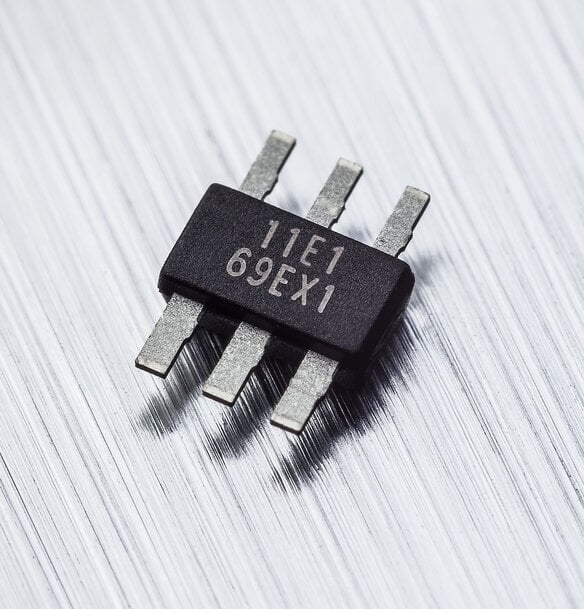
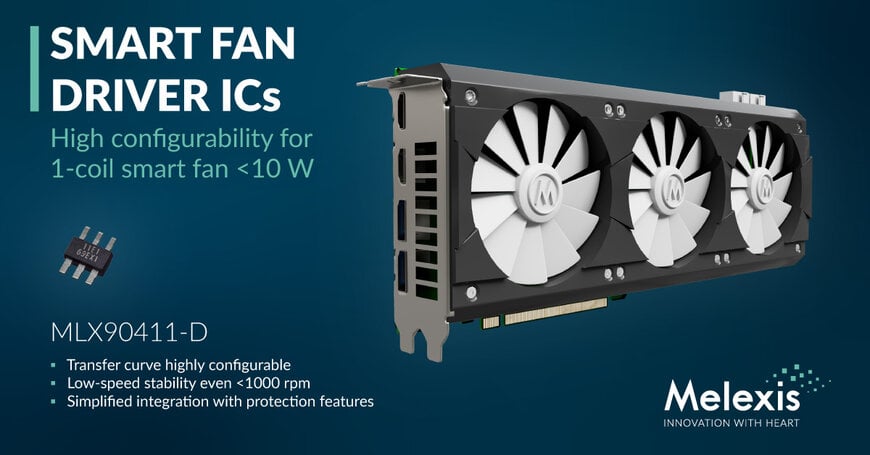
Melexis has expanded its single-coil fan driver portfolio with a new device designed for low-power cooling applications up to 10 W. The solution targets electronically commutated single-coil fans used in consumer electronics, household appliances, and power-conversion equipment, where acoustic performance, lifetime stability, and cost efficiency are key design constraints.
Addressing Noise, Lifetime, and Cost Constraints
Cooling fans used in gaming systems, PCs, refrigerators, uninterruptible power supplies (UPS), and energy storage systems (ESS) are increasingly required to operate quietly while maintaining stable performance over long service lifetimes. At the same time, manufacturers seek to reduce system cost and component count without compromising robustness.
The newly introduced fan driver is designed to operate with supply voltages of 5 V, 12 V, 24 V, and 32 V, covering both consumer and industrial voltage domains. Its architecture focuses on improving motor smoothness at low speeds, a known challenge in compact fan designs where torque ripple and control instability can increase acoustic noise and mechanical wear.
Motor-Control Algorithm and Speed Regulation
A revised proportional–integral (PI) control algorithm enables stable fan operation at speeds below 1,000 rpm, extending the usable operating range of single-coil motors. Multiple configurable start- and stop-profiles allow system designers to tune ramp-up and ramp-down behavior to specific airflow and noise requirements.
In addition, the speed-curve definition is configurable at both the minimum and maximum operating points. This allows precise airflow control while reducing unnecessary power consumption by lowering minimum fan speeds during light thermal loads. The result is improved acoustic behavior and reduced energy use, particularly in variable-load systems such as PC cooling or inverter-based power electronics.
Integrated Monitoring and System Simplification
To support system-level diagnostics and monitoring, the device integrates frequency generator (FG) and rotation detection (RD) outputs as standard features. This removes the need for variant-specific components and enables closed-loop monitoring of fan speed and rotation status.
The pulse-width modulation (PWM) input supports selectable pull-up or pull-down configurations, eliminating external inverters and reducing the overall bill of materials. This flexibility allows straightforward integration into different control architectures while simplifying PCB design.
Protection Functions and Reliability
The fan driver incorporates programmable locked-rotor protection (LRP), temperature shutdown (TSD), overvoltage protection (OVP), and short-circuit protection (OCP). These mechanisms protect both the motor and the driver under fault conditions and contribute to long-term operational reliability.
Electromagnetic compatibility (EMC) robustness and lifetime performance are maintained in line with the existing device family, supporting use in electrically noisy environments such as power infrastructure and industrial electronics.
Mechanical Compatibility and Target Applications
Housed in a SOT23-6 package, the device is pin-to-pin compatible with earlier family members, enabling migration without PCB redesign. This compatibility supports faster adoption in existing designs while extending functionality through higher configurability.
Typical application areas include gaming consoles, PC and GPU cooling, household refrigeration, and 24 V / 32 V fans used in UPS systems, inverters, and energy storage installations, where controlled airflow and low acoustic emissions are critical system parameters.
www.melexis.com
