
electronics-journal.com
09
'26
Written on Modified on
Integrated Semiconductors for Power, Sensing and Human Detection
Melexis expands its automotive, industrial and robotics portfolio with new power protection, lighting control, inductive sensing and FIR-based people detection technologies.
www.melexis.com
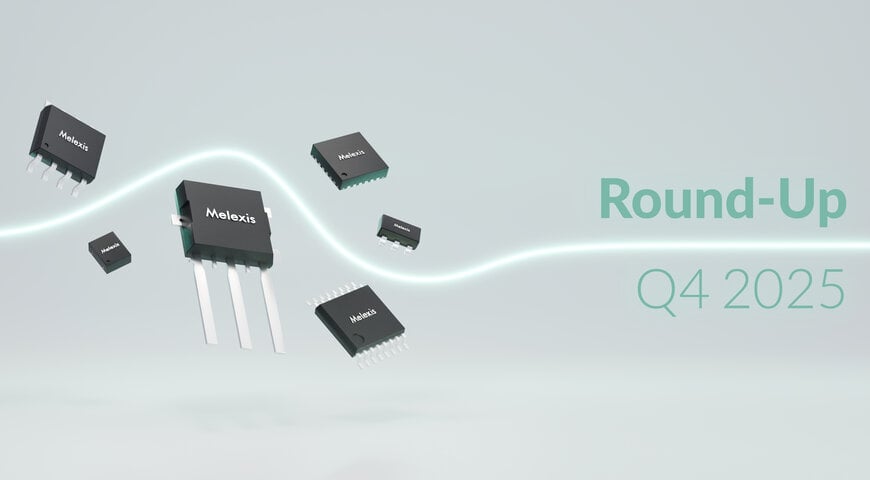
Melexis has introduced ten new semiconductor products and algorithms in Q4 2025, targeting efficiency, integration simplicity and functional reliability across automotive electrification, robotics, industrial automation and smart building applications.
Power electronics protection for SiC-based traction systems
One of the technically significant additions is the MLX91299, a silicon-based RC snubber designed to protect Silicon Carbide (SiC) power modules used in high-voltage automotive applications such as traction inverters. SiC devices switch faster than silicon IGBTs, which improves efficiency but increases voltage overshoot and electromagnetic stress during switching events.
The integrated snubber acts as a controlled energy dissipation path, reducing voltage spikes and limiting transient thermal stress. By minimizing switching losses and heat generation at peak load, the device supports higher inverter efficiency and contributes to reduced cooling requirements. This approach enables more compact inverter layouts while maintaining operational margins required for electric vehicle drivetrain reliability.
Code-free interior lighting control over LIN
The MLX80124 addresses automotive interior lighting architectures where RGB LED strips are deployed across multiple vehicle zones. Instead of firmware-based color calibration, the device relies on parameter-based configuration over LIN, eliminating the need for custom code development.
This architecture reduces software validation effort while ensuring color consistency across distributed lighting nodes, even when LED bins or suppliers vary. The solution is intended for scalable interior lighting designs used in digital cockpit environments, where uniform chromatic output and predictable behavior are required across vehicle platforms.
Inductive position sensing for robotics and e-mobility
For motion control applications, the MLX90514 inductive position sensor provides 16-bit resolution for contactless angle and linear position measurement. Inductive sensing avoids mechanical wear and contamination sensitivity associated with optical or potentiometric sensors, making it suitable for robotics joints, steering systems and electric actuators.
By integrating signal processing and calibration functions, the device simplifies control-loop design and reduces external component count. This supports faster system qualification and lower R&D overhead in high-volume robotics and e-mobility deployments.
FIR-based people detection without imaging
Melexis also released a people detection algorithm based on Far Infrared (FIR) sensing, targeting smart building and HVAC control systems. Unlike camera-based occupancy detection, FIR sensors measure thermal radiation patterns without capturing identifiable images, aligning with privacy-driven system requirements.
The algorithm is designed as a plug-and-play software layer, allowing system integrators to implement occupancy-based ventilation or lighting control without developing custom signal processing pipelines. This lowers integration barriers for large-scale building automation deployments.
Positioning within the semiconductor landscape
Across these releases, the technical emphasis is on reducing system complexity at the component level whether by absorbing high-voltage transients, removing embedded software from lighting control, or integrating sensing and processing into single devices. Rather than introducing new standards, the products align with existing automotive and industrial architectures such as LIN networks, SiC-based power stages and contactless sensing topologies.
According to Marc Biron, the portfolio expansion is intended to give engineers validated building blocks that reduce design risk while meeting efficiency, reliability and scalability requirements across multiple industries.
Application areas
The newly introduced solutions target electric and hybrid vehicles, industrial drives, collaborative and mobile robots, and smart building infrastructure, with a common focus on power efficiency, integration density and predictable system behavior.
www.melexis.com
