
electronics-journal.com
31
'25
Written on Modified on
Dual-Core Embedded Platform for AI and Real-Time Control
DigiKey distributes Arduino’s UNO Q, a dual-processor development board bridging embedded control and edge AI workloads.
www.digikey.com
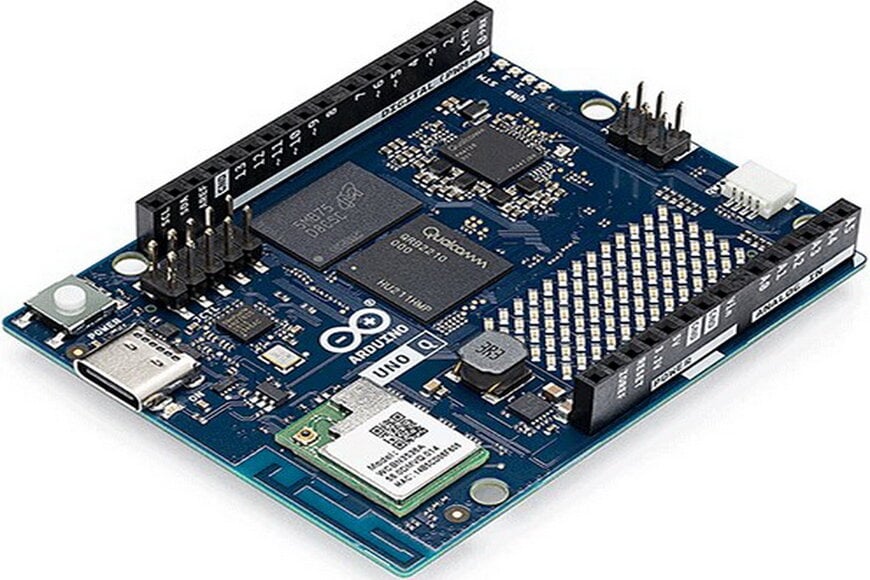
The Arduino UNO Q is a dual-processor development platform that integrates a high-performance microprocessor unit (MPU) capable of running Linux alongside a deterministic microcontroller unit (MCU), enabling embedded systems designers to address demanding applications in robotics, Internet of Things (IoT), and AI-enabled sensor systems on a single board. This architecture supports workflows combining real-time control with higher-level computing and machine-learning inference.
Platform Architecture and Core Capabilities
The UNO Q’s hardware architecture departs from conventional single-controller boards by co-locating two distinct processing subsystems. The primary MPU, based on a quad-core Arm Cortex-A53 running at 2.0 GHz with an integrated GPU and dual image signal processors, is paired with 2 Gbytes of RAM and 16 Gbytes of onboard eMMC storage. This subsystem is capable of hosting the Debian Linux operating system and executing Python scripts and AI inference tasks directly on the board.
Complementing the MPU, the board includes an Arm Cortex-M33-based MCU operating up to 160 MHz with dedicated real-time control responsibilities. The MCU executes time-critical functions such as sensor polling, motor actuation, and peripheral interfacing, maintaining predictable latency characteristics required in embedded control systems.
Connectivity and expansion adhere to Arduino heritage by maintaining standard UNO headers for compatibility with existing shields, while additional connectors (Qwiic for sensors and high-speed headers for MIPI cameras and displays) extend the board’s applicability to computer vision and multimedia applications.
Unified Development with App Lab
The platform’s software environment, Arduino App Lab, brings together development for both processors under a single toolchain. App Lab abstracts the dual-processor nature of the board, allowing developers to deploy projects that execute Arduino sketches on the real-time MCU and Python or containerized AI models on the MPU without needing separate development environments. Communication between the processors is facilitated by the Arduino Bridge, an RPC (remote procedure call) framework that enables inter-processor function invocation without bespoke communications code.
By combining real-time control with Linux-class compute, the UNO Q is positioned for multiple technical use cases:
- Robotics: Implementing autonomous navigation and sensor fusion while maintaining deterministic motor control loops.
- Edge AI and Computer Vision: Running inference on camera feeds and integrating results into physical actuators or displays.
- IoT and Smart Systems: Hosting embedded web services and dashboards for remote monitoring while managing local sensor networks in real time.
A practical demonstration with environmental sensing hardware involves the MCU acquiring sensor data via I²C and relaying it through the Bridge to the MPU, where Python routines generate visualizations and host a web dashboard, exemplifying an integrated digital supply chain for embedded data workflows.
Positioning Within Embedded Development Platforms
The UNO Q’s dual-processor, dual-OS design aligns it with emerging edge computing trends that demand concurrent real-time control and inference capabilities on a single, compact platform. While conventional microcontroller boards focus on low-latency control and single-board Linux computers like single-board computers (SBCs) emphasize high-level computation, the UNO Q attempts to bridge these domains without external co-processors or complex communications stacks.
www.digikey.com
Positioning Within Embedded Development Platforms
The UNO Q’s dual-processor, dual-OS design aligns it with emerging edge computing trends that demand concurrent real-time control and inference capabilities on a single, compact platform. While conventional microcontroller boards focus on low-latency control and single-board Linux computers like single-board computers (SBCs) emphasize high-level computation, the UNO Q attempts to bridge these domains without external co-processors or complex communications stacks.
www.digikey.com
