
electronics-journal.com
05
'26
Written on Modified on
Edge Processing Enables Faster Millimeter-Wave Scanning
Integrated signal-processing architecture adopted to accelerate millimeter-wave imaging for security screening, reducing data load and enabling near real-time analysis.
www.digikey.com
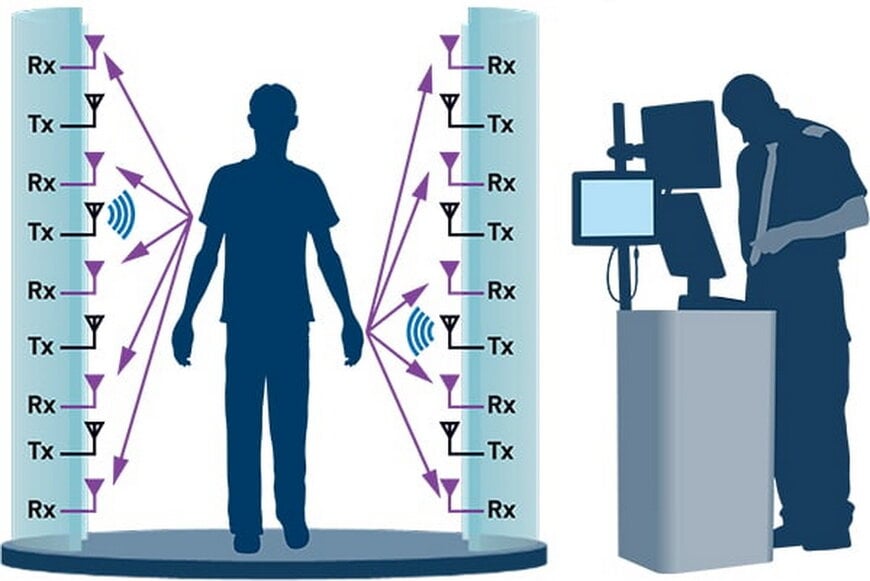
Millimeter-wave (mmWave) imaging is increasingly used in security scanning at airports, stadiums, and public buildings because it can detect both metallic and non-metallic threats and provide spatial location of suspicious items. Traditional mmWave systems generate and process large quantities of backscatter data across antenna arrays, and processing this data quickly has been a barrier to deploying systems capable of rapid, walk-through scanning without pauses. Designers of advanced security scanners sought improvements in scanning speed, data processing throughput, and system integration to meet operational demands for throughput and accuracy.
To address these challenges, developers implemented an integrated hardware solution that embeds edge processing directly within the mmWave signal chain. The architecture combines frequency synthesis, RF transmission and reception, and analog-to-digital conversion in a tightly coupled signal chain, shifting significant demodulation and decimation tasks to edge hardware rather than central processors.
Technical Challenge and Goals
Existing mmWave systems rely on components that produce raw backscatter data requiring extensive central processing. This approach increases latency, demands high central processor bandwidth, and limits the number of channels and frequencies that can be scanned in rapid succession. System architects aimed to overcome these limitations to achieve faster scan times, higher resolution imaging, and reduced latency in real-time threat detection scenarios.
Key goals included:
- Increasing scanning throughput to support continuous movement of subjects through the scanning area rather than requiring pauses.
- Reducing the volume of raw data passed to central processors by performing initial signal processing at the hardware edge.
- Maintaining sufficient resolution to identify small objects while improving operational speed.
Technical Solution Deployed
The adopted solution integrates multiple specialized integrated circuits (ICs) into a cohesive mmWave imaging chipset. Central to this architecture is a wideband frequency synthesizer that supplies precise RF signals, several multi-channel transmitter and receiver ICs that handle upconversion and downconversion across the 10 GHz to 40 GHz range, and a multi-channel analog-to-digital converter (ADC) capable of high-speed sampling. Embedded state machines and on-chip filters within the transmitter and receiver ICs allow rapid channel switching and preliminary signal conditioning without continuous central control intervention.
A critical feature of the deployed architecture is on-chip edge processing within the ADC stage. This processing decimates and demodulates selected bands of interest, synchronizes data across ICs, and presents data that is substantially reduced in volume and closer to the final imaging information required for automated analysis. By offloading early-stage processing, the system reduces reliance on a central processor and shortens the overall data path.
Deployment and Integration Support
In the development phase, solution providers worked with imaging system designers to integrate the chipset into the broader scanning platform. The hardware components were preconfigured to support coordinated frequency stepping and rapid antenna switching. Advanced sequencers within the transmitter and receiver ICs were programmed with optimal filter and multiplier settings to streamline frequency sweeps. This on-chip sequencing minimizes explicit external control commands, enabling faster channel transitions and more predictable timing behavior.
Results and Measurable Benefits
By embedding edge processing and synchronizing key functions, the integrated hardware approach reduced the necessary scan time significantly. System simulations and measurements showed that coordinated switching and on-chip processing enable complete frequency sweeps across multiple channels in milliseconds rather than seconds. With channel-to-channel switching on the order of nanoseconds and rapid ready-to-transmit transitions, full scans from 10 GHz to 40 GHz can be completed in about 20 ms, and further architectural enhancements (such as parallel frequency groups) offer the potential for additional speed gains.
Although specific throughput percentages and energy figures were not disclosed, the architectural shift to edge-centric processing yields objective benefits by reducing the load on central processing units, lowering data transfer overhead, and enabling near real-time imaging that supports continuous movement through security portals.
The deployment of integrated mmWave hardware with edge processing addresses long-standing bottlenecks in imaging speed and system responsiveness. By reshaping the processing pipeline and embedding demodulation and decimation tasks within hardware, developers achieved substantial improvements in scanning throughput and laid the groundwork for next-generation security scanners capable of rapid, accurate imaging in high-traffic environments.
www.digikey.com
The adopted solution integrates multiple specialized integrated circuits (ICs) into a cohesive mmWave imaging chipset. Central to this architecture is a wideband frequency synthesizer that supplies precise RF signals, several multi-channel transmitter and receiver ICs that handle upconversion and downconversion across the 10 GHz to 40 GHz range, and a multi-channel analog-to-digital converter (ADC) capable of high-speed sampling. Embedded state machines and on-chip filters within the transmitter and receiver ICs allow rapid channel switching and preliminary signal conditioning without continuous central control intervention.
A critical feature of the deployed architecture is on-chip edge processing within the ADC stage. This processing decimates and demodulates selected bands of interest, synchronizes data across ICs, and presents data that is substantially reduced in volume and closer to the final imaging information required for automated analysis. By offloading early-stage processing, the system reduces reliance on a central processor and shortens the overall data path.
Deployment and Integration Support
In the development phase, solution providers worked with imaging system designers to integrate the chipset into the broader scanning platform. The hardware components were preconfigured to support coordinated frequency stepping and rapid antenna switching. Advanced sequencers within the transmitter and receiver ICs were programmed with optimal filter and multiplier settings to streamline frequency sweeps. This on-chip sequencing minimizes explicit external control commands, enabling faster channel transitions and more predictable timing behavior.
Results and Measurable Benefits
By embedding edge processing and synchronizing key functions, the integrated hardware approach reduced the necessary scan time significantly. System simulations and measurements showed that coordinated switching and on-chip processing enable complete frequency sweeps across multiple channels in milliseconds rather than seconds. With channel-to-channel switching on the order of nanoseconds and rapid ready-to-transmit transitions, full scans from 10 GHz to 40 GHz can be completed in about 20 ms, and further architectural enhancements (such as parallel frequency groups) offer the potential for additional speed gains.
Although specific throughput percentages and energy figures were not disclosed, the architectural shift to edge-centric processing yields objective benefits by reducing the load on central processing units, lowering data transfer overhead, and enabling near real-time imaging that supports continuous movement through security portals.
The deployment of integrated mmWave hardware with edge processing addresses long-standing bottlenecks in imaging speed and system responsiveness. By reshaping the processing pipeline and embedding demodulation and decimation tasks within hardware, developers achieved substantial improvements in scanning throughput and laid the groundwork for next-generation security scanners capable of rapid, accurate imaging in high-traffic environments.
www.digikey.com
