
electronics-journal.com
23
'26
Written on Modified on
Melexis Unveils High-Resolution 22-Bit Inductive Encoder
The MLX90520 fulfils the demand for high-accuracy, cost-effective position sensing in robotics and large machinery joints with diameters between 20 and 200mm.
www.melexis.com
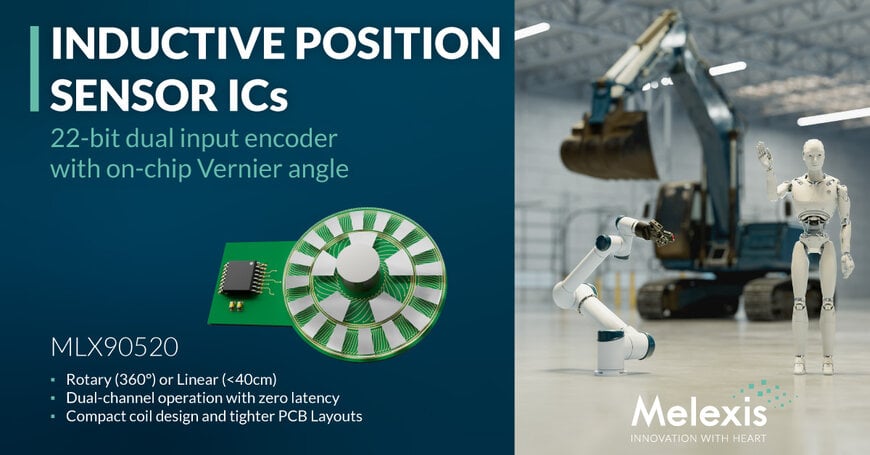
Melexis has released a high-resolution inductive encoder IC designed to meet increasing demands for accurate, robust position sensing in robotics, automated systems, and large motion mechanisms. The MLX90520 provides 22-bit resolution for both rotary and linear movement, targeting applications where high fidelity feedback and system reliability are critical.
High-Precision Inductive Sensing and Its Relevance
Position feedback is a foundational element in motion control architectures for robots, automated machinery, and large mechanical joints. Traditional optical encoders have long served this purpose, but they pose challenges related to mechanical fragility, sensitivity to contaminants, and the need for sizeable auxiliary components such as magnets. In contrast, inductive sensing relies on electromagnetic field interaction between coils and targets, offering inherent robustness to environmental conditions such as dust and particulates, and reducing the dependency on precision optics or large magnetic assemblies.
The MLX90520 functions as an absolute inductive encoder interface IC capable of resolving motion with 22-bit granularity. It supports both rotary and linear motion up to 400 mm and outputs positional data via SPI or SSI digital protocols. This combination of high resolution, low latency, and digital output formats aligns with engineers’ needs for deterministic feedback in complex control loops, especially in larger robotic arms and industrial actuators.
Technical Characteristics and Integration Advantages
The key technical advancement in the MLX90520 is its 22-bit resolution, which corresponds to over four million distinct positions across a full motion range, enabling fine-grained feedback that can improve motion repeatability and control precision in tasks such as robotic joint articulation or heavy machining operations. By internalizing digital processing, the IC minimizes noise and latency in position reporting.
One notable design attribute is the encoder module’s slim profile—less than 3 mm for the IC, printed circuit board (PCB), and target combined. This compact form factor allows through-shaft integration and simplifies mechanical assemblies compared with optical and magnetic alternatives that often require bulky encoder housings and magnets. The inductive approach also avoids reliance on magnetic fields, which can be sensitive to nearby ferrous materials or external stray fields, and instead leverages electromagnetic coupling that is intrinsically more immune to such disturbances.
Functional safety considerations are addressed through on-board digital processing and an architecture that supports compliance up to SIL 3 at the system level. For industrial and robotics applications where system failure can lead to significant safety risks, such compliance provides a measurable benchmark for integration into safety-critical motion control systems.
Industrial Application Scenarios
The inductive encoder’s 22-bit resolution and robust sensing make it suitable for a range of industrial use cases. In robotics, high-accuracy feedback is essential for precise manipulator control, trajectory execution, and coordinated multi-axis motion. In large machinery—such as construction equipment or agricultural automation—accurate positional awareness across broad rotational or linear ranges ensures repeatable and safe operation of actuators and joint mechanisms. The slim module profile is particularly advantageous in space-constrained mechanisms where traditional encoder packages would be difficult to accommodate.
Beyond robotics and large machines, the MLX90520’s combination of high resolution and digital integration may also benefit automated assembly lines, pick-and-place equipment, and linear actuator-based systems in industrial automation where precision and uptime are key performance indicators.
Integration Considerations and Competitive Position
When compared with conventional optical encoders, inductive encoders like the MLX90520 reduce mechanical complexity and improve resistance to contamination, offering a clear trade-off in favor of durability and integration simplicity. While some magnetic encoder solutions also provide robust performance, inductive sensing does not require magnets, alleviating design constraints associated with magnet sourcing, placement, and stray field effects. Additionally, the availability of standard digital interfaces (SPI, SSI) facilitates integration with modern controllers and motion systems without extensive conversion logic.
www.melexis.com
