
electronics-journal.com
28
'26
Written on Modified on
European Space FPGA Collaboration for Satellite Systems
NanoXplore and STMicroelectronics partner to qualify NG-ULTRA FPGA for space missions and strengthen European digital infrastructure.
www.st.com
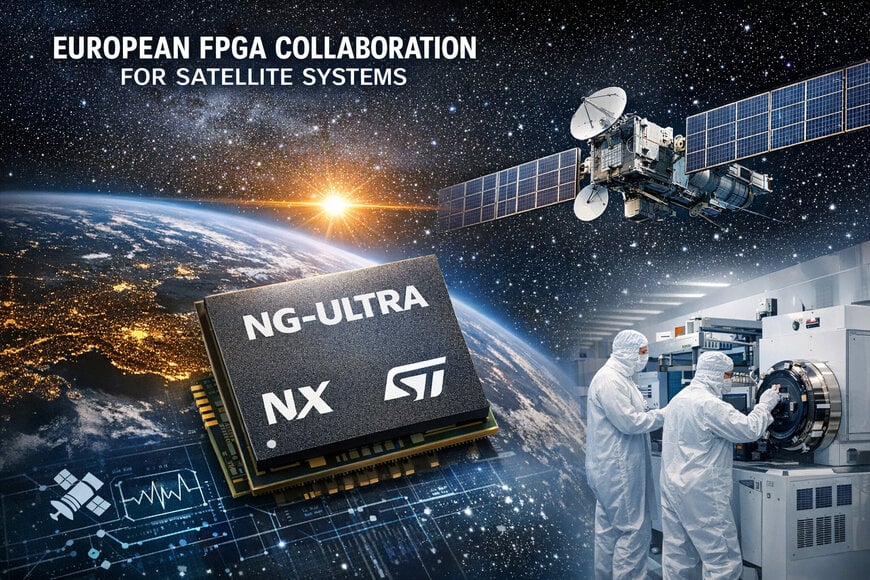
NanoXplore SAS and STMicroelectronics have jointly developed and qualified a European FPGA hardware platform for space applications, targeting onboard computing and data processing in satellite systems under the new ESCC 9030 standard. The cooperation brings together NanoXplore’s FPGA design expertise with STMicroelectronics’ semiconductor manufacturing and process technology to deliver a radiation-hardened System-on-Chip (SoC) Field-Programmable Gate Array (FPGA) for aerospace and “new space” missions.
Context of the Cooperation
NanoXplore SAS is a European designer of radiation-hardened FPGAs tailored to the high-reliability requirements of space and aerospace applications. STMicroelectronics is a global semiconductor manufacturer with advanced digital process, packaging, and qualification capabilities. The technical challenge addressed by this cooperation is the need for a high-performance, radiation-tolerant digital platform that meets emerging satellite system requirements—processing large data volumes onboard while complying with European space standards—and reduces reliance on non-EU supply chains.
The collaboration was required because designing a space-grade FPGA involves complementary expertise: NanoXplore provides domain-specific FPGA architecture and logic design, while STMicroelectronics supplies mature digital silicon process (28 nm FD-SOI), advanced packaging, test infrastructure, and quality assurance across European sites.
Technical Solution and Division of Responsibilities
The product of this cooperation, NG-ULTRA, is a radiation-hardened SoC FPGA that integrates a multi-core Arm® Cortex®-R52 processor with programmable logic on a single silicon die built using ST’s 28 nm fully depleted silicon-on-insulator (FD-SOI) technology. This architecture reduces board complexity, lowers total system mass and power consumption, and supports in-orbit hardware reconfiguration via its SRAM-based programmable fabric.
NanoXplore led the development of the FPGA architecture, logical IP integration, and specifications for onboard computing functions such as data routing, image/video processing, and software-defined radio. STMicroelectronics provided process technology expertise, manufacturing in its 300 mm fabrication plant, space-grade packaging, and reliability testing to achieve qualification. NG-ULTRA demonstrates tolerance to harsh space environments with a Total Ionizing Dose (TID) capability of up to 50 krad(Si) and robust immunity against single event effects validated for high Linear Energy Transfer (LET) levels.
Deployment and Implementation
NG-ULTRA has been qualified to the new ESCC 9030 standard, which covers high-performance microcircuits on organic or plastic packages intended for space use, a first for European FPGA technology. This qualification ensures reliability in low- and medium-Earth orbit (LEO/MEO) environments and aligns with the reliability expectations of constellation and long-duration missions.
The industrial deployment spans multiple European facilities: NanoXplore design centers in France coordinate the architectural and logical design, while STMicroelectronics’ fabs in France and Italy handle silicon fabrication, packaging in Rennes, and test & reliability assurance, creating a secure, EU-based supply chain for space electronics.
Applications and Use Cases
NG-ULTRA targets key satellite subsystem functions requiring significant onboard processing capability at controlled mass and power budgets. Use cases include on-board computer units, data management and routing between subsystems, real-time image and video processing with compression/encoding, and software-defined radio functionality. Its reconfigurable logic enables hardware adaptability post-launch, allowing system updates and evolving mission requirements to be supported without hardware redesign.
Expected Impact
Achieving ESCC 9030 qualification for NG-ULTRA represents a measurable advancement in European digital infrastructure for space systems. It provides satellite builders with a platform that meets stringent reliability standards while being sourced entirely within the EU, addressing strategic supply-chain independence and compatibility with volume deployment models. The integrated SoC architecture also improves system reliability and reduces latency compared with separate processor and FPGA components, optimizing performance per watt and lowering total system cost.
www.st.com
