
electronics-journal.com
30
'26
Written on Modified on
Toshiba Releases Automotive Motor Control IC Samples
A new gate driver IC for brushed DC motors simplifies system architecture and enhances safety for next-generation automotive applications like doors and seats.
www.global.toshiba
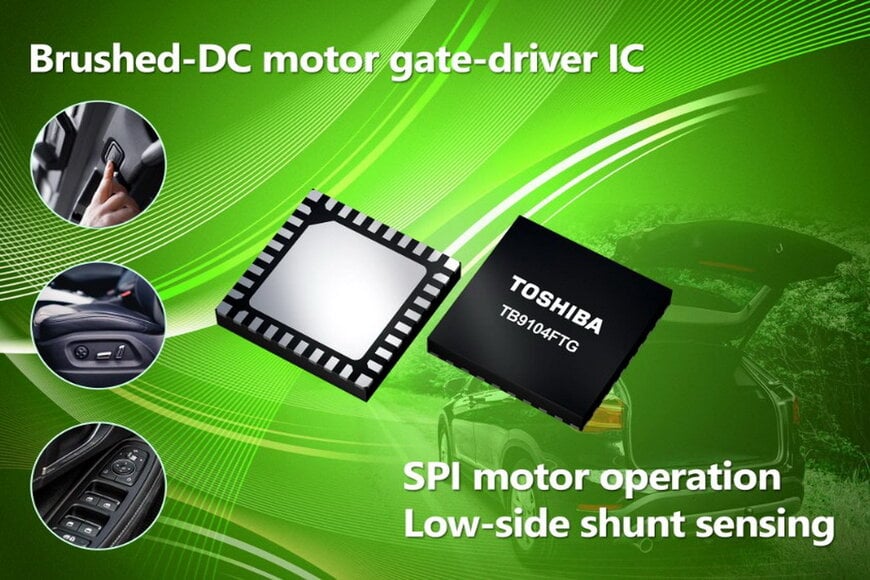
Toshiba Electronics Europe GmbH has begun providing engineering samples of a new gate driver integrated circuit (IC) intended to improve control and efficiency in high-current automotive brushed DC motors, addressing technical needs in body system actuation such as power tailgates, sliding doors and seat adjusters.
Streamlining Motor Control for Automotive Body Systems
The TB9104FTG gate driver IC integrates a serial peripheral interface (SPI) control path alongside conventional pulse-width modulation (PWM) inputs, enabling direct and flexible motor operation control over a high-speed communication link. By consolidating multiple motor controls on a single SPI bus, the architecture reduces the required wiring harness complexity and lowers the processing burden on host microcontrollers (MCUs), which are common constraints in automotive electronic control units (ECUs).
Technical Capabilities and Operational Parameters
The device is packaged in a compact VQFN32 form factor (5.0 mm × 5.0 mm typical) with an exposed thermal pad designed to enhance heat dissipation when used with external H-bridge MOSFETs. It supports both single and dual half-bridge configurations, enabling simultaneous control of two brushed DC motors, which is relevant to digital supply chain architectures in automotive body electronics where multiple actuators are driven from a centralized control node.
To address safety in high-current applications, the TB9104FTG includes an integrated high-precision current sense amplifier that feeds back to the MCU, enabling precise drive-stop control in the event of abnormal current conditions. The IC also incorporates detection functions for low supply voltage, charge pump overvoltage, device overheating, external MOSFET status and SPI communication errors, supporting diagnostic and fault-handling mechanisms expected in safety-critical automotive systems.
Automotive Reliability and Qualification
The gate driver is slated for qualification to AEC-Q100 Grade 1 standards, indicating its design for operation across an extended temperature range from −40 °C to +125 °C, consistent with the thermal and reliability demands of next-generation automotive equipment. These specifications align with industry expectations for robust component performance in environments subject to wide temperature swings and electrical load variability.
Application Context and Industry Relevance
Brushed DC motors remain prevalent in vehicle body applications requiring reliable torque at low speeds and simple control, such as window lifts, door drives and seat positioning mechanisms. By integrating SPI-based control and built-in PWM generation, the TB9104FTG reduces system complexity and supports higher-level MCU resource allocation, addressing engineering challenges associated with networked motor control and congestion on serial communication buses within the automotive data ecosystem.
www.global.toshiba
