
electronics-journal.com
04
'26
Written on Modified on
Unified Wi-Fi 8 Architecture for Enterprise Networks
Broadcom has introduced a Wi-Fi 8 access point and switch platform designed for AI-ready enterprise networks.
www.broadcom.com
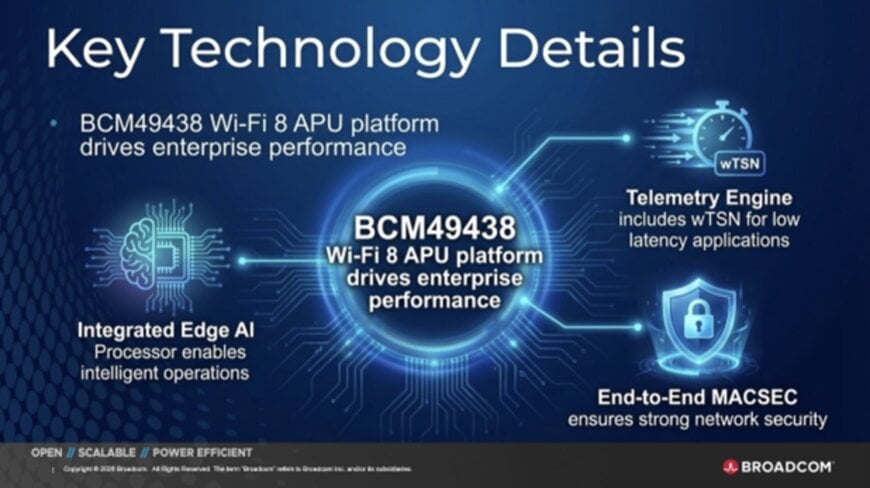
Broadcom has unveiled the industry’s first enterprise Wi-Fi 8 access point and switching solution built on a unified architecture, combining edge AI processing, multi-gigabit Ethernet, and end-to-end security.
Transition to Wi-Fi 8 in enterprise environments
The introduction of Wi-Fi 8 marks a step change in enterprise networking requirements. Higher bandwidth, ultra-low latency for real-time AI workloads, and rapidly growing telemetry volumes from connected devices are placing new demands on both wireless and wired infrastructure. These requirements extend beyond access points to include advanced switching platforms capable of supporting multi-gigabit throughput, deterministic latency, and enhanced quality of service.
Broadcom’s announcement builds on its Wi-Fi 8 radio technology introduced in October 2025 and addresses the need for coordinated upgrades across access and aggregation layers in campus networks.
Edge AI–enabled Wi-Fi 8 access point platform
At the core of the Wi-Fi 8 access point platform is a new accelerated processing unit, the BCM49438. The device integrates high-performance computing, wireless networking, and AI acceleration into a single silicon platform. When combined with Broadcom’s Wi-Fi 8 radio chips—BCM43840, BCM43844, and BCM43820—the platform supports real-time optimisation and adaptive intelligence across multiple frequency bands.
The integrated edge AI/ML engine enables local model execution without requiring a separate neural processing unit or coprocessor. From a system design perspective, this reduces hardware complexity, power consumption, and bill-of-materials cost while enabling low-latency inference for applications such as security monitoring, traffic optimisation, and anomaly detection at the network edge.
Trident X3+ Ethernet switch platform
Complementing the access point is the Trident X3+ Ethernet switch platform, powered by the BCM56390. The switch doubles front-panel bandwidth to support up to 48 multi-gigabit ports, addressing the density and throughput requirements of Wi-Fi 8 deployments.
The platform integrates multi-gigabit PHYs—including BCM84918, BCM54908, and BCM54908E—along with Power over Ethernet power sourcing equipment to deliver both bandwidth and power to access points. A security-first design incorporates MACsec on all switch ports, combined with a Secure Boot engine and hardware root of trust to protect system integrity.
End-to-end security and analytics
Broadcom positions the solution as the first enterprise portfolio to implement MACsec across both access points and switches, enabling encrypted traffic from the wireless edge through the wired infrastructure. The implementation is designed to support post-quantum-cryptography-compliant security mechanisms as standards evolve.
In parallel, the unified architecture introduces expanded telemetry and analytics capabilities. Data is collected consistently across access points and switches, enabling deeper, real-time visibility for AI-driven network operations. This approach moves beyond basic logging toward continuous performance and security analysis within the enterprise data ecosystem.
Deterministic networking and industrial readiness
The architecture also supports wireless time-sensitive networking using IEEE 1588 Precision Time Protocol. This enables deterministic, ultra-low-latency communication, which is relevant for industrial automation, real-time control systems, and AI-driven manufacturing environments where timing precision is critical.
Industry context and operational drivers
The platform is positioned against several converging trends: increased bandwidth demand driven by hybrid work, heightened exposure to adversarial AI-based attacks, the rise of AI-centric compute environments, and growing sensitivity to operating expenditure in network upgrades.
According to analysis from Dell’Oro Group, an end-to-end approach that integrates access points, switches, analytics, and security can reduce operational complexity while improving network performance and resilience.
Implications for enterprise networks
By aligning Wi-Fi 8 access, multi-gigabit switching, edge AI, and security within a single architectural framework, Broadcom’s solution addresses both performance and operational challenges associated with next-generation enterprise networks. For organisations planning campus upgrades, the approach provides a structured path to support AI-driven applications, enhanced security postures, and scalable network operations as Wi-Fi 8 adoption accelerates.
www.broadcom.com
