
electronics-journal.com
19
'26
Written on Modified on
GDDR7 Compliance Test Solution Accelerates High-Speed Memory Development
Keysight Technologies introduces a transmitter compliance solution designed to support PAM3-based GDDR7 validation for graphics and AI system developers.
www.keysight.com
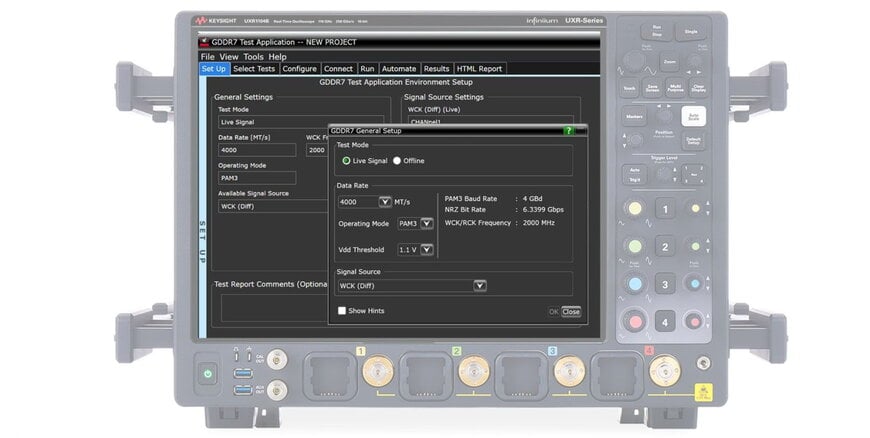
Keysight Technologies has released a new GDDR7 transmitter compliance test solution that automates validation of pulse amplitude modulation (PAM3) signaling in next-generation graphics memory, addressing signal-integrity and interoperability challenges at ultra-high data rates for high-performance computing and artificial intelligence applications.
Addressing PAM3 Signaling in GDDR7
Graphics Double Data Rate 7 (GDDR7) memory represents a generational shift in memory interfaces by adopting PAM3 encoding instead of traditional non-return-to-zero (NRZ) signaling to increase bandwidth while managing channel complexity. This modulation scheme uses three distinct voltage levels to convey data more efficiently per cycle, enabling data rates up to around 48 Gbps per pin but requiring precise measurement techniques to ensure signal integrity under real-world conditions.
The Keysight solution comprises D9370GDDC test software running on UXR real-time oscilloscopes. When paired with a high-frequency probe amplifier and 25 GHz probe, it provides automated compliance testing aligned with JEDEC JESD239 specifications and advanced signal-to-noise-and-distortion ratio (SNDR) analysis. These measurements account for crosstalk and other channel impairments, enabling engineers to identify faults in electrical, timing, jitter, and eye-diagram characteristics essential for GDDR7 compliance.
Relevance for Technical Development
For memory and GPU vendors targeting markets such as AI accelerators, gaming platforms, and high-performance computing, validating PAM3 signaling is a core requirement in the digital supply chain to meet performance and interoperability targets. Automating compliance testing reduces manual setup, shortens validation cycles, and yields repeatable measurements to support design optimization at targeted 48 Gbps signaling rates.
The solution’s automation and low-noise measurement floor support detailed electrical and timing analysis, helping engineering teams reliably optimize transmitter designs early in the development process. Such capabilities are critical as PAM3-based GDDR7 interfaces become commonplace in systems demanding greater memory bandwidth and efficiency.
Industry Validation and Demonstration
Keysight plans to demonstrate the GDDR7 transmitter compliance solution at DesignCon 2026 in Santa Clara, California, from February 24–26, where engineers can observe test workflows and PAM3 signal-integrity measurements in practice.
Application Context
Engineers working on next-generation GPUs and memory subsystems will find this test solution applicable in design validation and qualification workflows, particularly where high-speed interfaces drive critical performance targets. The combination of automated compliance testing, advanced SNDR metrics, and high-bandwidth probing aligns with industry trends toward increased signaling complexity in digital interfaces such as those found in high-end graphics and AI accelerators.
The introduction of PAM3-aware compliance testing reflects broader industry adoption of GDDR7 signaling standards and underscores technical challenges in validating advanced modulation schemes at multi-tens of gigabits per second.
www.keysight.com
