
electronics-journal.com
20
'26
Written on Modified on
CEA-Leti Unveils Chip-Scale EPR Spectrometer
22nm battery-powered IC achieves ultra-fast scans, wide spectral span and high sensitivity.
www.cea.fr
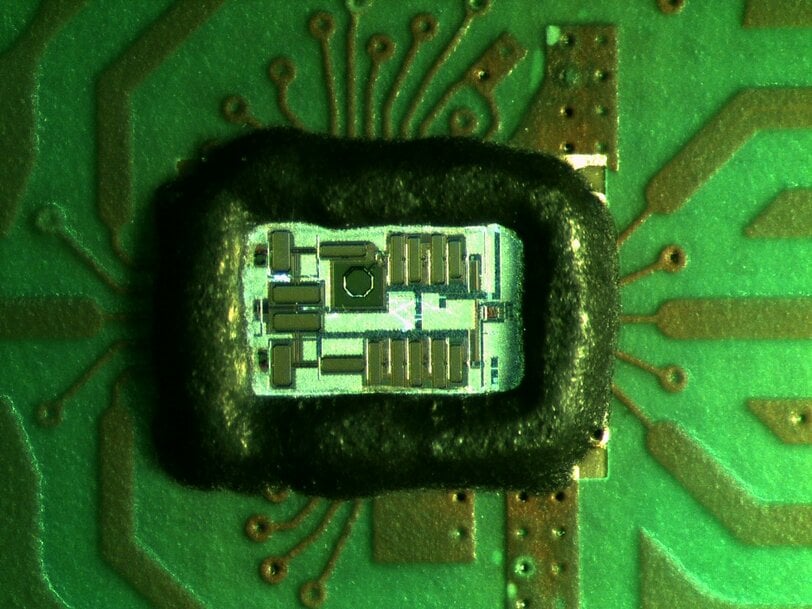
On-chip EPR spectrometer, fabricated on CMOS GF22nmFDSOI technology. The 4.4mm2 passivated circuit is mounted on a Printed Circuit Board (PCB), and bondings are molded. The sample to be analyzed is directly deposited onto the chip.
CEA-Leti and CEA-IRIG have validated the first ultra-fast, battery-operated electron paramagnetic resonance (EPR) spectrometer integrated on a single chip. The breakthrough, presented at ISSCC 2026, demonstrates record scan speed, wide spectral coverage and high sensitivity from a 22 nm integrated circuit.
The research paper, titled “A 1400 THz/s Ultra-Fast-Scan 14 GHz EPR-on-a-Chip Based on Injection-Locked Phase Detection Featuring 120 µM Concentration Sensitivity,” details a system that replaces bulky electromagnets used in conventional EPR instruments with an ultra-fast frequency-scanned architecture. The innovation enables high-performance paramagnetic sensing in portable and space-constrained environments where traditional laboratory systems cannot operate.
Record performance at milliwatt power
The chip-scale spectrometer delivers:
CEA-Leti and CEA-IRIG have validated the first ultra-fast, battery-operated electron paramagnetic resonance (EPR) spectrometer integrated on a single chip. The breakthrough, presented at ISSCC 2026, demonstrates record scan speed, wide spectral coverage and high sensitivity from a 22 nm integrated circuit.
The research paper, titled “A 1400 THz/s Ultra-Fast-Scan 14 GHz EPR-on-a-Chip Based on Injection-Locked Phase Detection Featuring 120 µM Concentration Sensitivity,” details a system that replaces bulky electromagnets used in conventional EPR instruments with an ultra-fast frequency-scanned architecture. The innovation enables high-performance paramagnetic sensing in portable and space-constrained environments where traditional laboratory systems cannot operate.
Record performance at milliwatt power
The chip-scale spectrometer delivers:
- 1,400 THz/s scan rate
- 100-Gauss equivalent spectral span
- 120 µM concentration sensitivity
- 96 mW power consumption
- 200 ns scan time across full span
This performance surpasses existing miniaturized EPR systems, which typically compromise sensitivity or spectral range to gain speed. The ultra-fast scans combined with wide spectral coverage allow detection of fast-passage effects and transient chemical phenomena that are difficult to observe with conventional instruments.
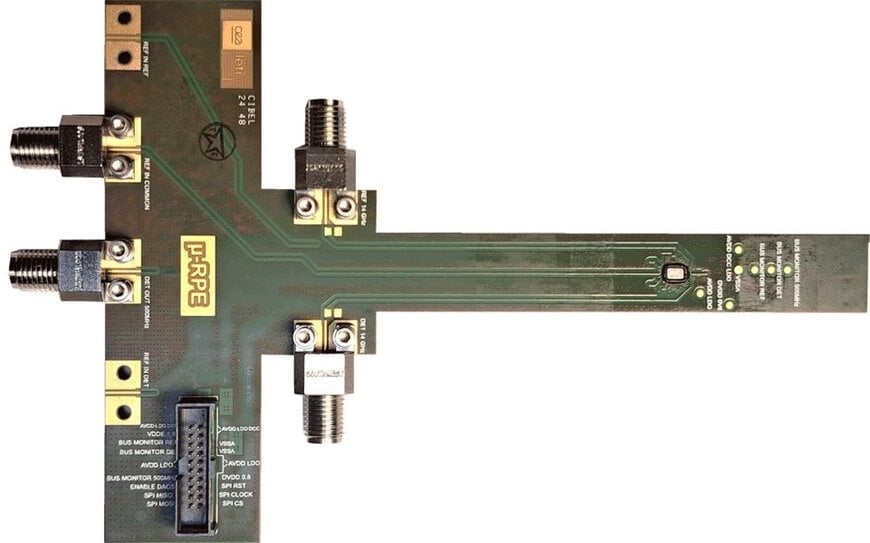
The 96mW on-chip EPR spectrometer is programmed, driven, and monitored through a dedicated Printed Circuit Board. The PCB aspect-ratio fits with the need to insert the chip inside a 0.5T permanent magnet.
Injection-locked phase detection architecture
At the heart of the system is a novel injection-locked phase-detection design. Instead of encoding EPR signals as amplitude or frequency variations, the architecture captures them as phase shifts. Leveraging the inherently low phase noise of injection-locked oscillators, the approach achieves exceptional sensitivity in a single-sensor chip-scale system.
Serge Gambarelli, research director at CEA-IRIG, said the goal is to enable compact EPR systems capable of operating on only a few watts, making on-site chemical analysis feasible in environments previously inaccessible to traditional instruments.
Alexandre Siligaris, senior research engineer at CEA-Leti, noted that RF and frequency-synthesis architectures originally developed for telecommunications were adapted to integrate a complete EPR system onto a single advanced 22 nm chip.
Toward portable spectrometry
By shrinking EPR to chip scale, the development opens pathways for applications in healthcare diagnostics, materials characterization and environmental monitoring. Portable, low-power EPR devices could support field-based chemical analysis, embedded monitoring in research systems and distributed sensing networks.
The circuit represents the first scientific instrument fabricated using 22 nm FDSOI technology. Although manufactured by GlobalFoundries, the system architecture, circuit design and measurement methods were fully developed and patented by CEA.
The work is part of CEA’s Moonshot µ-RPE program, which aims to deliver compact, deployable EPR spectrometers. Future development includes planar magnet research led by CEA-Liten to further expand application potential.
The achievement marks a significant milestone for European microelectronics in scientific instrumentation, bringing high-precision spectrometry beyond centralized laboratories and into real-world environments.
www.leti-cea.com
The 96mW on-chip EPR spectrometer is programmed, driven, and monitored through a dedicated Printed Circuit Board. The PCB aspect-ratio fits with the need to insert the chip inside a 0.5T permanent magnet.
Injection-locked phase detection architecture
At the heart of the system is a novel injection-locked phase-detection design. Instead of encoding EPR signals as amplitude or frequency variations, the architecture captures them as phase shifts. Leveraging the inherently low phase noise of injection-locked oscillators, the approach achieves exceptional sensitivity in a single-sensor chip-scale system.
Serge Gambarelli, research director at CEA-IRIG, said the goal is to enable compact EPR systems capable of operating on only a few watts, making on-site chemical analysis feasible in environments previously inaccessible to traditional instruments.
Alexandre Siligaris, senior research engineer at CEA-Leti, noted that RF and frequency-synthesis architectures originally developed for telecommunications were adapted to integrate a complete EPR system onto a single advanced 22 nm chip.
Toward portable spectrometry
By shrinking EPR to chip scale, the development opens pathways for applications in healthcare diagnostics, materials characterization and environmental monitoring. Portable, low-power EPR devices could support field-based chemical analysis, embedded monitoring in research systems and distributed sensing networks.
The circuit represents the first scientific instrument fabricated using 22 nm FDSOI technology. Although manufactured by GlobalFoundries, the system architecture, circuit design and measurement methods were fully developed and patented by CEA.
The work is part of CEA’s Moonshot µ-RPE program, which aims to deliver compact, deployable EPR spectrometers. Future development includes planar magnet research led by CEA-Liten to further expand application potential.
The achievement marks a significant milestone for European microelectronics in scientific instrumentation, bringing high-precision spectrometry beyond centralized laboratories and into real-world environments.
www.leti-cea.com
