
electronics-journal.com
26
'26
Written on Modified on
Zoned Airflow Cooling Targets Embedded AI Hotspots
Ventiva proposes distributed thermal architecture using ionic airflow to manage localized heat in compact edge computing systems.
ventiva.com
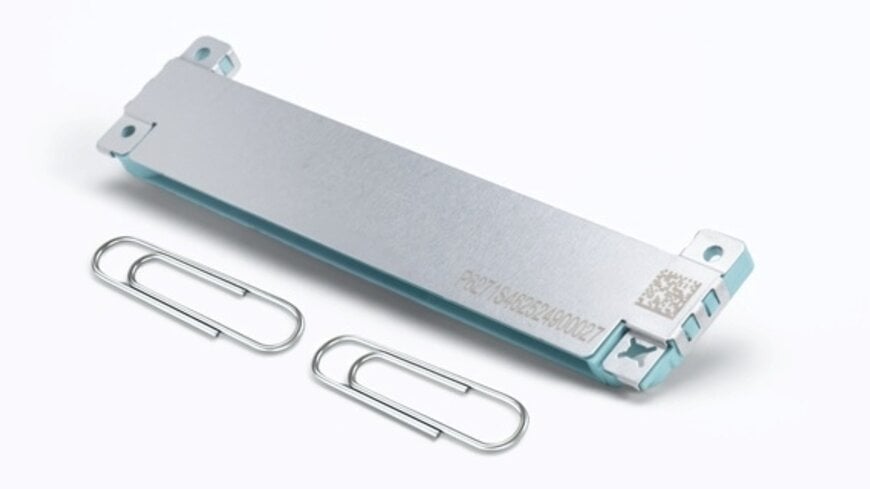
Higher on-device inference loads in edge AI hardware are creating localized heat concentrations that conventional fan cooling distributes inefficiently. Addressing this, Ventiva introduced a zoned thermal architecture based on ionic airflow rather than centralized mechanical fans.
Cooling applied where heat actually forms
Instead of pushing air across an entire enclosure, the Zoned Cooling design directs airflow toward specific components such as CPUs, memory, storage or sensors. The approach reduces internal airflow impedance and allows separate thermal regions inside a device.
This layout aligns with embedded and industrial edge systems where different subsystems operate at different duty cycles. Concentrating cooling capacity on active zones helps maintain operating temperatures without oversizing system-wide airflow, which is relevant for compact edge controllers in a digital supply chain.
Electrohydrodynamics replaces rotating fans
The system relies on Ventiva ionic cooling technology based on electrohydrodynamics (EHD). Ionized air molecules are accelerated inside an electric field, generating airflow without rotating parts.
The thermal subsystem consists of the ionic cooling device, a fin stack, and a vapor chamber or heat pipe. Because airflow is produced electrically, the module operates without mechanical vibration and can be deployed as multiple distributed units within a chassis. Each module continuously monitors its operation and adjusts airflow to demand.
This modular placement enables designers to separate thermal zones and simplify internal layouts, reducing dependence on large centralized fan assemblies.
Architectural implications for compact AI devices
Edge AI hardware often experiences localized hotspots from sustained workloads. Zoned cooling distributes several small airflow generators around heat sources instead of scaling a single larger fan. The modular structure allows thermal capacity to be scaled by adding modules rather than redesigning the enclosure.
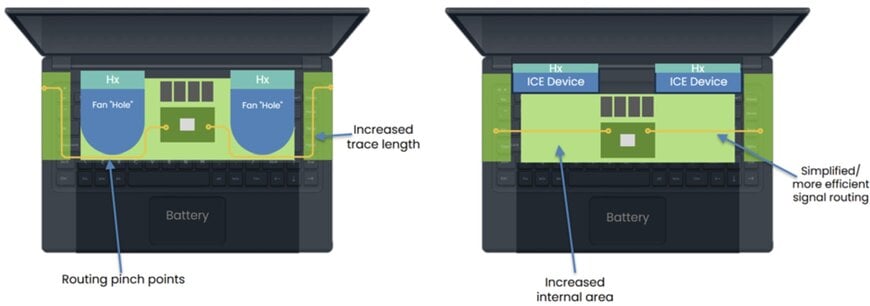
The concept was demonstrated in a laptop reference platform supporting a 28 W CPU and 44.3 W total system power inside a chassis thinner than 16 mm. Three 62 mm Ventiva modules were arranged in parallel, reclaiming approximately 7,200 mm² of motherboard area after removal of conventional fan hardware and relocating ventilation to the rear edge.
From laptop validation to embedded platforms
Laptop integration served as a validation environment due to tight acoustic and spatial constraints compared with larger intelligent edge equipment. The same distributed approach can be applied to embedded controllers and sensor-rich systems where different components generate heat intermittently.
By shifting from centralized airflow to localized thermal zones, the design enables scalable cooling matched to workload distribution rather than enclosure volume.
www.ventiva.com
