
electronics-journal.com
03
'26
Written on Modified on
Expansion of Desktop and Mobile Processor Portfolios for Artificial Intelligence
AMD introduces the Ryzen AI 400 Series and Ryzen AI PRO 400 Series to provide hardware-accelerated processing for consumer and enterprise desktop computing environments.
www.amd.com
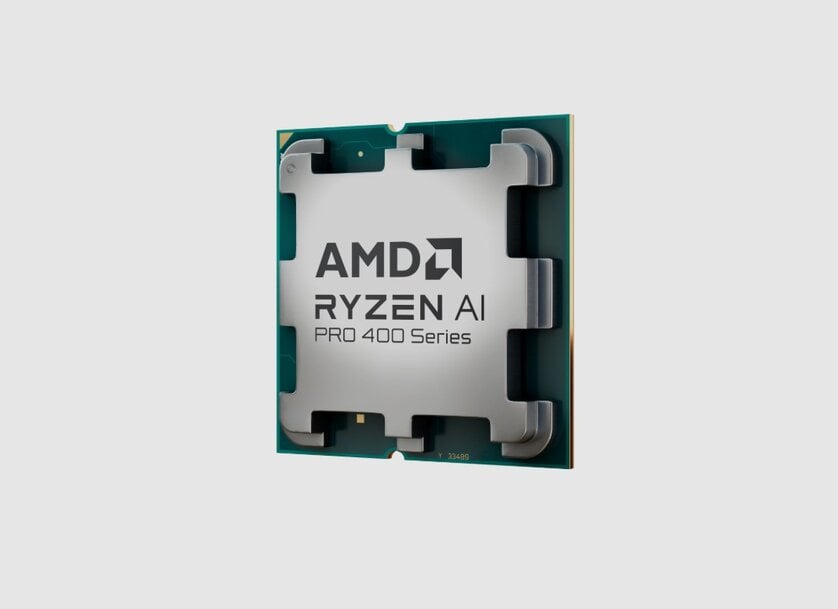
Advanced Micro Devices has expanded its portfolio of x86 processors to include the Ryzen AI 400 and Ryzen AI PRO 400 series, specifically engineered to support the evolving automotive data ecosystem and broader enterprise digital supply chains. These processors integrate dedicated neural processing units (NPUs) based on the XDNA 2 architecture to manage local generative artificial intelligence (AI) workloads in both mobile and desktop form factors.
Hardware Architecture and NPU Integration
The introduction of these processors marks the first implementation of the XDNA 2 NPU and RDNA 3.5 graphics architecture in a desktop environment. Announced at Mobile World Congress in Barcelona, Spain, on March 2, 2026, the new desktop units utilize the AM5 socket, allowing for integration into existing commercial and consumer system designs.
The flagship Ryzen AI 7 PRO 450G desktop processor features eight CPU cores comprising four Zen 5 and four Zen 5c cores with a peak boost clock frequency of 5.1 GHz. Technical performance is defined by the XDNA 2 NPU, which delivers up to 50 trillion operations per second (TOPS). This metric meets the minimum hardware requirements for Microsoft Copilot+ features, enabling local execution of AI tasks such as real-time translation and automated document summarization without relying on cloud-based latency.
Enterprise Security and Management
For professional environments, the PRO series incorporates the AMD PRO feature set, which provides hardware-level security hardening and remote management capabilities. This suite includes multi-layered security protocols designed to protect sensitive data across a digital supply chain.
In the mobile segment, the Ryzen AI PRO 400 Series includes up to 12 CPU cores and provides power efficiency rated for up to 19.8 hours of battery life in specific notebook configurations. The high-end Ryzen AI 9 HX PRO 470 model is designed for mobile workstations, offering 60 TOPS of AI processing power to handle intensive data analytics and modeling tasks.
Technical Application and Use Cases
By shifting AI processing from the cloud to the edge, these processors reduce data transmission requirements and improve privacy for technical applications. In industrial and automotive contexts, local AI processing allows for:
- Predictive Maintenance: Real-time analysis of sensor data to identify equipment failure patterns.
- Secure Data Handling: Processing proprietary telemetry and logistical data locally to comply with strict data sovereignty regulations.
- Enhanced Productivity: On-device large language model (LLM) acceleration to assist in code generation and technical documentation.
Competitive Benchmarks
The Ryzen AI 9 HX PRO 470 demonstrates measurable performance advantages in multi-threaded workloads and AI-specific tasks. In comparative testing against comparable mobile chips, such as the Intel "Panther Lake" Core Ultra series, the XDNA 2 architecture provides a higher TOPS-per-watt efficiency, which is critical for maintaining performance in thermally constrained mobile environments. While previous-generation desktop APUs offered higher raw CPU clock speeds in some configurations, the 400 series focuses on the balance of CPU, GPU, and NPU throughput required for modern software ecosystems.
www.amd.com
The Ryzen AI 9 HX PRO 470 demonstrates measurable performance advantages in multi-threaded workloads and AI-specific tasks. In comparative testing against comparable mobile chips, such as the Intel "Panther Lake" Core Ultra series, the XDNA 2 architecture provides a higher TOPS-per-watt efficiency, which is critical for maintaining performance in thermally constrained mobile environments. While previous-generation desktop APUs offered higher raw CPU clock speeds in some configurations, the 400 series focuses on the balance of CPU, GPU, and NPU throughput required for modern software ecosystems.
www.amd.com
